Showing posts with label plants (See also trees). Show all posts

Friday, July 1, 2022

Yesterday, Today, and Tomorrow

Even though I love many aspects of Nature, I confess that I am not a very good gardener.  That is why the plants in my yard that have endured over the years are those than can survive with little care (except perhaps for a brief soaker-hose during extreme drought).  One plant that has just managed to endure through tough times is a plant with an unusual common name -- the "yesterday-today-tomorrow plant."  It is so named because each flower is a deep blueish purple when first appearing but changes to a light shade the next day. On the third day, the flower has turned white.  And so, when flowers come frequently enough, they display a range of three colors.

He also lived in changing times.
The scientific name for the yesterday-today-tomorrow plant is Brunfelsia, so named for Otto Brunfels, who lived in Germany during the first half of the 1500's.  Those were tumultuous times because in 1517 Martin Luther posted his famous theses on a Roman Catholic church, thus beginning the Protestant Reformation.  Otto Brunfels' life exemplifies those changes:  He had trained in a Catholic monastery but later became a pastor of a Protestant church.  One thing endured through those decades:  Brunfels' interest in herbs, which were one source of medicines.  Although the three-volume work on herbs he wrote included sometimes questionable folklore, it also displayed woodblock illustrations, which was a fairly new innovation for printed books.  As the contemporary commentator John Lienhard states about Brunfels' compendium, "The images long outlived the words."

I know that biologists have to name species with Latin names. Nevertheless, I do enjoy how the common name for that Brunfelsia plant expresses one aspect of how humans experience time.  We remember yesterday.  We are aware of today. And we think ahead to tomorrow.  How should we handle our awareness of those three periods of time?

I think it is a reasonable assumption that anybody who has lived any length of time is bound to have some regrets about the past (even if they don't like to admit it). However, as  the 5th-century B.C.E poet Agathon wisely reminds us, “Even God cannot change the past.”

What about tomorrow?  Our modern, Westernized technologized societies change so rapidly that it makes life harder than it otherwise might be.  Our uncertainties about tomorrow can make it easy to worry about what challenges will come next.  Yet Jesus encouraged his followers by saying "Do not worry about tomorrow... Today's trouble is enough for today." [Matt. 6:34, NRSV]  (Is a bit of wry humor perhaps being displayed in his second sentence?)

What about today?  Many spiritual advisers (ranging from yoga teachers to authors of self-help books) tell us to "be present" to what is happening right now.  Or they phrase it that we should "live in the present."  I do need to cultivate awareness.  Nevertheless, I also need to draw upon my memories of the past, sometimes being sustained by them.  And I need to think about future days and plan for them.  I cannot very well be isolated in the present.

Maybe I can learn something from that yesterday-today-tomorrow plant.  Despite its name's dividing time into three parts, it is the same flower that endured and evolved through the string of three days.  There was actually a continuity through the course of time.

~ ~ ~

As you reflect upon your life, are there some continuities you would like to sustain?

Inspiration for today, and for tomorrow.

(The quotation by John H. Lienhard is from his Engines of Our Ingenuity website, episode No. 2241, "Otto Brunfels.")
(The quotation by Agathon is taken from Bloomsbury Treasury of Quotations, edited by John Daintith, © 1994, p. 523.)
(The photo of flowers is by gailhampshire from Cradley, Malvern, U.K.
 and is used under a  Creative Commons Attribution 2.0 Generic license..)

Friday, April 1, 2022

The Colors of New

I know it dates me, but I remember well when physical card catalogs were the means of locating a book in a library. The 3 in. x 5 in. cards were kept in small, deep drawers that had a rod running though the cards near their bottom edge so they could not be spilled, disrupting their alphabetical order. In middle school, when my fellow students' class and I were taken to the library, we were taught how to use its card catalog. (In elementary school, simply browsing in the books had been sufficient.) The middle-school librarian taught us that for every book in the library, there were three types of cards in the catalog's wooden drawers: Title card, Author card, and one or more Subject cards.

Having learned that system, when my father took my sister and me to the city's central library, I was delighted upon seeing the massive wall of inviting brown drawers. I could browse through the creme-colored cards with almost as much enjoyment as browsing in the books themselves.

A recent book put out by the Library of Congress informs me that, "Harvard's assistant librarian, Ezra Abbot, is credited with creating the first modern card catalog designed for readers" in the 1860's. Previously, books that were being added to a library had often been merely listed in a librarian's ledger book -- making locating a listing as hard as locating the book itself. Another invention of that time-period was the book's card-pocket, in which a checkout card was kept, removed as a record when the book was borrowed, and replaced upon the book's being returned.

I marvel at not only the efficiency but also the simplicity of these two inventions: They were something any librarian could easily adopt and create on their own. (In contrast, imagine trying to build a computer and write cataloging software, or trying to draw today's barcodes by hand!)

Thinking back upon these changes in libraries, I become more aware of how countless new inventions have appeared during my lifetime. Even staying within the walls of a library, microfilm replaced paper newsprint, but was then itself replaced. Long-playing records were added to some libraries, but then became outdated. Changes in technology have come so fast that two historians, Andrew Pettegree and Arthur der Weduwen (in The Library: A Fragile History) caution today's librarians against jumping too quickly on the bandwagon of the new. Today's innovation can become tomorrow's antique artifact. A newer technology seems to always be just around the corner. Changes occur even more rapidly beyond a library's walls.

A joyful sign
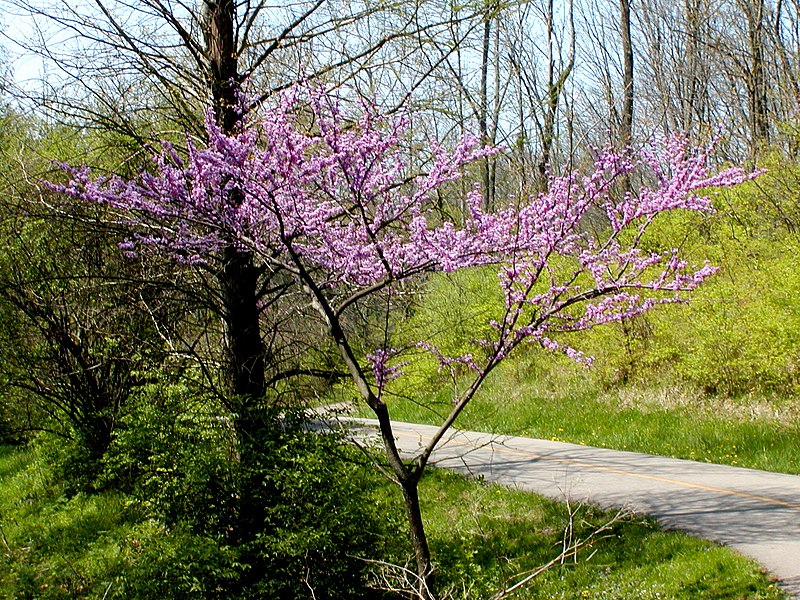
When I turn away from human societies and look at Nature, I also find the new, but it is a different type of newness.  I see the bright yellow-green spring-leaves emerging on a tree that had been bare for months. And I see the brilliant pink blooms on an otherwise bare redbud tree. This is a type of newness that is different from human inventions. It is the newness of renewal and rebirth. It is a type of newness that is ancient. And it is reassuring amid a world of human struggle and destruction. For, as the 19th-century poet Gerard Manley Hopkins wrote:
"... nature is never spent;
There lives the dearest freshness deep down things...."
Hopkins saw that type of newness as a gift of God's Spirit, which "broods with warm breast and with ah! bright wings."

The newspaper's headlines might be only bad news, but the view of spring out my kitchen window is very good news.

~ ~ ~

Is there a way you find a renewal that lies deeper than human innovation?


(The quotation about the catalog is from the book
 The Card Catalog: Books, Cards, and Literary Treasures, © 2007, p. 82.)
(The lines by Hopkins are from his poem "God's Grandeur.")

Friday, April 2, 2021

Being Strengthened by Spring

The COVID pandemic beginning in 2020 brought so many types of losses. Losses of such things as:  Family members, friends, and acquaintances.  The ability to move about among people in public with ease and safety.  Gathering in indoor worship spaces to be inspired by beautiful music and words.  The relaxing conviviality of dining in restaurants while chatting with friends.

We can gain strength by naming those losses.  We can also be strengthened by turning our attention to the continuity of the cycles of Nature.  Such as spring's flowers -- which were the focus of the following article, first published in 2015.

~ ~ ~ 


A gift from Nature
The painter Georgia O'Keeffe once said, "A flower is relatively small."  And yet she depicted them as being enormous!  Her easily identifiable paintings of flowers, which were one of her favorite subjects later in her career, often depict a single, huge, brightly-colored flower spilling over the edges of the canvas.  One of O'Keeffe's flowers can cover a hundred times its square-area in real life.  A biologist could easily appreciate that out-of-scale depiction, although for biological rather than aesthetic reasons.  After all the flower was a revolution in the evolution of life on planet Earth.

Green plants with photosynthesizing chlorophyll did exist on our planet before there were flowers.  However, it could take those conifers over a year to produce seeds snugly nested in cones.  One revolution flowers brought (when they evolved 100 million years ago) was the ability to release a seed in only a month.  That was an explosion in reproductive capability. That flower-explosion also brought about a revolution in the prehistoric world of animals.  As flowers evolved into different shapes, the insect world evolved simultaneously, new insects being adapted to take advantage of new food-source shapes.  In turn, bird and mammal species found new food in the flowers, seeds, and insects, thus putting competitive pressure on the older species of dinosaurs.

“Beauty too rich for use”Today, understandably, few people are thinking about such significant events in the history of planet Earth when they purchase or pick a flower.  Flowers can be an earnest business for commercial flower-growers and florists.  But it is a flower's enjoyable color, fragrance, and shape that capture an average person's attention.

True, flowers do sometimes become a part of solemn ceremonies.  A wreath of flowers can soften the hard edge of a coffin, thus soothing the hearts of the bereaved.  Despite the flower's fragility, symbolizing the transitoriness of life, its reproductive associations bring a hint of life into the acceptance of death.

More frequently, however, flowers shout out "life!"  The humorist Mark Twain made the earnest observation that "Whatever a man's age, he can reduce it several years by putting a bright-colored flower in his buttonhole."  Over a century later, men wear boutonnieres much less often. But the symbolic tie between flowers and restored life endures.  All the way down to anti-war demonstrators inserting flowers into phalanxed soldiers' rifle barrels.

With their colorful intensity and their message of new life, specific flowers have gained a role as a prominent symbol in many of the world's faith-traditions:  The lily of Easter resurrection in Christianity. The lotus of life-giving tranquility in Buddhism. And the light-giving Golden Flower in Taoism.

For the billions of bees and other insects who search for food each day, flowers are a serious business.  But for most people, flowers are just plain fun!

Life can open up at spring.
~~~
Where do you encounter flowers?  Do you have any favorites?  What do they express?

Friday, December 6, 2019

A Crocus in the Snow

A vibrant flower amid the cold.
It is a classic subject for nature photographers:  a vividly purple flower
 in the midst of white snow. Why is that image appealing to us?

Part of its appeal comes from its aesthetic beauty -- so much so that it demonstrates what have long been held to be some of the identifying characteristics of beauty.  One of those is that beauty is created when some features that might otherwise be experienced as being in conflict are instead held together in harmony.  In this case, the intensity of purple contrasts with the absence of color in the snow; yet the two are held in harmony.  The contemporary professor of religion Steven R. Guthrie, explaining this aspect of classical Western thought regarding beauty, writes that, "In Plato's dialogues... harmony in this sense is not uniformity or unanimity but the beauty that emerges from different elements in right relationship.... It is, in Dante's words, 'an order' from 'things disparate.' "

Most people like the image of the crocus in the snow.  That favorable emotional response points to another aspect that the Western philosophical and theological traditions have identified as being a characteristic of beauty.  Namely, that something beautiful creates a resonance within us that is pleasing.  In that regard, Guthrie explains that " [Thomas] Aquinas draws our attention to the immediate impression that beautiful things make upon our senses."

In the case of the crocus in the snow, however, those who find the image beautiful are often responding to more than the aesthetic beauty of purple against white.  A purple blotch on a white background would not elicit the same emotions that the flower does.  What also resonates within us in the case of the crocus, even if unconsciously, is the contrast between the new life of the emerging flower and the surrounding cold snow of winter -- the season in which most plants die back.  This additional form of contrast is also a dimension of the image's beauty that is pleasing to us.  Not only is the tension between purple and white held together, but life and death are held together in a moment of harmony when the crocus emerges out of the snow.  The 18th-century poet Christopher Smart, in his poem praising God, expressed how the crocus stands out from other plants around it.  He wrote:
"The laurels with the winter strive;
The crocus burnishes alive
     Upon the snow-clad earth."

The moment of plant-nativity displayed by the crocus can thus evoke within us that enduring quality of hope that sustains our human existence.  Gandhi once wrote:

Glimpses through the clouds."I do dimly perceive that whilst everything around me is ever changing, ever dying, there is underlying all that change a living power that is changeless, that holds
 all together, that creates, dissolves, and re-creates.... And is this power benevolent or malevolent? I see it as purely benevolent. For I can see that in the midst of death life persists, in the midst of untruth truth persists, in the midst of darkness light persists.
 Hence I gather that God is Life, Truth, Light."

It is through our human capacity to not only resonate when experiencing aesthetic beauty but also respond to symbols that we can open ourselves to the transcendent dimension of reality.  The crocus in the snow reveals to us more than the survival capability of a specific flower.  It points to the Ultimate Ground of all existence.  And in that Ground are the "flower-bulbs" and "seeds" of all that can be.  There is an Indian saying that:
"All the flowers of all the tomorrows
 are in the seeds of today."
The real challenge can be spotting those "seeds" and nurturing them.  Sometimes we cannot even see them at all.  But even when we cannot perceive them, we can hope, and like Gandhi we can have faith that they are there despite being hidden beneath the snow.

~ ~ ~

(What do you hope for?  Can you see any way you might contribute to that future growth of something good?)


(The Steven R. Guthrie quotation is from his book Creator Spirit:
 The Holy Spirit and the Art of Becoming Human
, © 2011. pp. 201-202 & 205.)
(The lines by Christopher Smart are from "A Song to David,"
 taken from Encompassing Nature, ed. Robert M. Torrance, © 1998, p. 1015.)
(The Gandhi quotation is from his Young India, 11-10-28, as quoted in Gleanings from
 the writings of Mahatma Gandhi bearing on God, God-Realization and the Godly way
, ed. R. K. Prabhu.)

Friday, September 6, 2019

Spuds: Not Something to Spit At

They rarely make it into the news.  Potatoes, that is.  Not as colorful or as flavorful as their cousin the sweet potato, the common "Idaho potato," as we call it, needs to be dolled up with sour cream and bacon bits before it becomes appealing to our sensation-desiring tastes.

The only occasion during my lifetime that the potato made front-page news was when an over-confident vice-presidential candidate made a photo appearance at an elementary school.  Potatoes fared better than the candidate, however, who tried to correct a boy's spelling of "potato" -- when it was the boy's spelling that was correct.

Even if news reporters rarely find potatoes newsworthy, a young painter with a heart intensely responsive to the poor did:  Vincent van Gogh, in his 1885 painting "The Potato Eaters," captured the somewhat sad nobility of a poor family sharing a meal of plain potatoes.

In the quite contrasting economic situation of U.S. in its post-W.W.II baby-boom, some potatoes became disposable items, so cheap that they could be turned into toys and then tossed away.  "Mr. Potato Head" (the first toy to be advertised on the new medium of television) was a simple assortment of plastic feet, ears, eyes, and other body-parts that could be stuck into a passive potato.  What a simple toy compared to today's electronic games!  And yet, it was a toy that made room for a child's imagination and for play between children (especially after Mrs. Potato Head came along).

There is a long ancestral story behind today's potatoes.  The lowly potato plant prefers high altitudes, its native place having been the western mountain range of the Americas, especially in what is today Peru and Colombia.  Discovered by Spanish conquistadores, it was carried across the Atlantic in the 16th century.  Once it reached Europe, it worked its way northward from the Mediterranean countries, eventually reaching the British Isles.  In the following century, it returned to America, but this time to the eastern coast of North America, carried there by the Puritans.  As European-Americans carried it further westward, the now thoroughly domesticated potato came full- circle, meeting in Wyoming some of it close relatives who were natives.

Despite the ways potatoes have thus served humankind, they usually make an appearance in history books by their absence. Namely, the Irish famine of 1845 and 1846.  When the potato first came to Ireland a couple centuries before, the tubers, growing underground, had the advantage of being hidden from the sight of marauding British who wanted to destroy the Irish people's crops.  But in the mid 1840's, a blight devastated the usual harvest of potatoes, which the Irish had come to depend upon as their staple crop, their essential form of produce.  A Catholic priest, Father Mathew captured the plight and observed:
"In many places the wretched people
were seated on the fences of their gardens,...
wailing bitterly
[over] the destruction
 that had left them foodless."
A million Irish emigrated to America.

Perhaps there is a lesson to be learned from the humble potato.  Potatoes are so knobbly that the standard reminder to grocery shoppers is that there is no "perfect" potato.  So is it with us humans, with our moles, birthmarks, and other physical imperfections.

Also, our media today force us to live in a society that spotlights celebrities.  But few of us can be a celebrity.  Adolescents and young adults can especially feel unworthy because they have not accomplished something "big."  Nevertheless, like the potato that has served as a staple crop, it is the common people -- those who ring the cash-registers, tend the kids, and pick up the garbage -- who serve as the foundation of society.  There is a beauty in that.

~ ~ ~

(Has the long history of the potato made you think anything about our lives today?)


(The quotation by the priest is taken from The Origins of Fruit and Vegetables by Jonathan Roberts, © 2001, p. 192.)
(The first photo is in the Public Domain. The second is used by Fair Use.)

Friday, May 25, 2018

Among Friends, Books, and Plants

It is the midsummer of 1866.  Five-thousand Prussian troops move into the city of Brünn (in the present-day Czech Republic) as one step in their invasion of the Austro-Hungarian Empire.  Forcing themselves upon the civilian community, sixteen army officers house themselves at the Abbey of St. Thomas, where ninety-four horses of the military are also moved onto the grounds.  The abbey is required to feed everybody at its own expense.  With the city's sanitation pushed to its limits, cholera breaks out, spreading through the terrified city.  Over six weeks, three-thousand civilians and soldiers die.  And on one of those dark days, observing it all from his window at the abbey, would have been a friar with a now famous name: Gregor Mendel.
A dignified-looking friar.
This is not the setting in which most books place Mendel.  Almost invariably, they put him in the abbey's seemingly idyllic garden in which Mendel grew his now famous pea plants -- leading to his scientific discovery of the basic patterns of inheritance.  Placing him in that idyllic garden cultivates a contrast between science and stereotyped religion, especially given our modern myth that science and religion have usually been in conflict.  I still remember my own surprise in middle school upon reading in my biology textbook that a "monk" made one of the pivotal discoveries of modern science.

A peaceful-seeming abbey.
More precisely, the religious order Mendel was part of was a Roman Catholic order of friars (the Augustinian order). That classification meant that its members were more integrated into the surrounding secular community, primarily as teachers, even though in this case living in an abbey.  And the friars of the Abbey of St. Thomas were especially engaged.  The Abbey had a 30,000 volume library with books on botany, horticulture, agriculture, physics, and, of course, theology.  Among Gregor's friar-colleagues were a musical maestro, a Goethe scholar, and a noted philosopher. The head abbot, Cyrill Franz Napp, was current on the latest scientific discoveries. It was in this abbey setting -- more conducive to enlightenment than being surrounded by occupying troops -- that "Mendel found a supportive scientific community," as the contemporary biographer Simon Mawer puts it.

Gregor Mendel was fond of logging statistics on many things, not just his famous pea-plant hybrids.  He also kept data on the weather and astronomy.  His being educated in probability and combinational mathematics doubtlessly encouraged his applying those types of skills to the study of plants.  The data led him to discovery.

A seemingly simple plant.Despite the temporary distraction of an occupying army, Mendel's now famous scientific paper on plant hybridization was published that same year of 1866.  It was the culmination of eight years of work, hand-pollinating and logging seven pairs of traits in 28,000 pea plants, their 40,000 flowers, and nearly 400,000 seeds.

May we in our own small ways show determination in wanting to observe and appreciate the world of Nature, even when human conflict and chaos might dishearten us.

~ ~ ~

Have there been friends who have been part of your learning or your appreciating more the world of Nature?

(The quotation by Simon Mawer is taken from 
Gregor Mendel: Planting the Seeds of Genetics, © 2006. p. 30.)
(The drawing of pea plants, Pisum sativum, is from the book Flora von Deutschland, Österreich und der Schweiz, 1885,
 by Prof. Dr. Otto Wilhelm Thomé, and is used under a Creative Commons Attribution-Share Alike 3.0 Unported license.)

Friday, January 19, 2018

Cotton: A Soft but Prickly Story

My hunch would be that I experienced cotton even before my very first memory.  Probably as an infant, I experienced the soft touch of sterilized cotton, or the careful cleaning of my ears with a cotton swab.  I can make that assumption because those items were regular residents in our medicine cabinet.  By the time I was taught the song about Peter Cottontail, I had the basis for knowing what a cottony tail would be like.  I now know, however, that there is a lot of rough, impure history behind that white substance.

Looking like puffy clouds.
Just to begin with, cotton (from plants of the genus Gossypium) is never that pure in the natural world.  Although humans' use of it dates back maybe 7,000 years, the cottony material begins as seedy fibers packed within a seed capsule called a "boll."  Both picking cotton from the plants and extracting seeds from the cotton-fiber are laborious tasks.

Despite that challenge, a cotton industry flourished in India from 2000 to 1000 B.C.E., having gotten its roots in the Indus Valley of northern India and eastern Pakistan. Ancient people of Egypt and China also harvested and converted the plant's cotton into clothes. Late medieval Germans, who could only imagine the plants that cotton came from, named it baumwolle, or "tree wool."  (Fancifully, some people imagined that in other countries lambs must grow on trees.)

A deceptively simple act.It is when we follow the story of cotton into an English-speaking country, Britain, that the story at times becomes more painful.  By the 1800's, British colonialism had enforced policies on India that favored the new industrial looms in England.  As a result, the native cotton-weaving enterprise in India was undone, and the people of India were forced to buy more costly fabrics from the looms of colonial Britain -- even when the cotton was grown in India.  This is why Gandhi's encouraging the people of India to spin their own cotton thread at home was part of a political revolt.

A quiet determination.
"The Cotton Pickers"
by Winslow Homer
The U.S. was another source of cotton for the rapidly industrializing Britain, and the American side of the story is even more painful.  By 1790, slavery was actually on the decline in the U.S. because it was not economically sustainable.  But that changed with the invention of the cotton gin by the ingenious Eli Whitney in Savannah. The climate in the U.S. South allowed the cultivation of only a "green seed" variety of cotton, which demanded an inordinate amount of time for extracting the cotton fibers from the seeds.  With Whitney's machine, a person could extract in one hour what would have previously required several days.  Once the word about the invention was out, farmers planted green seed cotton in mass -- and an economic place for slave-labor was ensured.

In hot weather, I enjoy the cool comfort of cotton shirts.  I am not that comfortable with some of the history behind the fiber in my shirt.  Hopefully, we humans will do better by each other in the future.  After all, the cotton plant offers us lots of good possibilities even beyond textiles: Material from that genus of plants provides salad oil, soap, stems for paper-making, and maybe even a drug for preventing HIV.

~~~

What thoughts or memories has this story of cotton evoked in you?


(Both the photo of Gandhi and the painting by Homer are in the Public Domain
because their copyrights have expired.)

Friday, September 1, 2017

Awarded Second Place

In the shadow of one famous.
Aristotle, Theophrastus,
 and Strato discuss biology
It's not easy being a second-stringer.  Especially today -- when being a celebrity is so highly rated -- those who have done well but are not "tops" easily fall into the great hall of the virtually forgotten.  One such scientist was named Theophrastus, and he lived in ancient Greece from about 372 to 287 B.C.E.  He was a pupil of Aristotle, and easily falls into that great man's shadow.  Anyone with a college-level education should know the name "Aristotle."  Few are even expected to learn the name "Theophrastus."  And yet, Theophrastus was called the "father of botany" by Linnaeus, the 18th-century scientist who developed modern biology's system for classifying species.

After Aristotle died, Theophrastus led the school Aristotle had created, continuing to teach not only botany but also zoology, physiology, physics, ethics, and the history of culture.  Today, we'd need a separate professor for each of those subjects, but Theophrastus strengthened the sense of unity among those various subject areas.  The school actually reached its peak attendance during his leadership.

Although Theophrastus wrote several books as a way of deepening education, the ones that had the most lasting influence were those about botany, such as Natural History of Plants and Reasons for Vegetable Growth.  He classified almost 500 plants, not just as an abstract subject, but also relating it to human cultivation, grafting, and propagation.  Even though Theophrastus is mostly forgotten today, some current scientific terminology still shows traces of the names he used for flowers and their parts.

Easily overlooked.It seems to me that it is not only Theophrastus who falls into an easily forgotten second place.  Plants do too.  On television nature documentaries, IMAX movies, and save-the-species campaigns, it is animals, not plants, that get most of the attention.  A panda is so much more cuddly than any plant (especially more than poison ivy).  In contrast, a lion is a better model than a plant for a child's nice stuffed toy (even though the lion is a predator that kills other mammals that we adore).

Part of the reason for this discrimination against plants obviously lies in animals' being much more animated -- the very basis for our word "animal."  That difference cannot be overcome even by time-lapse photography, which can make flowers at least appear to unfold, and plants appear to grow as fast as animals actually move.

Despite the second place that plants get in our attention, we and all animals depend in some way upon them, such as the oxygen for breathing that green plants give off.  In the late 19th century, the American biologist Asa Gray paid a tribute to plants in the opening pages of a botany book he wrote for young people.  Gray was himself a second-stringer among advocates for Darwin's theory of evolution, taking second place to Thomas Huxley.  Nevertheless, Gray knew the importance of plants, writing:
"The clothing of the earth with plants and flowers --
at once so beautiful and so useful, so essential to all animal life --
is one of the very ways in which [God] takes care of his creatures."


~~~

Has any houseplant, shrub, vine, or tree played a particular role in your life?  What?


(The Gray quote is in his Botany for Young People [1872]
 as quoted in Song of a Scientist by Calvin B. DeWitt, © 2004.  p. 21.)
(The photo of the three teachers is in the public domain, being a reproduction of art whose copyright has expired.)

Friday, January 6, 2017

Getting Beyond the Bitterness

I turned to the poem in the anthology partly because of an experience involving a friend when I was in college.  That fellow student's family owned a produce company that brought together vegetables from a number of farmers, cleaned and packed them, and distributed them to grocery stores.  One evening, my friend took me to see the company's processing center after the day's operations had been completed.  There I saw more radishes than I had ever seen in my life or will probably ever see again.  The radishes were neatly packaged in small bags piled five-feet high on a pallet five-feet square.  An estimated 125 cubic feet of the familiar reddish radish, each no more than an inch in diameter!

As I said, it was partly that memory that prompted me to turn to a particular poem -- one with "radish" in its title -- in an anthology of sacred poetry.  The poem was a simple three-liner by the 18th-century Japanese poet Issa:
"The man pulling radishes
pointed the way
with a radish."
So short, the poem forced my mind to pause, taking it a few moments to picture the gardener on his knees, one arm outstretched to give directions, using the humble radish in a new-found way, as a pointer.

Growing up, I was introduced to radishes when our family had Sunday dinner at a restaurant.  On each of our restaurant salads was a single brightly colored radish, mostly as garnish.  It would require returning to that restaurant a few times before my sister and I could begin to nibble like rabbits on the humble, red vegetable as we became accustomed to its bitter edge.

In the collection of spiritual poetry, I turned to the biography of this man Issa, and found there more bitterness than I was prepared for.  The biography described how "Issa (1763-1827)... lost his mother at the age of three and was continually beaten by his stepmother....  His later life was marked by poverty... and the death of his first wife and four young children.  But somehow he triumphed over all these obstacles and kept his simple, affectionate nature.  His is particularly admired for his love of animals and his championing of the underdog."

My heart warmed to this somewhat overlooked man, and so I turned back the pages of my book to read another haiku poem by him:
"In the cherry blossom's shade
there's no such thing
as a stranger."
This second three-liner was a very upbeat poem, the kind our U.S. society today prefers to have populating its collections of religious poems.  However, having read of Issa's life -- both the bitter and the beautiful -- I decided to treasure both of the poems, printed back-to-back on a single leaf of paper in my book.

~~~

Has there been in your life any bitterness you have had to get beyond to find your way?


(The poems and biography of Issa are from The Enlightened Heart,
 ed. Stephen Mitchell, © 1989.  pp. 99, 158 & 100.)

Friday, July 22, 2016

Flowers Against the Stereotype

Many a poet has drawn upon the delicate beauty of flowers for literary inspiration.  The softness of the petals.  The sweet fragrance.  Flowers thus lend themselves to being a symbol of femininity. (Also, notice how in our U.S. culture, women will be given a corsage to wear vastly more often than men are given boutonnieres.)

Here are some poetic examples of flowers in an inspiring role:  Shakespeare's Juliet, in the balcony scene of Romeo and Juliet, depicted herself as "a beauteous flower."   Alfred, Lord Tennyson connected the physical characteristics of a flower even more explicitly to those of a woman, writing:
"Lightly was her slender nose
Tip-tilted like the petal of a flower."
The 19th-century German writer Heinrich Heine went straight to the point, titling one of his poems "Du Bist Wie eine Blume," which translates to "You are Like a Flower."

Hard to believe it's a real flower!I wonder what such poets -- who thought of flowers as being delicate and feminine -- would have thought about a flower from Sumatra that I heard about on the radio. Far from sounding feminine, it was described as being "like a giant finger jutting straight up... eight feet tall and [weighing] 250 pounds."  Nor would a person want to extract the essence of the aroma this flower gave off, because it had a "distinctive rotting-corpse-like odor."  The evolutionary explanation behind that flower (scientific name Titan arum) is that the putrid odor enables it to attract insects who believe they are coming to the carcass of an animal on which they might feed.  The insects flocking to the flower get tricked, while the clever flower gets itself pollinated.

It was not only insects who have been disappointed in the case of this particular flower, which was on display at the U.S. Botanic Garden in Washington, D.C.  Many of the museum-goers who flocked to the flower, hoping to get a whiff of its repellent odor, were disappointed because the colossal flower emitted its odor for only a few hours, and did not have the courtesy to schedule its opening so as to align with the museum's daytime hours.

The finger-shaped Titan arum is not the only tropical Asian flower to have evolved such a trick of deception.  Another species, the Rafflesia arnoldii, has a more typical floral shape, being circular with petaled edges.  But it is similarly oversized (two or three feet in diameter) and also smells like a carcass during part of its blooming period, even if only briefly.

I was not among either the disappointed or the pleased museum-goers at the U.S. Botanic Garden. Nevertheless, I take delight in that news story about the non-stereotypical flower for two reasons.  I take delight first in being reminded again about how evolution, with all its immense variety, has developed a living being that defies our human expectations, particularly our cultural associations.  Secondly, I am pleased to hear that so many people can themselves take delight in an example of biodiversity that we ourselves would not have designed, and might have usually found repulsive.

~~~

Do you have any thoughts about these huge, putrid flowers?


(The Tennyson lines are from "Gareth and Lynette," line 574, in Idylls of the King1859-1885.)
(The news story was "Lure of Flower's Putrid Essence Draws Crowd," July 22, 2013. © NPR.)
(Second photo, by Henrik Ishihara Globaljuggler, used under Creative Commons Attribution-Share Alike 3.0 Unported license.) 

Friday, July 8, 2016

Life-Giving Corn

When I was a child, my mother would usually allow me in the kitchen while she worked. More than allow -- she often seemed to like it. She endorsed the motto of "learning by doing," inspired by the early 20th-century educator John Dewey.  When I was young, there was not much I could do by myself in the kitchen except watch up close.  But occasionally, there was a task I could do all by myself: shuck the corn.  However, she sent me outside to do it, knowing it could make a mess.

I would first open several sheets of newspaper, and spread them out on the driveway (the way I had been shown).  That would make it easy to fold up the discarded parts of the corn into a large wad that could be tidily dropped into the trash.  It was pretty easy for me to pull off the green husks and most of the long "hairs."  (Only once was I startled by a small, now dead caterpillar that lay neatly in one of the rows of kernels.)  It was a bit of a chore, however, to try to get rid of every last one of those "hairs" on the ear of corn.  I might have been appreciative of those silks if I had know that it was through them that the cob of corn had been brought to life, those strands being the upper female part of the plant's flower.

Over the past decades in the U.S., corn has been mentioned in the media mostly in regard to concerns about the amount of corn syrup in processed foods, or about the drawbacks of using food such as corn (rather than something like switchgrass) to make ethanol to add to gasoline. About the only time corn gets mentioned with exuberant appreciation is in the patriotic story of how in 1612 Capt. John Smith's ill-equipped Virginia colonists were saved by the bushels of corn they received from Native Americans.  And so, I'd like to speak a good word for the often overlooked corn (which is called "maize" in most of the world).

A stand for corn. (No puns, please.)
corn vendor
in India today
Those Virginia colonists were not the only people whose lives have been saved by corn.  When Columbus landed in Cuba, he found the production of maize going strong.  A similar discovery was made by Francisco Pizarro in the early 1500's.  The Inca nation (whose leader Pizarro captured) was vast:  2,200 miles long and containing nine million well-fed people.  Their lives were to a great part sustained by maize.  Even though corn contains little protein, its advantage over the world's other major grains (wheat and rice) is that it can be simply cooked and eaten without having to process the grain.

Moreover, the "sweet corn" bred for human eating is but one category of maize.  Even the Native Americans had field-corn as well for their domesticated animals (which in turn supported human life).  And they had flour corn, whose kernels are more suitable for making flour.  Not to mention that enduring cinema attraction, popcorn.

Preserved signs of a life-giving plant.
Guila Naquitz cave, Oaxaca, Mexico
(site of 6,250 year-old corn remains)
All these types date back to a form of wild grass in the Zea genus, whose seed-ear is minuscule.  Human cultivation enlarged that seed-ear.  The great chain of human life living off cultivated corn throughout the world has been traced back by archaeologists over 7,000 years!

~~~

Do you have any childhood memories involving corn?            
           
(The photo of the vendor is by Babasteve.  That of the cave is by Jerry Friedman.
  Both are used under Creative Commons Attribution Generic licenses.)

Friday, March 4, 2016

Hope in a Hole in the Ground

It would seem to be a sad thing to have to bury one's hopes in a hole in the ground.  It would seem to be the final recourse when a person had to abandon a long-held hope, trying to put it out of sight.  Even Jesus tells his disciples not to behave like the servant who "went off and dug a hole in the ground and hid his master's money" (Matt. 25:18, NRSV).  Nevertheless, a hope of a kind is put in the ground and covered over trillions of time around this planet every year. That hope is encapsulated in a seed.

If ever there were a question about whether the earth were good, it would seem to be answered by that act.  As the early 20th-century poet Rainer Maria Rilke poignantly put it:
"In spite of all the farmer's work and worry,
he can't reach down to where the seed is slowly
transmuted into summer.  The earth bestows."

This connection between hope and the ground came to me when I encountered again a one-line quotation by someone much less known than Rilke. The quotation was by Lucy Larcom. Although few people know about her, a fair number of people may have encountered a statement of hers that is used by organizations such as the Arbor Day Foundation.  Larcom succinctly wrote:  "He who plants a tree / Plants a hope."  Of course, in this case, the "hope" is not completely buried, seedlings or young trees being the ways trees are usually planted.  Nevertheless, what dependence upon the earth and upon a tenuous life other than our own is embodied in that act of planting!  A number of U.S. cities are now more aware of how precarious the life of trees can be, because droughts over the past years have killed so many trees, both young and old.  And how even more dependent peoples' hopes must be in countries where water cannot be obtained through a garden hose or a transporting truck.

To be fair to Jesus, I should point out that when he guides his disciples not to put their "talents" in "a hole in the ground," he is using an agricultural metaphor to provoke insights about human behavior (as is often the case).   He is encouraging his followers not to remain holed up in their own houses, but instead to put their "talents" -- both money and abilities -- into circulation. His words could be paraphrased as, "Don't isolate. Interrelate!"

As I return my thoughts to those seeds being placed in the ground and covered over with soil, I now realize that the instructions we are giving them without words are very much the same.  We are in effect saying:  "Don't stay isolated in that sterile paper envelope where you've been. Instead, return to that world your family came from.  Get back in touch with the earth with all its nutrients and microbes.  Interrelate with the life-forms that are in the soil.  And soak up the rain that filters down, letting your life interrelate with the clouds and sun above.  Grow."

And upon that instructed seed, we humans place our sometimes frail hope.  It is a hope that has not been entirely disappointed billions and billions of times.

~~~

Have you ever gardened?  Have you ever thought about the wonder in those seeds?


(Rilke quote from "The Sonnets to Orpheus," XII, trans. Stephen Mitchell, in Ahead of all Parting, © 1995. p. 433)
(The quote by Lucy Larcom [1824-1893] is from "Plant a Tree,"
as quoted in A Dictionary of Environmental Quotations, ed. Barbara K. Rodes, © 1992.  130:8.)
(Both photos by Roger Culos, used under Creative Commons Attribution-Share Alike 3.0 Unported licenses.)

Friday, May 1, 2015

The Earnestness and Frivolity of Flowers


Is a tulip a commodity or a gift of Nature? Or both?
The painter Georgia O'Keeffe once said, "A flower is relatively small."  And yet she depicted them as being enormous!  Her easily identifiable paintings of flowers, which were one of her favorite subjects later in her career, often depict a single, huge, brightly-colored flower spilling over the edges of the canvas.  One of O'Keeffe's flowers can cover a hundred times its square-area in real life.  A biologist could easily appreciate that out-of-scale depiction, although for biological rather than aesthetic reasons.  After all the flower was a revolution in the evolution of life on planet Earth.

Green plants with photosynthesizing chlorophyll did exist on our planet before there were flowers.  However, it could take those conifers over a year to produce seeds snugly nested in cones.  One revolution flowers brought (when they evolved 100 million years ago) was the ability to release a seed in only a month.  That was an explosion in reproductive capability. That flower-explosion also brought about a revolution in the prehistoric world of animals.  As flowers evolved into different shapes, the insect world evolved simultaneously, new insects being adapted to take advantage of new food-source shapes.  In turn, bird and mammal species found new food in the flowers, seeds, and insects, thus putting competitive pressure on the older species of dinosaurs.

“Beauty too rich for use”Today, understandably, few people are thinking about such significant events in the history of planet Earth when they purchase or pick a flower.  Flowers can be an earnest business for commercial flower-growers and florists.  But it is a flower's enjoyable color, fragrance, and shape that capture an average person's attention.

True, flowers do sometimes become a part of solemn ceremonies.  A wreath of flowers can soften the hard edge of a coffin, thus soothing the hearts of the bereaved.  Despite the flower's fragility, symbolizing the transitoriness of life, its reproductive associations bring a hint of life into the acceptance of death.

More frequently, however, flowers shout out "life!"  The humorist Mark Twain made the earnest observation that "Whatever a man's age, he can reduce it several years by putting a bright-colored flower in his buttonhole."  Over a century later, men wear boutonnieres much less often. But the symbolic tie between flowers and restored life endures.  All the way down to anti-war demonstrators inserting flowers into phalanxed soldiers' rifle barrels.

With their colorful intensity and their message of new life, specific flowers have gained a role as a prominent symbol in many of the world's faith-traditions:  The lily of Easter resurrection in Christianity. The lotus of life-giving tranquility in Buddhism. And the light-giving Golden Flower in Taoism.

For the billions of bees and other insects who search for food each day, flowers are a serious business.  But for most people, flowers are just plain fun!

Life opens up at spring.
~~~
Where do you encounter flowers?  Do you have any favorites?  What do they express?

Friday, February 6, 2015

Green in Tooth and Claw

As my explorations of history become more detailed, I find our misconceptions about history most interesting.  Frequently, it seems to me, our misconceptions reveal as much about us as they reveal about the actual historical events.

Such is the case with the all so familiar phrase "red in tooth and claw."  Today it is often used to evoke a picture of a "Darwinian" world of a predatory "survival of the fittest."  So much so, that most people assume the phrase "red in tooth and claw" was inspired by Darwin's theory of evolution.  In fact, that blood-tipped phrase predates Origin of Species by nine years, having been penned by Alfred Lord Tennyson in his 1850 poem "In Memoriam."  Moreover, Tennyson's poetic lament was prompted not by the death of any dinosaurs, but by the death of one of Tennyson's closest human friends.

Regardless of the origins of the phrase, more significant is what it conveys about our perceptions of Nature -- especially as we try to relate Nature to our human spirituality.  Or as we aim to say whether we can discover a sacredness in the world of Nature.

Darwin's theory of evolution evokes "survival of the fittest" ideas
Charles Darwin
A parallel misconception about history lies behind the phrase "survival of the fittest," which most people assume to have been introduced by Charles Darwin in Origin of Species.  In fact, what Darwin used in the first edition of his book was the phrase "struggle for existence," which does not sound as competitive.  Even that phrase was already in circulation -- but for describing human society.  In Britain during the first half of the 19th century, industrialization and migration to the cities had increased social strife.  Darwin employed that firsthand experience of a human "struggle for existence" in order to make his explanation for the evolution of other species of life more understandable.

(I do sometimes wonder what animals might think if they could know all the human projections we place upon them.)

flowers and insects exemplify cooperation in Nature
bee covered with pollen
in hibiscus flower
Today, our vastly increasing knowledge from the science of ecology reveals how evolution has occurred not just through competition but also through all sorts of mutually beneficial relationships. True, there is an ambiguity in Nature, in that the death of the prey means life to the predator.  And it is also true that there is an element of chance in biological evolution (just as there is in human life). However, one teacher of biology tells me that because of all the ways birds and insects pollinate plants as they gather food, there are more cooperative relationships than there are competitive relationships in Nature.

Nature as a whole is strongly self-sustaining.  So much so that we might borrow the word "green" from the environmental movement to say that Nature is green in tooth and claw!

~~~

Where do you see relationships in the non-human realm of Nature?


(The drawing of Darwin is in the public domain
in the U.S. because it is over 70 years old.)
(The flower photograph, by Luc Viatour, is used under terms of GNU Free Documentation License.)

Friday, June 27, 2014

Bananas: It’s Not All Elementary

Most people know of Charles Darwin's voyage on the Beagle, and of the scientific discovery that was it's outcome.  Few people, however, know how that journey was the result of parental care and concession.  Charles's father first objected to Charles's joining the voyage, but soon gave in, even paying his son's way.  Two sentences in a letter of the father to his son on the journey caught my eye.  From England, the father reported to his son some thousands of miles to the south, "I got a Banana tree.  I sit under it and think of you in similar shade."  It might seem an unusual topic, but knowing, as I did, how Charles was not especially close to his father, I heard in those lines an expression of the father's love for his son by means of sharing news on a topic that would interest the young Charles -- Nature.

Exotic in England and the U.S. in Darwin's day, imported bananas are now common in the U.S., and are an easy means for parental care.  Being soft and sweet, a banana can be more appealing to a small child than an apple or an orange might be.

I got a kick out of seeing some banana trees when, as a child, my family moved to the South, but I was disappointed to find that its variety of fruit was not the kind we bought in stores. Grocery-store bananas, despite being now so commonplace, are nonetheless oddities of Nature.  Just to start with, a banana "tree"  is not actually a tree.  The definition of "tree" is usually a plant with a woody stem, but a banana plant's stem is instead formed out of the stems of leaves, and made strong by the pressure of water.  (A banana plant is really in a way a giant herb, being in the same group of plants that produce cardamom, ginger, and turmeric.)

A second thing that makes the matter of bananas not so elementary is that the banana fruit we eat is sterile and seedless.  The sterility is caused by cultivated banana plants having three sets of chromosomes.  That violates the normal course for sexual beings, by which a species is usually perpetuated by each parent contributing one set of chromosomes, the offspring having two sets, and thus being fertile.  Long before the word "cloning" captivated our popular imagination, banana growers had figured out how to, in a sense, "clone" new banana plants from the suckers of an old plant.

The seemingly simple banana is thus an example of the long story of humans' lives being intertwined with the lives of domesticated plants.  Although we in the U.S. encounter banana plants mostly through their fruit, in other countries, the banana plant's leaves are used in a variety of ways, from making a plate for a meal to creating shingles for a thatched hut.

That parent lovingly feeding her small child bright bananas probably has no idea that she is also introducing her child to a word that will eventually allow the child to expand its vocabulary in multiple ways.  That child, besides learning the simple, rhythmic word "banana," might in time graduate to "banana split," "banana seat," and "banana republic."  Not to mention the colorful exclamation that a person "has gone bananas!"

~~~

In what way is food you share or eat along with others a way of caring?


(The quotation from Charles Darwin's father's letter is
 dated 7 March 1833, and is No. 201 in the on-line Darwin Correspondence Project.)

Friday, April 4, 2014

A Plant that Lost Its Social Status


When I was a child, there were two things my mother was most likely to comment upon when she looked out the window into our backyard.  One was when she spotted a cardinal, a hopeful sign that cardinals might be nesting nearby.  The second thing she would frequently comment upon was when she noticed a new bright dandelion flower that seemed to have suddenly appeared in the grass.  The cardinals would never allow me to approach and look at them close up.  But the dandelion flowers would.

My sister, the neighborhood kids, and I would take greater delight in the puffball that would later appear from such a flower.  The ball seemed like a toy (of a kind that no human could have ever constructed).  We were fascinated by its perfectly spherical shape made of delicate hairs so lightly attached that we could blow them off the stem.  As we watched the hairs with their tiny seeds float away, seemingly carefree in the breeze, we children had no concern at all that we might have been increasing the labor of some adults trying to weed their lawns.

The dandelion flower's ability to release to the lightest breeze its feathered seeds (as many as 50 per flower) is part of the larger story of how the dandelion has spread across the planet Earth.  The other key to understanding dandelion history is realizing that for most of its history the dandelion was not considered to be a weed. Instead, it was thought to be one of the most important and versatile gifts that Nature provided to humankind.

Going back just a little over a century, we can get one clue to the dandelion's usefulness in an 1888 U.S. Formulary of medicine.  A full 12 of the 435 prescriptions listed included an ingredient from the dandelion plant.  Although the dandelion-human connection had begun centuries earlier in Europe, by 1800 the plant had reached the Pacific coast of the U.S.  The plant had been carried westward by European pioneers and by winds propelling its puffball's seeds.  (It would eventually get to Japan.)

Over the past few decades, many writers on spirituality have been excited to discover the rich tradition of prayers and thought of the Celtic Christians.  Researchers have also found in Celtic history many references to dandelions, an indication of the roles the plant played in culture throughout Europe.  Its primary uses were as a diuretic and as a vegetable.  Because of its deeply-notched leaves, the plant (which had an ancestry of many millions of years behind it) was honored with the name "dandelion" from the Old French words for "lion's teeth."

detail of painting
by Richard Mauch, 1921
The dandelion's involvement with human society is demonstrated in its being mentioned in literature as diverse as that of Nathaniel Hawthorne, Thoreau, George Eliot, and Beatrix Potter. By the 20th century, however, medicines and diets had changed, and dandelion greens came to be eaten mostly by the poor who had to stretch their food budget with a free, found vegetable. In the U.S. and some other countries, the dandelion has now mostly returned to its former life as a vagabond, blown about by the wind.

~~~

Do you have any memories about dandelions?


(The photograph of the yellow flower is by Arcanewizard
and is used under a Creative Commons Attribution 3.0 Unported license.)

Friday, February 7, 2014

Byways of Chocolate and Flowers

I have no doubt that sales of chocolates and flowers increase in the U.S. before every Valentine's Day.  Hardly anyone shopping on Feb. 12th & 13th would know, however, that chocolate and flowers intersect at a point in history a little over three centuries ago. That conjunction tells a story involving, of all things, British imperialism, science, and religion.

As with many such incidents in the byways of history, the connecting character in the story is now one of the little-known figures of history.  His name is Hans Sloane (1660-1753), and he is the person who introduced milk-chocolate to the United Kingdom.  A larger story begins to emerge when we find out that Sloane had a collection of 71,000 objects that, after his demise, became the basis for the British Museum in London. Flowers enter the picture as we learn that among those objects were 800 new species of plants from around the world that he had collected.

What had brought that about?  Sloane's collecting was not just a personal mania.  He was part of a wave of collecting plants and animal specimens by the English during the 1600's and 1700's. That foundation for botanical and zoological studies rode the wave of British expansionism as the British Navy spread throughout the globe, establishing colonies, and securing trade in goods and slaves.  Plants -- particularly flowering tropical ones -- were among the cargo brought back to England.

It is the connections surrounding the milk-chocolate man Sloane that get us more specifically to matters involving flowers, science, and religion.  Sloane, with his vast collection of specimens, corresponded with the botanist John Ray (1627-1705), who  would come to publish a three-volume catalogue of over 16,00 plant species.

John Ray
Ray was able to accomplish such an astonishing feat because he developed an innovative system of classification, the key to which was concentrating on the seeds produced by flowers. Although modern biological classification has evolved beyond Ray's system, he established species as the basic unit.  Also, modern botany still employs Ray's major division of plants into monocotyledons (such as corn), which have a single leaf sprouting from the seed, and dicotyledons (such as lima beans), which have two leaves sprouting from the seed.

In the historical study of the relationship between science and religion, John Ray is best know for another book he wrote, The Wisdom of God Manifested in the Works of the Creation.  That title dates Ray as being from an earlier era of science, in which scientists more freely mixed their scientific observations with their belief about God.  It is an approach no longer used by scientists today.

Nevertheless, virtually everybody feels that Nature's cacao plant and the chocolate derived from it were very smart inventions.  And countless people love flowers.  Hopefully, we have all been able at times to feel (as Ray did) a love for the marvelous intricacy of living beings, whether or not we depict it as being the wisdom of God.

~~~

Have chocolate or flowers added anything to your spirit for living?  How?


(The drawing of John Ray is in the Public Domain
 because its copyright has expired.)