Showing posts with label Islam. Show all posts

Friday, November 1, 2019

Knowing Water

Transparent, but a lot to be seen there.All of us have known water since before our earliest memories of anything.  Maybe that first taste of water was from a nippled bottle, maybe from a small cup.  But we encountered water long before we could have thought about it.  Water is basic.

Despite its being so basic, there are many ways that we know water.  Thus there are many ways -- all valid -- of answering the question, "What is water?"  And they demonstrate the variety of ways we know this world.

On a beginning chemistry exam, if I am asked what water is, I know to answer that water is composed of two atoms of hydrogen and one atom of oxygen -- H2O.  I understand water chemically as I understand that formula, along with knowing what a molecule is.  But that is a very abstract type of knowledge.  Long before modern chemistry, humans knew what water is when they were refreshed by drinking it or bathing with it.

Writers of the Bible knew those immediate ways of knowing water.  They also knew how those ways of knowing water are not confined to the human race but are also experienced by other
animals. The writers of the Bible knew how experiencing water’s life-giving properties could open a person to remembering and re-encountering God.  As a typical psalm of creation, Psalm 104 (1--11a, NRSV), puts it, speaking to God:
"You make springs gush forth in the valleys;
they flow between the hills,
giving drink to every wild animal."

We can know more about water as we come to know it through our religious traditions. As a Christian, I understand religiously what water is in several ways:  By attending baptisms. By singing hymns and hearing scriptures containing the word “thirst.”  And by joining with other people of faith to see that homeless people are provided water.  Christianity and Judaism are not unique in their integration of the theme of water into their theological reflections.  In the Islamic tradition, the Qur’an (Koran) states:
"In the water that Allah sends down from the clouds and quickens therewith
the earth after its death and scatters therein all kind of beasts,
and in... the clouds pressed into service between the heaven and the earth,
are indeed Signs for a people who understand."

The telling presence of water.Scientists, in their own way, know which planets might have had forms of life by finding indications that the planet has had water -- water being essential for life.  If I pause to reflect upon water, which I often take for granted, I can re-discovery my commonality with all of life.  A commonality not just in needing water, but also a commonality in yearning, longing, and striving. Also, it is through a recognition of types of striving in other kinds of living beings (animals and plants) that we intuit that they are alive too.

Gabriel García Márquez's novel One Hundred Years of Solitude is set in a town in a tropical jungle. In a memorable scene, the protagonists' encounter with a new form of water becomes an encounter of a miraculous kind.  A gypsy opens a chest, revealing to the protagonist and his father José Arcadio "an enormous, transparent block with infinite internal needles in which the light of the sunset was broken up into colored stars."  José  Arcadio ventures a guess as to what it might be:
" ' It's the largest diamond in the world.'
'No,' the gypsy countered. 'It's ice.' "

~ ~ ~

(Can you recall a particular occasion when you had no water handy, and recall how it felt to take that first drink when you were so thirsty?)


(Qur’an quotation is from sura 26, trans. Muhammad Zafrulla Khan, quoted in Matthew Fox's One River, Many Wells, p. 38.)
(Quotation from Márquez's One Hundred Years of Solitude, © 1970, p. 18.)
(Photographs are in the Public Domain.)

Friday, June 22, 2018

A Rocky History Read Backwards

Writers in Western culture have long employed the metaphor of a "book" for depicting the natural world, with we being "readers" of that "book."  Theologians in both Christianity and Islam have said that the "Book of Nature" might even speak to us something about God.  It was a famous scientist, however, who in 1859 drew upon the "book" metaphor to explain an aspect of the geological record.  In Origin of Species, Charles Darwin wrote:
"I look at the natural geological record... as a history of the world imperfectly kept,
 and written in a changing dialect; of this history we possess the last volume alone....
 Of this volume, only here and there a short chapter has been preserved;
 and of each page, only here and there a few lines."

Darwin was having to explain why -- unlike, other books that we haven't finished reading -- we know more about the last pages of the book of the Earth's geology than about the first.  Today, geologists have succeeded in reading more and more of those pages, going further and further back, despite the fragility of many fossils, and the fact that fossils were created only under special circumstances.  This geological "history book" is being read from the back towards the front.

Almost like glass.
It was not along a book-like, historical narrative that I first encountered the science of geology.  Instead, I first experienced the identity of rocks in compartmentalized categories. When I was of upper elementary-school age, I was given a boxed set of rocks.  It consisted of a white, plastic tray of 15 thumb-size rocks, each one in its open-topped compartment.  The makers of the set, knowing that children would want to take the rocks out of their cubbyholes, wisely managed to adhere a small, identifying nametag to each rock.

An intense yellow.
 I found the differences between those unpolished rocks fascinating.  White gypsum.  Yellow sulfur.  Black coal.  Even the feel of each one was different.  Despite that childhood enjoyment, when I had some brief encounters with geology books in high-school and college, I could never get the rocks to "speak" to me.  When those books tried to explain geological history, I could not create a powerful enough mental picture because those geological layers were out of sight, underground.

That changed one day when my wife and I were driving slowly through a mostly desert area of Big Bend Natl. Park in southwest Texas.  When our car turned around the corner of  a small projecting mass of rock that had been hiding part of our view, my wife exclaimed, "That field's growing boulders!"  And how striking indeed was that area of desert beside our car.  It was a flat, tan area of desert, on which it looked as if a giant had been playing with a set of dark-brown marbles ranging from one foot to several feet in diameter.  It was if the surface of the Earth had been turned inside out, with those out-of-place boulders shouting a message about how their lives that had once been underground.  Yet they now stood there before us, unmoving, like a moment frozen in time. A book held open to one page so that we might read it more carefully

~~~

Have you ever seen rocks or geological structures that were fascinating to you?


(The Darwin quote is from the last paragraph of
 Chapter IX of Origin of Species [orig. 1859].)

Friday, June 8, 2018

The Mathematics of Miracles

Although most people have never read Walt Whitman's long poem "Song of Myself" in its entirety, many people have heard or read stanzas taken from it.  One such stanza concerns a mouse.  The poem as a whole is Whitman's celebration of all people and all of the natural world as they resonate through Whitman's experience of himself in the world.  The mouse appears in these lines:
"I believe a leaf of grass is no less than the journeywork of the stars,
... And the cow crunching with depressed head surpasses any statue,
And a mouse is miracle enough to stagger sextillions of infidels."

So small, yet so complex.Whitman has, of course, chosen a mouse in part because of its small size -- in contrast to many Christians of his day citing grand events as miracles. But when I first read that line in college, I was able to appreciate his choice of a mouse because I had for awhile had a pet white mouse when I was in high-school.  My mouse was part of a science project.  (The mouse was not going to be harmed in any way -- I was too soft-hearted for that.  I was just going to try to measure its output of carbon dioxide.)

Whitman's statement "a mouse is miracle" evoked my memory of my little white mouse's miraculous features when observed up close:  The slender flexibility of its tail.  The softness of its body despite so much energy.  Its countless white hairs.  Its small round eyes. (Can they really see like mine, although being so tiny?).  Its pointed nose, always seemingly sniffing.  The way it bent its body slightly from side to side as it explored its world.

Poet and church-cleric
John Donne
Whitman's line about the mouse came back to me recently when I read a quotation by a poet who lived two centuries before Whitman.  It was an observation by the poet and church minister John Donne, which struck me as being insightful:  "There is nothing that God hath established in a constant course of Nature, and which is therefore done every day, but would seem a miracle and exercise our admiration, if it were done but once;... The ordinary thing in Nature would be greater miracles than the extraordinary, which we admire most, if they were done but once... and only the daily doing takes off the admiration."  Donne points us toward everyday miracles.

Today, most mainstream Christian, Jewish, and Islamic theologians would join John Donne in cautioning against searching for the miraculous in some rare interruption of the working of natural laws that science has discovered.  As I go about my day, from getting out of bed to going back to sleep at night, everything going on about me can on some level be described as being natural processes.  I might never find God if I expect to find the Divine only in some interruptions of natural laws.

Donne's theological observation, coupled with my memory of Whitman's mentioning a mouse, made me think about the sextillions of little mice throughout the world, sometimes labeled "pests," but each a little miracle in its own right if seen up close.

~~~

Is there something in Nature you encounter everyday that you think is marvelous?

(The Whitman line is from "Song of Myself,"
 originally in his 1855 collection Leaves of Grass.)
(The Donne line is from a March 25, 1627 sermon, as quoted in Rebuilding the Matrix by Denis Alexander, © 2001, p. 426.)

Friday, April 27, 2018

The Beauty of Grace,
and the Grace of Beauty

Most of us have known someone who stood out for having a special ease and courtesy in interacting with people.  Whereas most of us are uneven in our interactions, such people have a wonderful, graceful steadiness.  When we are in the presence of such people, we can feel the beauty of such grace.

“Beauty too rich for use!”There is also a grace in beauty itself.  Encountering something beautiful can allay our anxious spirits, and give us a boost in facing our next step in life.  We can encounter such beauty in a painting or a piece of music. But our experiencing grace can be even greater if the beauty is something in Nature itself.  Such as a sunset.  Or a field of wildflowers.  Such natural beauty can be more powerful because we know, at least subconsciously, that it was not constructed by human hands.  We experience such natural beauty as a gift -- something that need not have been.

However, there is an old debate:  Is what we experience as beauty really a part of the natural world itself, or is it something merely in the eye of the beholder?  Traditionally most Christian preachers have treated the beauty experienced in Nature as really being there, and as a reason for praising God the Creator.  But skeptics who insist that the beauty we sense only seems to be in Nature have as a spokesperson the 18th-century Scottish philosopher David Hume, who wrote, "Beauty in things exists in the mind which contemplates them."

That debate seems to be critical -- a debate over whether beauty is a gift from God or just an illusion.  However, could it be that such a contrast is too starkly drawn?  Instead of framing the matter as an either-or choice, could it perhaps be more insightful to explore a both-and answer?  That is to say, to explore how the grace of beauty is both in the external world and in my perception.  Beauty is experienced where the two intersect.

Even though we people are variable in our capacity for perceiving beauty, we can name recurring kinds of features in beauty.  Such as when a contrast -- such as of colors or sizes -- which could be felt as discordant is instead experienced as creating a harmony.  If such colors or objects were not really in the world, we would not exclaim, "How beautiful!"

True, my experience of beauty does depend upon an internal act of perception.  But that does not make it any less an example of grace.  Just as there is order within the external world, there is remarkable order within my sensory organs and brain, which makes possible my perception of beauty, even if it is culturally nurtured.  That such order exists in human makeup is also a grace, a gift.

The transcendent aspect of beauty has led religious thinkers to see beauty as one window into God.  The great medieval Christian theologian Thomas Aquinas depicted God as being Ultimate Truth, Goodness, and Beauty.  And one of the sayings of Islam is:
"God is beautiful and loves beauty."

A window giving us a glimpse of grace.

~~~
What are the effects of beauty upon you?  Where do you encounter beauty in Nature?


(The Hume quote is from Essays, "Of Human Tragedy," and is taken from
 Bloomsbury Treasury of Quotations, ed. John Daintith, © 1994, p. 54.)
(The Islamic saying is from the Hadith of Muslim, and is taken from
 World Scripture:  A Comparative Anthology of Sacred Texts.  © 1991.  p. 88.)

Friday, November 24, 2017

Scattered Gifts

Have you ever had an old paperback begin to come apart at its spine, with some of the pages falling out?  What a mess!  It is especially a problem if the book is one you like to return to frequently.  (I resorted to putting one of my books in a plastic bag to prevent the loss of any of its loose pages.)

The Italian poet Dante (1265-1321) turns that loose-page nightmare on its head in the climax of his trilogy The Divine Comedy.  He draws upon the classic "book of Nature" metaphor in the Western tradition, which was a way of expressing how the natural world can be an opening into the Divine, a revelation about God.  Dante imaginatively scatters the "pages" of Nature's book.  He does so as an analogy to the way that there are wonders of Nature scattered all about us wherever we go.  He then brings the pages together, providing us this vision:
"In its depth I saw ingathered, bound by love in one single volume,
 that which is dispersed in leaves throughout the universe: 
...as though fused together in such a way
 that what I tell is but a simple light."
That this is no loose-page nightmare but instead a wonderful vision is underscored by this verse being in the part of his trilogy that is entitled Paradiso -- Paradise.

Entering the mind of an artistic visionary.
   Dante holding his own book,
The Divine Comedy,
with vision over his shoulder
   
Even though references to the "Book of Nature" are common in Christianity before the Scientific Revolution, the references to that metaphor are usually somewhat prosaic.  In contrast, in this passage, Dante opens up the metaphor with a grand poetic flourish, like the swirl of the brush on an artist's canvas.  The picture he paints of pages "dispersed... throughout the universe" is so evocative that I can easily see myself, as if in a dream, walking about in a world in which there are large, ornate pages scattered about on the ground.  As I slowly walk, I thoughtfully pick up one page after another, eager to read what is written there.  In real life, if the pages of that book I keep in a plastic bag were blown about by the wind, I would be alarmed.  But turning Dante's vision into a beautiful dream allows me to see the imagery of scattered pages in a different light.  And see the world in a different way.

The mind of a child exploring Nature.Dante's imagery also resonates with the way children sometimes spontaneously collect objects from Nature.  One of the "leaves" of Dante's "volume" might be actual leaves from a tree, scattered upon the ground.  Or the child might delight in a found feather,, especially if it is colorful.  Even a rock, plain by contrast, might have something interesting in its shape.  So many objects to discover in this world of countless objects!  It is as if the child who gathers those things together, bringing them home, is somehow desiring to integrate diverse experiences into the whole of their growing life.

Dante points to another way in which the countless things we encounter in the natural world are united:  They are "bound by love in one single volume."  With that single poetic stroke, he draws upon what has been a central concept in Christianity, Judaism, and Islam.  Namely, that the key to understanding Ultimate Reality is to see the world we live in as if it were full of delightful gifts from One who loves us.

~~~

Are there some threads by which you make sense of your experiences of the world?


(The quote is from Dante Alighieri's Divine Comedy, 
 [La Divina Commedia, 1321], Paradise, XXXIII, 85-90.)
(The portrait of Dante by Bronzino is  in the public domain because its copyright has expired.)

Friday, December 25, 2015

Playing with the Nativity

Focus of a child's imagination
​
​
One luxury of our modern Western societies is that many of us are able to have a plenitude of Christmas decorations.  The selections in Christmas stories reveal the enduring popularity of nativity scenes, from folk pottery of South America to wood carvings of Asia.  My wife says that as a child her favorites were nativity scenes that allowed her to move unattached figures about.  And, of  course, some of the favorites of children in those scenes are, understandably, the animals.


Keeping life afloat
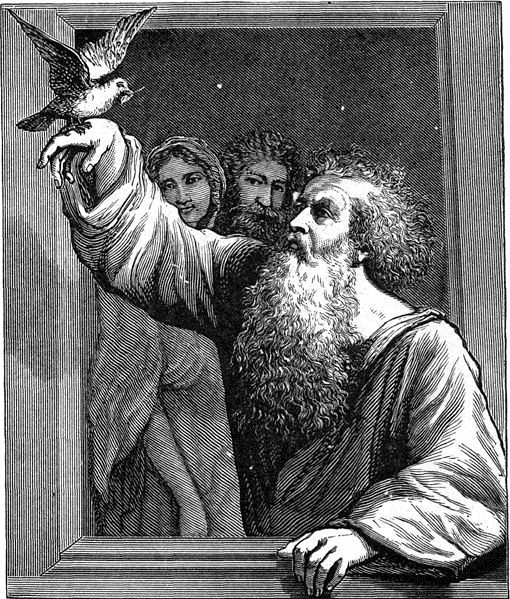
Seeing a child play with those animals that are a part of Jesus's birth-scene often makes me think of a similar children's toy:  the arks with pairs of animals, based on the story of the flood in the Bible's book of Genesis.  (Christianity shares with Judaism that version of the story of animals being saved; and the figure of Noah as rescuer is also in Islam's Qur'an.)  Young children enjoy animating the animals by moving them about.  And figuring out how to fit all the animals into the ark can be a learning experience.

Our contemporary dictionaries have several definitions for "ark," but one older use of the word endures only in history-recording dictionaries such as the Oxford English.  In the 1700's and 1800's, English gentlemen (and their counterparts in U.S.'s New England) were often collectors of objects from nature:  fossils, plant samples, bones, insects, etc.  If the collector could afford it, he kept those samples in a multi-drawered cabinet that came to be called an "ark."  The Biblical connection was so strong that the wood cabinets were sometimes even designed with a sloping top -- the way the roof of Noah's ark would have to have been sloped so the rain would run off.

Natural scientists of that time period had a "fitting" problem that was even greater than how to fit their growing number of samples into their arks (and even more challenging than children getting toy animals back into their ark).  Namely, figuring out how all the fossils, plants, and animals represented by their samples fit together historically and biologically.  Eventually, Darwin's discovery would prove to be a breakthrough.

This story of the resourcefulness of natural science converges with the resourcefulness of Christianity with its nativity scenes.  That is because the Bible itself does not explicitly depict any animals surrounding baby Jesus in the manger.  Sheep are only referred to indirectly in the Bible's book of Luke; camels are never mentioned in the story of the magi in Matthew; and no donkey is mentioned.  All those animals around the Christmas manger are thus the product of humans' imaginatively interpreting the meaning of the Biblical stories.  It seems as if representing the glory of new creation and the glory of God demanded a more holistic picture -- one that involved a range of animals.

Knowing how to careToday, for some of us, another dimension -- another aura -- surrounds those nativity scenes.  Just like Noah, we humans today are trying to rescue animals from extinction by trying to evoke in our human hearts a new birth of the spirit of Creation-Care.  On this ark of planet Earth.

~~~

Do you have any childhood memories involving crèches or living nativity scenes?


(The picture of a nativity is used under a
Creative Commons Attribution-Share Alike 3.0 Unported license by L.Kenzel.
Both illustrations of Noah are in the public domain because their copyrights have expired.)

Friday, April 17, 2015

Animals Emerging Out of Darkness

Tens of thousands of years ago, human beings would have sat around fires after dark, listening to storytellers.  Occasionally their eyes would have followed sparks rising upward in the fire's heat -- bright sparks joining the stars against the darkness of the night sky.  I imagine that while looking up into the night sky and listening to the storyteller, their minds would have begun to see shapes -- constellations -- emerging out of the myriad stars:  Images of animals and of people.  There, a bear!  And there, a scorpion!

An immense time later, in the 9th century C.E., a man named Jahiz (or "al-Jahiz") described a different way that animals emerged out of darkness.  Jahiz wrote about how he and Bedouin travelers camping in the desert at night had repeatedly observed a series of animals coming out of the surrounding darkness.  First came the flying insects, drawn into the campfire's circle of light.  Then, looking for food as well as warmth, came lizards, mice, snakes, and even foxes. Sometimes as many as seventy different kinds of animals would emerge on a single night.

Animals have been a favorite subject for books' illuminations.
 
from The Book of Animals
Jahiz collected such accounts and spun them together with stories, other observations of animals, and philosophical reflections in his Book of Animals.  It was more than an inventory of those animals that emerged out of the darkness.  What also emerged into the awareness of the Bedouins and Jahiz was how the animals seemed to form a hierarchy from tiny to large, and how the animals' lives were tied together with multiple interrelationships. Jahiz (being also a writer of philosophy and theology) added to that awareness his answer to some Bedouins' question of why the Creator had made noxious creatures.  Jahiz explained to his companions in the desert (and to his readers) that:  "Each species constitutes a food for another species....  Divine Wisdom has decreed that some species are the source of food for others, and some species are the cause of death for others."

Orpheus's music was said to be so alluring that it even attracted animals.
Orpheus and the Beasts
Constellations emerging into focus. Real animals coming out of the darkness.  So also have animals emerged into the lives, culture, consciousness, and imagination of human beings.  That emergence occurred in a transformative way in the Neolithic period 10,000 years ago, when animals were domesticated for food and labor. There was also another form of emergence as animals became part of humans' mythologies, legends, fables, and proverbs.

In the 20th century, as our societies became more urban, animals often faded into the background, often forgotten except for when we took outings to the zoo or to national parks. Today, however, I think animals might be re-emerging into our human consciousness in a new way.  As we watch TV shows such as Nature and National Geographic, we learn about more of life's immense diversity -- the number of species being almost as innumerable as stars in the night sky.  Also, we are trying to bring into sharper focus how we might be caretakers for threatened species so that they will not become extinct, like stars extinguished into darkness.

~~~

Are there occasions on which you think of animals?  What are those occasions?


(The Jahiz quote is from his Living Beings,
as quoted in Darwin's Ghosts by Rebecca Stoat, © 2012, p. 53.)
(The page from the Arabic book is in the public domain because its copyright has expired.) 

Friday, April 3, 2015

Not in Jest


A day for trying to remain good-humored
I am not a seer.  Nevertheless, I can predict one news story that will assuredly be on my radio every April 2nd:  There will be a news story explaining how some other news story the preceding day was only an April Fool's hoax.  The inevitability of that post-April-Fool's story makes me want to not believe anything I hear on any April 1st.  It seems it might be safer to just wait twenty-four hours until everything gets sorted out.

But life won't wait for everything to be cleared up.  There are too many things I have to accept as if they were true, or I would be paralyzed.  Even stepping out my front door in the morning, I have to assume the ground will support me the way it did the day before.

These thoughts came to me after I was struck by the similarity between two quotations, even though their authors never met.  The first quotation is from Islam's primary scripture, the Qur'an (Koran).  In this passage, God (using the royal plural) tells us:
"Know that We did not create the heavens and the earth,
 and all that is between them, in frivolous play."

"sparrows all bear messages"     -- Thoreau
Reading that passage, I recalled immediately a quotation by the 19th century American writer Henry David Thoreau. It goes like this:
"God did not make this world in jest;
 no, nor in indifference.
 These migrating sparrows
 all bear messages that concern my life."

These lines from Thoreau tell me that I should treat the world of Nature around me --  a world not made by humans -- with an earnestness.  Even treating it as having messages for me.  The line quoted from the Qur'an, in its context, tells me the same.  It is a view also expressed by the traditional Christian idea that Nature can in some fashion be read as the "Book of Nature," with its messages about God.

Even if I do turn my attention away from the many distractions of our highly technological society to look at Nature for awhile, the challenge can be that there are so many "messages," and they do not always seem to be saying exactly the same thing.  One "message" Spring brings feels comfortably warming after the harsh winter.  Another "message" that Spring often delivers irritates my allergies and can lead to a sinus infection.  And those are only two of the messages at one particular time of year in my "Inbox" from Nature.

Experiencing Nature personally, without taking it too personally.
It can be a bit like trying to sort out which e-mails are junk-mail needing only a glance, which e-mails are easily misleading spam, and which are personal e-mails I should truly slow down for, letting the inner message sink into my mind and heart.  Only some messages seem to be "signs" in the sense of pointing significantly to deeper truths.

Nevertheless, perhaps by just going through the "Inbox" of Nature every day -- being sure it gets my attention -- I will be invigorated.  For, as the 20th-century author Isaac Bashevis Singer said:
"What nature delivers to us is never stale."


~~~

Is there a particular time during the day when you have a chance to turn your attention to Nature? What is that occasion?  How does observing it affect you?


(The verse from the Qur'an is 21:16.)
(The Singer quote is from New York Times Magazine, 26 Nov. 1978,
 as quoted in A Dictionary of Environmental Quotations, ed. Barbara K. Rodes, © 1992.  87:108.)