Showing posts with label environmental concern. Show all posts

Friday, July 2, 2021

There's More to Penn and His Pen

A child's learning involves being able to identify things. (Spoon. Ball.)  And it involves being able to recognize recurring patterns.  (That ball and spoon both go down when pushed off the edge of the table.)  However, that wonderful human ability to identify things and discern recurring patterns has a drawback: It easily results in our simplified classifying and stereotyping of people.

Not only do we easily group people by race or ethnic background, we also classify historical personages by what they are most famous for.  For example, one person becomes "a scientist" in the historical record, even though that "scientist" might have most enjoyed playing with their children. Or, another famous person becomes "a singer," even though that "singer" might have most enjoyed tinkering with old clocks.

Can classify the people by their clothes.
One historical figure in early North American history has become indelibly linked to the state of Pennsylvania:  William Penn, whose last name is the first part of that state's name.  There is a bit of irony here, because even after getting the king of England's permission to establish a colony in the "New World," William Penn spent more years in Germany and England than in the future U.S.  Because most education in the U.S. today is secularized, American-history textbooks classify the man as a political leader.  Books on the history of Christianity, in contrast, classify him as a leader of a religious movement, the Quakers.  As a result of such classifications, neither type of textbook is likely to tell the reader about Penn's thoughts and writings about Nature.

William Penn's enjoyment of Nature is demonstrated by the name he had preferred for the colony he founded in 1691: "Sylvania," meaning "forest" in Latin.  It is from the same Latin root for "Sylvania" that we get the little-used English word "sylvan," meaning related to wooded areas.  (It was King Charles II who stuck "Penn" on the front end of the colony's name in honor of William Penn's father, an admiral.)

Even though on national holidays such as the Fourth of July, patriotic Pennsylvanians might focus only on William Penn's interest in founding a colony, that man's appreciation of Nature is revealed in words like these that flowed from his pen:

"The world is certainly a great and stately volume of natural things, 
and may be styled the hieroglyphics of a better one, 
But, alas, how very few leaves of it do we seriously turn over!
... The country is both the philosopher’s garden and his library, 
in which he reads and contemplates 
The power, wisdom and goodness of God."

With those words in Penn's book "Some Fruits of Solitude," he is sharing in a long tradition within Christianity of viewing the natural world  as a revelatory "Book of Nature" that supplements and complements another book, the Bible.

Artists' portraits of Penn and his fellow 17th and 18th-century Quakers frequently portray them wearing their distinctive flat-topped black hats as an aid to picture-viewers in identifying them as being Quakers.  (The Quaker Oats Company has stated that one such portrait on their trademarked cereal boxes is not William Penn, as they once claimed, but is just a generic Quaker.)  Those flat-topped hats with two projections to the side look out of fashion today.

A sparkle of beauty added to our life.

But perhaps not out of fashion might be William Penn's additional thought that,"It would go a long way to caution and direct people in their use of the world" if "they were better studied" in the natural world as revealing the Divine.  He continues: 

"For how could man find the confidence to abuse it,
While they should see the Great Creator stare them in the face, 
in all and every part thereof?"

~ ~ ~

(Is there any way that you feel you "see the Great Creator" in Nature?)


(Both quotations are from William Penn's book "Some Fruits of Solitude" [1682, 1693], capitalization modernized.)

Friday, June 5, 2020

Bubbles within a Great Bubble

Hopes enclosed under glass.It reads like a modern parable, even though all the details come from newspaper archives.  In September of 1991, eight men and women, outfitted in blue jumpsuits, made an appearance before an excited press.  The small team was about to embark upon an experiment -- not going into space, but entering a human-made ecosystem called Biosphere 2.  Sunlight would enter the glass windows of the 3-acre complex of domes and pyramids.  But other than that solar intervention, Biosphere 2 was designed to grow its own food, create its own oxygen naturally, and filter its wastewater through the soil for purification.  A New York Times headline described it as a "Man-Made World."  An ABC news program held out the hope that the project might "save the world" -- because after all, Biosphere 2 would be sealing out the environmentally damaged, polluted world that the Earth had become.  The team in jumpsuits entered the Biosphere, and the airlock was sealed.

Any sci-fi writers worth their salt would know what should happen next if this were to be made into a Hollywood movie:  Competitiveness, jealousies, and sexual attractions would emerge among members of the team.  One member would turn into a Captain Bligh, fomenting a mutiny among the crew, who had been wanting the bountiful Biosphere to be an enchanted island of Tahiti.

As it turned out, the real Biosphere 2 soon had problems of a more ecological nature.  Even though its sealed world had included a miniature rainforest, coral reefs, and numerous species of animals, growing crops was difficult.  The team had to break into an emergency 3-month food supply they had kept a secret.  Despite that surreptitiousness, reporters discovered that deliveries were being made to the Biosphere twice a month -- seeds, vitamins, and mousetraps.  Mice were not the only pest needing controlling.  There were also cockroaches (no surprise), and nematode worms and mites attacking the crops.  Moreover, the honeybees and hummingbirds that were to have pollinated the crops had died.

Of more immediate danger, a surge of bacteria was reducing the oxygen level to such a point that it was as if the team were living at an altitude of 14,000 feet.  A truckload of liquid oxygen had to be called in and sprayed into the Biosphere.

As the ecologist Rebecca Stewart summarized it, “The Biosphere 2 experiment failed to generate sufficient breathable air, drinkable water and adequate food for just eight humans, despite an expenditure of $200 million.”  The bubble had burst.  Reflecting upon our scientific knowledge, the scientists Joel Cohen and David Tilman wrote:
“No one yet knows how to engineer systems that provide humans with
 the life-supporting services that natural ecosystems produce for free.”

Hopes grounded in a larger sphere.
A rare look at a rare planet
A century earlier, it was the idea of a much more immense "bubble" that had initially prompted the word "biosphere."  In the 1800's, scientists had coined that word to refer to the network of integrated living species, from microscopic to large, that surround the Earth.  In 1926, the Russian scientist Vladimir Vernadsky published a book about this living "skin" that surrounds our planet. The living beings in the biosphere not only draw upon the chemical elements of the Earth and air;  they also re-create the oxygen, nitrogen, and carbon dioxide.

Expressing appreciation for the Earth.
We must marvel at what this Earth-Bubble, our home, can do.  But we might also draw upon the failed bubble-world of Biosphere 2 to ask if there isn't an intangible "bubble' we sometimes live in.  When we live in our high-tech human-made world without an awareness of how it is being sustained by the systems of Nature, are we not living in a mental bubble?  The danger of such a mental bubble is why our faith-traditions have cultivated prayers of gratefulness to use upon awakening, before eating, and when going to sleep, awaiting the sun's next rising.

~ ~ ~

(Do you have a way of remembering Nature in an appreciative way?  What is it?)


(Quotations and details are taken from "The Lost History of One of the World’s Strangest Science Experiments"
 by Carl Zimmer, The New York Times, March 29, 2019.)
(The picture of Biosphere 2 and of the Earth are used under Creative Commons Attribution 2.0 Generic licenses.
 The picture of the nomad is in the public domain because of its age.)

Friday, June 7, 2019

As Busy as... You Know What

The artist's and scientist's eye as one.
Melissographia (1625)
Our contemporary academic fields chop our one world into many pieces.  We classify a matter as falling within the area of history or biology or religion.  But such categorization can obscure the wholeness of our complex lives.  I was reminded of that drawback when I read the news story about three beehives of honeybees having survived the terrible fire in Notre-dame Cathedral in 2019. As the beehives on the roof had been part of a project to restore Paris's  population of critical pollinators, was the news story about environmentalism?  Or was it a story about biology because it testified to bees' natural durability?  Or, given the centuries-long history of that cathedral -- involving religious, political, and secular events -- does the bee story fall within the category of "history"?

Even within our category of "history," we create sub-categories.  And textbooks on the history of Christianity will be employed more often by religion professors than by the history department.  That sidelining of church history in our secular age means that the historical contributions of the church to preserving bees might go overlooked.  But monks and other church employees whose names have been forgotten cultivated bees for both tasty honey and the tallow to make church candles.  The environmental writer Paul Shepard informs us that:
"In Wittenburg, Germany, before the [Protestant] Reformation, some churches used 35,000 pounds of wax a year. On Candlemas Eve, hives were decked with ribbon and a song...beginning, ' Bees awake.' [was] sung as people carried wax candles,"

Bees have also navigated their way into the field of literary lore.  Many a Sherlockian enthusiast knows that Sherlock Holmes dreamed of eventually leaving stimulating London to retire to the English countryside -- where he would enjoy taking care of honeybee hives.

Bee geometry.
We also need to reserve a page in the mathematics textbook for bee geometry.  That is because the distinctive six-sided perimeter around each cell of honeycomb fits the greatest number of those tiny compartments into a hive.  It requires some higher mathematics to prove that an equivalent number of eight-sided cells would require greater space.  How do the bees "know" to go for hexagons? What pressures drive them?  To answer that puzzle, we would also need specialists in animal behavior.  And maybe a physicist too.

Bees also show up in the field of genetics.  Forget the familiar picture of two sexes coming together to create offspring with a 50-50 chance of being male or female.  In the peculiar world of honeybees, only the queen lays eggs, the numerous worker bees are undeveloped females, and the very few males that exist come from unfertilized eggs!

Bees have also buzzed their way into art books.  The complicated clash of circumstances and
personalities that occurred between Galileo and Pope Urban VIII is too often misrepresented
Golden bees survive grace a tomb.
 as a stereotyped battle of truth vs. ignorance.  But if we follow the path of bees, we would find that before their conflict, Urban had praised Galileo's scientific writings and was a promoter of the arts and architecture.  Urban was from the Barberini family, whose signature symbol was bees.  A triad of bees mark many buildings in Roman built under that Pope's patronage; and golden bees grace Urban's tomb.

So numerous have been bees interconnections with the human race that we could develop a course titled "Honeybee History."  But then we'd have to argue over whether it should be handled by the history, biology, or environmental studies department.  Any professors up for co-teaching an interdisciplinary course?
~ ~ ~

Specialization suits bees quite well. Do you think it suits humans?


(The Paul Shepard quotation is from his book The Others: How Animals Made Us Human, © 1996, p. 124.)

Friday, April 5, 2019

Waste Not, Want Not

It's hard not to make jokes about it . But many of the jokes cannot be repeated on this website, given the respectful tone toward readers it aims to maintain.  We do have a high-sounding word for those low jokes: "scatological."  Yes, I'm talking about feces, manure, dung.

Not trying to be a clown.Perhaps a courteous way to begin to talk about it—especially in a website about Nature—is to talk about dung beetles.  When observing them, the comedy, instead of being scatological, can become lighthearted.  And, indeed, it is hard not to make jokes about dung beetles once you know that the oversized ball they comically struggle to take home is made out of manure.  When the manure the dung beetle locates is rolled in the usually sandy soil in which the beetle lives, it usually becomes a perfect sphere, sometimes larger in diameter than the beetle in length. As if to add another gag to its comic act, the beetle will often walk on its forelimbs, pushing the ball backwards with its rear legs.

There is, however, a seriousness of purpose behind the act.  The aim of the beetle's often difficult struggle is to get the ball into a burrow, where the beetle's eggs laid into the sphere will incubate in the decomposing heat of the manure. That choice of a material for a nursery also means that there will be ready-made food right at the mouths of the larvae once they hatch.

The most famous of entomologists.It is so fascinating for naturalists (or Nature lovers) to watch the dung beetle's maneuvering that they inspired the classic opening essay in Jean-Henri Fabre's ten-volume book on entomology, the study of insects.  He wrote of a group of them:
"What excitement over a single patch of Cow-dung! 
Never did adventurers hurrying from
the four corners of the earth
display such eagerness
in working a Californian claim."

Now that I've coyly talked about insects, I can return to my more delicate subject.  Viewed from a wider perspective than the several square yards a dung beetle inhabits, the matter of manure takes on larger implications.  Life on this finite planet could not exist if one species' waste did not become another species' raw material.  Moreover, the long-term quality of human civilization will depend in part upon how adept we become at recycling what we would have otherwise considered to be just trash or waste.

Given the critical nature of caring about where things go once we think we have gotten rid of them, the content of that beetle's prized ball might not be a bad place to begin our reflections. We humans, for good reason, do not talk too much about what we flush down the toilet. (One TV talk-show host in the early days of television even got disciplined for making a joke about what was demurely called a "water closet.")  Nevertheless, much could be revealed about the practical challenges of building a human civilization if we examined how humans have dealt with such waste.  Although I've never encountered a copy of the book, I do know that the nonfiction writer Lawrence Wright has written a book titled Clean and Decent: The Fascinating History of the Bathroom and the Water Closet.

Being economical.
house in Tibet with manure-brick wall
People who have economically poorer lives in traditional cultures live out the meaning of "Waste not, want not."  In some societies, animal dung is even shaped into bricks, dried in the sun, and used as fuel.  Or even to make houses!  Mind you, I'm not suggesting that such a method of house-construction be widely adopted.  But such ingenious uses of even the most distasteful waste (as that little beetle knows) can help remind us that Nature is the Great Recycler. And it must be.

~ ~ ~

Have these reflections lead you to any thoughts about life?


(The quotation by Fabre is from his Souvenirs Entomologiques.)

Friday, October 27, 2017

Swimming with Hippos

Trying to convey the cuteness we see.
When I first heard about swimming with hippos, it evoked in my mind an animated-cartoon image of a child playfully floating in colorful, bubbly water.  The cartoonists would probably make the hippo bubble-shaped too -- chubby and cute, with tiny ears that would excitedly spin.  After my imagination got back down to Earth, I thought that it might not be that nice having potentially smelly hippos (maybe dirty too?) in the water in which people were swimming. But that was not how some people in Africa experienced it.  To them, having hippos in their swimming and bathing water was a true lifesaver.

I understood how that could be when I read about an experience described by C. Dean Freudenberger.  The people in Africa who swam and bathed in the river began to lose some hippos when the animals were shot by soldiers for food.  Without the usual hippo population feeding on marsh grasses and reeds, those plant populations exploded, trapping more silt, and thus slowing the water's flow a the edges of the river.  In that altered environment, snails flourished -- along with parasites called liver flukes, which need snails for part of their life cycles.  Sadly, humans are another part of the life cycle of liver flukes (Schistosomiasis). People began dying, ultimately due to the deaths of life-saving hippos in the water in which they bathed.

Like us, but so different.
I know this environmental story is one of many.  To me, though, there was an added poignancy as I pictured in my mind the relative sizes of the three creatures involved:  Microscopic fluke, human, and hippopotamus so huge it could be fangerous to people, but in this case was an ally against the tiny.

Reading Freudenberger's account made me remember seeing a mother hippo in a zoo with her baby, half-immersed in water.  I was struck by the massive solidity of their bodies.  Even the creature people were calling "the baby" seemed too large for the man-made pond.  And it seemed that a pond the size of Africa would be the right size for the mother.

Those solders in  Freudenberger's story were not the first people to have hunted hippos.  Most Biblical scholars think the Behemoth described in God's speech to Job in the Old Testament is a hippopotamus.  In that part of the narrative in the Hebrew Bible, God mentions the way hippos were hunted with harpoons.  God is not, however, interested in giving any hunting lesson. Instead, God seems to be trying to lift Job out of his self-centered perspective on himself.  God does so by describing such animals as the awe-inspiring hippo:
"Look at Behemoth, which I made just as I made you; it eats grass like an ox. 
 Its strength is in its loins, and its power in the muscles of its belly....
 It is the first of the great acts of God -- only its Maker can approach it with the sword.
 For the mountains yield food for it where all the wild animals play.
 Under the lotus plants it lies, in the covert of the reeds and in the marsh.
 The lotus trees cover it for shade; the willows of the wadi surround it.
 Even if the river is turbulent, it is not frightened"

~~~

Is there a particular animal you find awe-inspiring or humbling? Which one?


(Freudenberger's account about the hippos is related by
Calvin B. DeWitt in DeWitt's Song of a Scientist, © 2012.  p. 224,.)
(The Bible passage quoted is Job 40:15-16, 19-23a [NRSV] © 1989.)

Friday, June 9, 2017

Bears: Too Much and Too Little Like Us

The history of humans and bears has been a love-hate relationship.  Or to put it in a more historical order, a hate-love story, because it has taken time for our fear and hatred of bears to subside and our fondness for them to grow.  In past centuries, bears were nearly expunged from the Mideast, Europe, and the U.S.  Today, polar bears on notecards tug at our hearts, trying to persuade us to preserve their homes.  From fear to love.

Cute in cartoons, but...Given that order of events, it interests me that a child's first encounter with bears usually comes in a loving, not a hateful way. Our societies may have had a hard time coming to delight in bears, but a child can delight in them early in life upon first being read "Goldilocks and the Three Bears."  As a child's reading level advances, bears can be stepping stones -- from Paddington Bear to Winnie the Pooh to Smokey the Bear with his instructions.  (If, as a young adult or adult, a person makes their way into Tolstoy's War and Peace, that person even encounters a young pet bear being among the guests at a drunken party Pierre attends.)

Despite our childhood intimacy with fictional bears (all the way down to teddy bears), real bears in the wild prefer to keep their distance from humans.  Bears prefer running away over attacking. Thus, one of the greatest delights of tourists in national parks is having the good luck of sighting a bear (safely, of course).  I remember my wife and I sitting eating lunch on a gentle wooded slope in Sequoia National Park when a brown bear quickly passed us, running over the hilltop to keep its distance from people on the other side, paying no attention to my wife and me.  We were also lucky in seeing a grizzly bear in Yellowstone when we were on a somewhat remote trail.  Almost beyond our range of sight, we watched the grizzly through binoculars.  It was standing watching us, keeping its distance, evaluating I am sure whether we were going to leave the trail and come closer.

Feeling for the bear.
That standing pose and their taillessness are reasons people have thought bears to be like people.  The native American Mewuk even have a story about bears "dancing."  The bear-human resemblance has, however, sometimes been an endangerment to bears' freedom, such as when they have been pressed into service riding bicycles in circuses.  Even today, people too easily think they understand a bear's emotions, even though bears' facial expressions are not like our own.  Such misreadings have resulted in injury when bears have been approached.  National park rangers exile any bear that hurts a person.  We protect them by keeping our distance.

A life of their own.An inordinate fear of bears in Western culture led for centuries to the cruel entertainment of bear-baiting, in which dogs were set upon a chained bear to attack it  In the 19th century in the U.S., the nature writer John Muir appealed for compassion for bears.  He did so by pointing out additional similarities to us:  "Bears are made of the same dust as we, and breathe the same winds and drink of the same waters.  A bear's days are warmed by the same sun, his dwellings are overdomed by the same blue sky, and his life turns and ebbs with heart-pulsings like ours, and was poured from the same First Fountain."
~~~

Do you have any memories of a real bear?  What about a bear in a book, or a stuffed toy?


(The Muir quote [1871] is taken from
 A Dictionary of Environmental Quotations, ed. Barbara K. Rodes, © 1992.  139:22.)
(The first two pictures are in the Public Domain because their copyrights have expired.)
(The last picture is by A. N. Komarov and is used under a Creative Commons Attribution 3.0 Unported license)

Friday, March 31, 2017

The “House” that Nature Built

When I was in high-school, one area of curriculum being offered was called "home economics." Although the classes included household budget, they were primarily such things as cooking and sewing.  (Mostly girls attended.)  That recollection of the label "home economics" came back to me recently as I read about some of the history behind modern ecology -- history dating back 150 to 350 years.

So many interrelationships!
illustration from
one of Haeckel's book
The key to understanding the matter is a single Greek word oikos, which means "house."  Although the fundamental ideas behind ecology developed over centuries as scientific knowledge grew, the term "ecology" was coined in 1866 by the prominent German biologist Ernst Haeckel.  To put what he did in English, a prefix derived from oikos was attached to the suffix "-logy" which means scientific study (as in bio-logy).  Thus, eco-logy looked at all of Nature as being a large "house" full of interrelationships that science was in the process of discovering.

That "-logy" suffix was a significant choice because it was a shift from a term scientists had been using in the preceding two centuries.  (Here's where those high-school classes about a woman's taking care of a home comes in.)  Before Haeckel, it was common for Europeans studying Nature to speak of the "economy" of the natural world.  We can see in "economy" the same "eco-" prefix as in "ecology." But "economy" has a different suffix, from nomos.  It is also from Greek, but means "management."  Thus, "eco-nomy" refers to the management of some type of "house" (à la "home economics" classes).

In the case of the "economy" of Nature, however, the "house" is not a building constituted by humans.  Nor are the humans the main managers.  In the worldview of scientists in the 1600's and 1700's, Nature by itself was seen as having an "economy," that is, a set of efficient, purposeful interrelationships.  This is why, for example, the 18th-century biologist Linnaeus was able to write:
"By the Oeconomy [i.e., Economy] of Nature,
 we understand the all-wise disposition of the Creator
 in relation to natural things,
 by which they are fitted to produce general ends [i.e., purposes]
 and reciprocal uses."


A much larger biological "home"?Over two-and-a-half centuries after Linnaeus -- who pioneered modern biological classification -- our current scientific knowledge and understanding of Nature's diversity and complexity has exploded.  Our increasing awareness of the wildness of Nature -- its resistance to being entirely domesticated or even subdued by our attempts at "management" -- has even raised questions about whether any "house" metaphor is accurate.

There is one thing our environmental problems have shown us, however:  As the 20th-century eco-theologian Sallie McFague puts it, in order for humankind to live sustainably in Nature, we need to learn this planet's "house rules."
~~~

What is the world of Nature (the non-human world) like to you?


(The Linnaeus quote is from his "The Oeconomy of Nature," 1749,
as quoted in Nature's Economy by Donald Worseter, © 1994, p. 37.)
(The illustration from Haeckel's book is in the Public Domain because its copyright has expired.)

Friday, April 15, 2016

Touched by Turtles

A scientist with the heart of a mystic
In the first part of a longer essay, the science writer Loren Eiseley tells a touching story about when he was a child.  He and a friend of his own age were walking across a high railroad trestle, something they were forbidden to do lest a train come when they were on the bridge.

As Eiseley described the experience, "One could look fearfully down... at the shallows and ripples in the shining water some 50 feet below.... From the abutment of the bridge we gazed down upon the water and saw among the pebbles the shape of an animal we knew only from picture books -- a turtle...."

I was a bit surprised by the next event:  "We scrambled down..."   When I began that sentence, I thought the boys' guilt at being on the forbidden trestle had overtaken them.  The remainder of the sentence, however, revealed that was not the reason:  "We scrambled down the embankment to observe [the turtle] more closely."  At this point, I was touched because it seemed that the boys' delight in another living being had been strong enough to overcome the adventure of trestle crossing.  That was true in a way, but the following sentence brought a darker atmosphere to Eiseley 's story:  "I saw that the turtle, whose beautiful markings shown in the afternoon sun, was not alive.... The reason for his death was plain.  [S]omeone engaged in idle practice with a repeating rifle had stitched a row of bullet holes across the turtle's carapace."

Reading this account, my emotions shifting, I was carried on a sequence from childhood adventure, to feeling the attraction of life, to a sobering realization of the potential dangerousness of humankind.  I felt as if I had been carried on a journey somewhat paralleling the course of U.S. attitudes toward turtles in my own lifetime.

The first turtle I saw as a child was one of the small turtles (only 2 to 3 inches in diameter) once frequently sold in pet stores.  They are less common now because we have learned that they are vulnerable to disease as pets, and thus do not live long.  Today, TV is educating people about the need to protect sea turtles' nesting grounds.  Those campaigns draw upon our human ability to be touched by the cuteness of newly-hatched baby turtles racing to the sea.  People even assist turtle infants in the race.

Rooting for the tortoise.
In many cultures, turtles have frequently represented stability, wisdom (because of the longevity of some species), and patience.  It is that last quality -- especially in the form of dogged persistence -- that shows up in the many variations of Aesop's fable "The Tortoise and the Hare." That fable teaches us that if we persist at working toward a goal, we can "win the race," as long as we don't get cocky like the hare.

In the final part of Loren Eiseley's childhood recollection,  he tells how his father guided him toward a more mature thinking that could incorporate an awareness of human destructiveness. Today in the U.S., we can wonder if our now greater concern for the environment and our growing love for Nature will be dogged enough to catch up with the destructiveness of our previous habits.  Or will the "hare" instead win because it had a head start?

~~~

Have you seen turtles or tortoises in the wild?  Where?  What were they like to you?


(The Eiseley quote is from "The Cosmic Orphan" by Loren Eiseley,
in the Propaedia to the Encyclopaedia Britannica, 15th edition, © 1977.  p. 206)

Friday, December 25, 2015

Playing with the Nativity

Focus of a child's imagination
One luxury of our modern Western societies is that many of us are able to have a plenitude of Christmas decorations.  The selections in Christmas stories reveal the enduring popularity of nativity scenes, from folk pottery of South America to wood carvings of Asia.  My wife says that as a child her favorites were nativity scenes that allowed her to move unattached figures about.  And, of  course, some of the favorites of children in those scenes are, understandably, the animals.


Keeping life afloat
Seeing a child play with those animals that are a part of Jesus's birth-scene often makes me think of a similar children's toy:  the arks with pairs of animals, based on the story of the flood in the Bible's book of Genesis.  (Christianity shares with Judaism that version of the story of animals being saved; and the figure of Noah as rescuer is also in Islam's Qur'an.)  Young children enjoy animating the animals by moving them about.  And figuring out how to fit all the animals into the ark can be a learning experience.

Our contemporary dictionaries have several definitions for "ark," but one older use of the word endures only in history-recording dictionaries such as the Oxford English.  In the 1700's and 1800's, English gentlemen (and their counterparts in U.S.'s New England) were often collectors of objects from nature:  fossils, plant samples, bones, insects, etc.  If the collector could afford it, he kept those samples in a multi-drawered cabinet that came to be called an "ark."  The Biblical connection was so strong that the wood cabinets were sometimes even designed with a sloping top -- the way the roof of Noah's ark would have to have been sloped so the rain would run off.

Natural scientists of that time period had a "fitting" problem that was even greater than how to fit their growing number of samples into their arks (and even more challenging than children getting toy animals back into their ark).  Namely, figuring out how all the fossils, plants, and animals represented by their samples fit together historically and biologically.  Eventually, Darwin's discovery would prove to be a breakthrough.

This story of the resourcefulness of natural science converges with the resourcefulness of Christianity with its nativity scenes.  That is because the Bible itself does not explicitly depict any animals surrounding baby Jesus in the manger.  Sheep are only referred to indirectly in the Bible's book of Luke; camels are never mentioned in the story of the magi in Matthew; and no donkey is mentioned.  All those animals around the Christmas manger are thus the product of humans' imaginatively interpreting the meaning of the Biblical stories.  It seems as if representing the glory of new creation and the glory of God demanded a more holistic picture -- one that involved a range of animals.

Knowing how to careToday, for some of us, another dimension -- another aura -- surrounds those nativity scenes.  Just like Noah, we humans today are trying to rescue animals from extinction by trying to evoke in our human hearts a new birth of the spirit of Creation-Care.  On this ark of planet Earth.

~~~

Do you have any childhood memories involving crèches or living nativity scenes?


(The picture of a nativity is used under a
Creative Commons Attribution-Share Alike 3.0 Unported license by L.Kenzel.
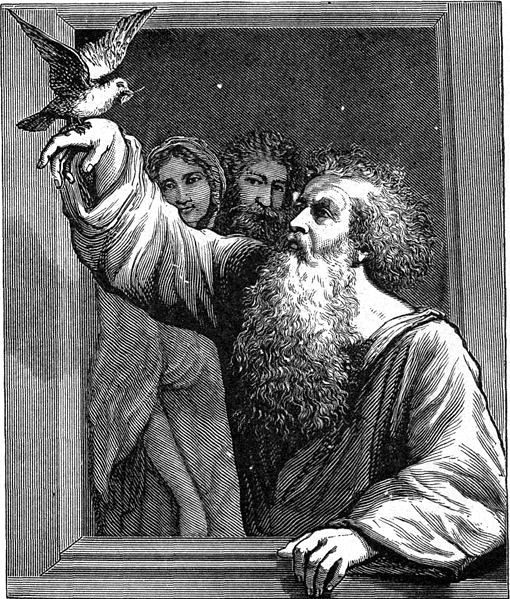
Both illustrations of Noah are in the public domain because their copyrights have expired.)

Friday, September 18, 2015

Light from the Woods

What kind of light shines through forests?Anyone who has seen a play by Anton Chekhov may well have felt that the characters were living in a locked room. Not a locked room of a murder-mystery, in which one of the characters must be the murderer.  Instead, a psychologically locked room, in which Chekhov's characters voice their failed dreams, never achieved projects, and unfulfilled desires.  In one play in particular, however, Uncle Vanya, a beautiful green illumination occasionally shines into the psychologically somber atmosphere.  It is the emerald light of a forest.  And it tells us something about Nature and the human spirit.

Twice in the play, the light glimmers through the voice of Dr. Astrov, a physician who every year has planted new forests.  Some of his lines seem to display remarkable foreknowledge of our current environmental challenges, especially given that the play was published in 1897.  For example, in Act I:
"The forests diminish year after year, rivers dry up,
 wildlife is coming to an end, the climate is spoiled...."

Astrov is able to express the beauty of forests, but only a very personal and individual way:
"When I plant a young birch and then see its leaves turn green
 and the way it sways in the wind, my soul is filled with pride...."
When he describes the human relationship to the forests in more communal terms, he is able to describe it only in a distancing or critical way because he is discouraged.  He quickly bores his distracted listener in Act III when he lays out on a table his series of maps charting the receding size of the forests over many years.  Also, his depiction of any combined life of humans and forests is only grim:
"What we have here is a degeneration, the result of a downhill struggle for existence....
 And so [man] destroys everything and never thinks about tomorrow...."

Thus, even though Astrov has nobly devoted much time and money to trying to sustain the forest, he cannot sustain a vision that will inspire other people.  Nevertheless, the green illumination that merely glimmers through him flares more brightly through another character, Sonya.  This is partly because she loves Astrov, but also because she is able to feel more loving toward all people. She is able to tenderly express a beautiful vision of how Astrov's reforestation work can be transformative:
"He says that the forests glorify our earth,
 they teach a person the meaning of beauty and kindle a spirit of majesty.
 The forests make the climate less severe.  In countries where the climate is mild,
 less energy is spent in the struggle with nature, and so there we find a gentler,
 more understanding person.  There too people are beautiful, pliant, and responsive;
their speech is elegant, and their movements are graceful."

A voice of another era, Chekhov still touches hearts.
Anton Chekhov
What does the playwright Chekhov himself think about these matters?  We have a solid clue in that he gives to Sonya the final words in the play -- the most beautiful and loving speech in the entire play.  We also have a more subtle clue in that the name "Sonya" is a Russian variant of the name "Sophia," which means Wisdom.

~~~

Do you know someone in whom the love of nature shines? Can you describe their spirit?


(The quotations from Uncle Vanya  by Anton Chekhov,
are from Anton Chekhov's Plays, translated by Eugene K. Bristow, © 1977.)
(A most accessible adaptation of the play is the movie version Vanya on 42nd Street.)

Friday, July 25, 2014

Tested by Toads and Frogs

I feel sympathetic toward children, with the multitude of tests they have to endure.  Not just those academic standard tests that have been so much in the news in recent years, but also the tests that come in the form of taunts and insults from other children.  Name-calling is the quickest way to insult.  And among the animal epithets one child can lay on another is, "You toad!"  How the toad got into the childhood lexicon is not hard to discern.  After all, what child would want their face to look like a lumpy, bug-eyed, warty animal?

There were other ways that toads were part of the tests of my childhood.  When one child did catch a toad, it could be a challenge to pass it from one pair of cupped hands to another without the toad escaping -- especially when the animal's strange, leathery skin could feel distasteful ("yucky," to use a child's word).

illustration for
"The Frog Prince"
Whether or not toads or their near look-alikes frogs were more prevalent in your childhood would have probably depended upon the dryness or wetness of the habitat that surrounded you.  (The categories "toad" and "frog" almost blend one into the other in the great variety worldwide, especially when tree-toads and tree-frogs are included.)  The similarity of shape and appearance between toads and frogs has meant that both entered folklore and fairy tales as a distasteful test to be overcome.  Would you want to kiss a frog?  Even if it might turn into a prince, thus fulfilling your heart's desires?

The fact that some frogs and most toads do have a toxic, protective liquid in the bulging sacks behind their eyes could make putting one's face too close to the animal a real fear.  People could be wary of approaching toads even if they believed the legend that a toad's body might hold the wondrous toadstone that could grant magical powers.  Shakespeare captured the tension about toads in these lines from As You Like It:
"Sweet are the uses of adversity,
Which, like the toad, ugly and venomous,
Wears yet a precious jewel in his head."

The ways toads and frogs test us extend beyond childhood and even beyond the pages of fiction. Today, the populations of frogs are truly in perilous decline.  Their permeable skins mean that they are early indicators of the spread of our human-made chemicals, especially when compounded by viruses and habitat loss.

When frogs are plentiful, it can also be a challenge for us humans to put up with the loud choruses of frogs finding mates in springtime.  One story from the Christian tradition, however, might inspire us to tolerance.  The story tells how St. Benno, searching outdoors for a place for prayer, was at first tempted to bid the frogs to be silent.  But then, Benno recalled a Bible passage expressing how animals too praise God.  And so, the saint commanded the frogs to "praise God in their accustomed fashion; and soon the air and fields were vehement with their conversation."


~~~

Do you have any childhood memories of toads or frogs?  Adult memories?


(The Shakespeare quote is from As You Like It, II, i.)
(The quote about the St. Benno story is from Beasts and Saints by Helen Waddell, © 1995, p. 66.)

Friday, January 24, 2014

Much between the Oink and Curly Tail

A character in PBS's Call the Midwife remarked that dogs look up to us, cats look down at us, but pigs see us as we are.  That bit of wit may say more about our relationships with dogs and cats than it does about pigs.  Nevertheless, pigs probably deserve more credit than they usually get.  Just to start with, we virtually never hold up any quality of a pig for people to emulate.  We say humans should be faithful, and recognize dogs as being so.  In contrast, to call a person a "pig" or a "hog" is always an insult.

detail from
Gauguin's The Black Pigs
Despite that contrast between our attitudes about dogs and pigs, there may well have been a similarity between the way ancient ancestors of dogs and of pigs entered the circle of human culture.  Our domesticated pigs are descendants of tusked wild boars.  Scavenging in humans' waste heaps, those boars that were less aggressive would have been more likely to have been domesticated (just as dogs were from their wild ancestors).  Recent DNA studies have now revealed that the transition from wild boars to pigs was made in seven separate regions of the world, ranging from China to India to Central Europe.

The human-pig relationship, however, has been an uneven one ever since those domestications in Neolithic times.  The unevenness has extended far beyond the matter of pork-eating being a taboo in parts of Judaism and Islam, in contrast with it being the primary source of meat in New Guinea. The larger difficulty has been in humans' not having figured out what degree of wildness and tameness they want in the lives of their hogs.  For centuries in Europe, hogs were allowed to wander freely, perhaps getting some of their own food from the forests, but also being able to search out humans' garbage.  That freedom meant that hogs sometimes caused accidents or killed children, leading to the oddity of a number of hogs having actually been put on trial during the 14th century before being executed.

Today, we have other problems resulting from an opposite condition -- a reduction in the pigs' freedom.  The over-concentration of hogs in massive factory farms has led to unnatural concentrations of urine and feces, far beyond the ability of Nature to reprocess it into the ground. And beyond our ability to find a good way of dealing with it.

pig statue in Sweden
Yes, the history of human-pig relationships has been an awkward one.  Knowing something of human nature, it should not be surprising that people have sometimes pointed the finger of blame at the pigs, even though we ourselves have been ultimately at fault.  It is not just Charlotte in E.B. White's Charlotte's Web who might feel some sympathy for the pig. Perhaps we could give pigs more credit for all they have contributed to the human race -- from pork to leather to bristle brushes to even finding highly valued truffles.  I am doubtful, however, that pigs will be given full credit.  Even when we see a sausage in a bun with mustard, we linguistically honor our canine friends by exclaiming "hot dog" -- saying "dog," when it was the pig that made the real sacrifice.

~~~

As you read this short history, did it bring any thoughts to mind?

Friday, October 18, 2013

Trees, Time, and Passing By

Trees rarely make the front page.  That did happen, however, in 2004 when Wangari Maathai won the Nobel Peace Prize for her Green Belt Movement begun in Kenya.  Knowing a bit about ecology, I was not surprised to hear about the physical side effects that resulted from that movement's planting trees, such as cleaner streams due to reduced soil erosion.  What intrigued me more were the intangible benefits those trees brought.  For example, friendships between Kenyan women developed because, as they made their daily trips in the hot sun carrying water, they stopped to converse in the shade of trees.

As I have reflected about trees in general, I've concluded that the most enduring intangible benefits trees bring derive from the way they serve as tabernacles of time.  Many species of trees can have life spans longer than ours can ever reach.  Trees, therefore, help families and communities hold onto life-giving memories from generation to generation.  That role trees can serve is made explicit in these lines from the early 20th-century poet Stephen Vincent Benet as he describes Richmond, Virginia:
"The trees in the streets are old trees used to living with people,
Family trees that remember your grandfather's name."

In Sequoia Natl. Park in California, I stretched my neck far back to look up at a tree that was young and growing long before Jesus was born.  Such pine trees and sequoias help us transcend our normal sense of time.  We usually think of time in terms of human generations, but that is subjective and human-centered. The 20th-century American Buddhist poet Gary Snyder speaks to the relativity of time scales in this way:
"As the crickets' soft autumn hum
is to us,
so are we to the trees
as are they
to the rocks and the hills."

Compared to many long-living species of trees, we humans are just passing by.  We are to them passers-by in time, similar to the way we pass by a tree beside the sidewalk or walking path. In countries where people do not get virtually all their food from the grocery story, people can also be more aware of the other, tangible benefits those trees provide.  The Hindu Upadesa Tarangini brings together those tangible benefits with trees' intangible reminder that we are passers-by in the following benediction placed upon a tree:

"Oh tree!  You are standing on the path.  Live for a long time and be happy, because with your blossoms the cuckoo is happy, and with your pollen the bumblebees are happy, and passers by are happy with your fruits.  So live long!"

~~~

Is there any tree in particular that you remember? What is your memory of it?


(The Snyder poem is taken from
Buddhism and Ecology, ed. Mary Evelyn Tucker, et al., © 1997.)
(The Hindu blessing is taken from Hinduism and Ecology,
 by Ranchor Prime, © 1992.)

Friday, April 19, 2013

Of Warps and Wefts and Life

"Everything's connected" -- it has now become a maxim, almost a cliché.  Connected, yes, but how?  That's the harder question.  (Not to mention the challenge of deciding and learning how to behave as if everything is connected.)  One of the most common of metaphors is the "web of life," but I have my reservations about it, as I shall explain.

Although many people today have now heard of the phrase the "web of life," few people know that it was coined way back in 1914 by a Scottish biologist, J. Arthur Thompson.  Like many other phrases of our contemporary environmental vocabulary, it took some time before it worked its way into the general vocabulary.  The  choice of that word "web" has proved quite useful in conveying an image of the multiple interconnections of Nature, rather than a simple chain of cause and effect.  For example, in some biology textbooks, the phrase "food webs" has become preferred over the more familiar "food chains," as a way of conveying that digestible substances do not follow a simple linear path, but instead create multiple interconnections among plants and animals.

I have just one reservation about that standard word "web," however:  It has an association with spiders!  And everybody knows how repellent spiders can be to many people, not just to Little Miss Muffet (even though only a few kinds of spiders are potentially dangerous). Because ecologists and environmentalists would like to cultivate in more people a love of Nature, I wonder if risking mental associations with spider bites and sticky cobwebs and haunted houses is the best idea.

male lesser masked weaver
More appealing than "web" I think, is another metaphor -- the "fabric of life."  That metaphor can convey the image of a protective cloth, even a beautifully woven one. Recently, I was reminded of the weaving metaphor for interconnectedness when I saw pictures of the weaverbirds of Africa.  Those skillful birds actually weave thin strips torn from grass to create a nest that protects their young against sun and snakes.  One species of weaverbirds even constructs a nest that is elegantly spherical.  Certainly an association with cute birds is more appealing than an association with spiders!

The metaphor of "fabric" has other advantages.   It can also convey the image of a cloth being torn, the connecting threads being broken by human carelessness, with the fabric unraveling as a result.  That was the way Rachel Carson employed the metaphor when, in Silent Spring, she warned about the indiscriminate overuse of pesticides.  She wrote:  "As crude a weapon as the cave man's club... has been hurled against the fabric of life."

Moreover, the "fabric" metaphor can be adapted to refer to the work of finding a new pattern for human living that will strengthen the living systems of the Earth.  That was the very imagery that was employed by a group of feminist ecological writers.  The subtitle of their book was The Emergence of Ecofeminism.  And the book's title? Reweaving the World.

~~~

Do the metaphors of fabric and of weaving convey anything to you?


(The quotation by Carson is from
 Silent Spring, by Rachel Carson, © 1962.)
(Both photographs licensed under Creative Commons Attribution-Share Alike 3.0 Unported licenses. 
The bird photograph by Dick Daniels, http://carolinabirds.org
The fabric by Cochas, Peru, 2008.)