Showing posts with label Bible. Show all posts

Friday, August 5, 2022

Summer and the Seasons

"Too hot!"  That has long been a common complaint by many people on the hottest days of summer.  However, when the extreme becomes even more extreme (aggravated in part by climate change), it can be very hard to dreamily sing "Summertime, and the livin' is easy."  Perhaps the following article, first published five years ago, can help make us more appreciative of summer as part of the recurring cycle of the seasons.

~ ~ ~

It was a late summer.  There were more clouds than typical for a summer day, but that felt good because it gave relief from the hot summer sun.  What felt even better was a breeze that brushed across my face, bringing the promise of a respite from the summer heat we had endured for weeks.  "Maybe we'll get a cooling rain," I thought.  My slight elation at the change in weather was, however, kept in bounds by a larger awareness.  Namely, I knew that the pleasant shift in weather I was experiencing was the result of a distant hurricane that was coming ashore farther away, bringing destruction upon other people.


Natural forces more powerful than myself.
The soothing breeze that brushed my face thus raises the question of how I should think and feel about those things in Nature that bring both good and bad.  That tiny breeze raises spiritual and theological questions far beyond its small size.  To my way of thinking, the most distasteful responses to a hurricane during the past few years have been by people who claimed that God steered the hurricane away from them in response to their prayers.  Those people were thinking only of themselves, and seem to have had little concern about the other people who would be hurt by a re-directed hurricane.  Nor do such comments display an awareness of a long tradition of theological thought about the matter.

A less selfish response does not require more scientific understanding of storms.  It only requires a "compassionate heart," to use a Buddhist phrase.  A wiser and more  open-hearted response to tragedy was modeled by Jesus after a tower fell, killing people.  Even without a knowledge of Newtonian physics, Jesus knew that natural disasters do not injure just bad people, and that they do not spare just good people.  Challenging his listeners to join him in that enlightened response, he asked rhetorically,  "Those eighteen who were killed when the tower of Siloam fell on them -- do you think that they were worse offenders...?  No, I tell you." (Luke 13:4-5, NRSV).  Jesus's reminder to us that "bad things can happen to good people," as we say today, echoes that same insight form the Jewish tradition's book of Job in the Bible. Job's suffering from natural forces was not a punishment.

Although in English we have separate words for "wind" and "spirit," in the Bible's original languages, the two are the same word.  We might think "wind-spirit." That equivalence can remind me when that light wind touches my face, to ask myself what my own spirit is like, especially when I know of the dangerous hurricane further away.
What winds are blowing through my own spirit?
There is another side of the coin to this matter of the uncertainties of the natural world -- the fact that natural forces can bring both damaging winds and needed rain.  I easily notice when bad luck befalls me.  In contrast, I easily overlook all the ways I have been helped by good things that were just as much beyond my control. The light wind that brushes my face can, therefore, widen my awareness even further.  The double meaning of wind-spirit can remind me to remember a larger spirit of unseen forces that support my life.  A native American Ojibwe song put it this way:
"Sometimes I go about pitying myself,
But all the while
I am being carried by great winds across the sky."

~~~

Is there a way you have come to think about the uncontrollable uncertainties of life?

Friday, June 3, 2022

Something Dependable

As summer approached, there was increasing discussion on the radio about the condition of my state's electric power supply.  Would it be able to withstand the high demands that would be placed upon it during summer's heat, when more air-conditioners would be run more often?  Had enough steps been taken to strengthen the state's electric grid to prevent the type of massive, extended blackouts that had occurred the winter of the year before -- shutting off furnaces, leaving people shivering inside their houses, some even dying?  The state's public-utility board and the electric grid operators both assured the public that the problems had been fixed.  And the company operating my local electricity ran TV commercials showing smiling people, happy that their electric company "had their back" (as the saying goes).  We could depend on them, we were assured. 

Nevertheless, I was not surprised when I awoke at 5:00 one May morning -- even before summer had begun -- and saw that the power was out in our house.  A glance out the window showed me that the same was true for my neighbors across the street, who are on a separate electric line and set of transformers.  Something on a much larger scale than the line to a single block of houses had been put out of commission.  And the cause had not been any extended period of intense heat, but instead a run-of-the-mill thunderstorm in the night.

Electricity of another kind.
Storm in the night
Admittedly, a power disruption for several hours is a modest challenge for most homes.  But it can symbolize the many failures of our human societies that can make them so undependable that sometimes we don't want to get out of bed in the morning.  Such incidents can, unfortunately, lead not merely to frustration (and maybe anger) but to hatred of some people who have not been dependable.  After a few hours in my house without hot coffee and without eggs being fried on my electric stove, I remembered that the power-company employees that were trying to restore the system also depended upon the same vulnerable system when they returned to their homes.  They had their challenges as well.

Fortunately, not too long after getting up in my dark house without power, there came something I know I could depend on: The sun gradually rose in the east.  It did so at the same predictable time it had the morning before.  Its light filtered through the clouds, bringing into my house a gentle but appreciated illumination through the windows.  I was able to set aside the flashlight I had been awkwardly carrying about, trying to do those morning tasks that did not require electricity.

In the New Testament's Gospel of Matthew, Jesus presents to his disciples what must be one of the most difficult of his instructions. Namely, “Love your enemies.” And what does Jesus put forward as an example that might inspire his disciples in such a difficult challenge? Does he point to some very noble person around him? No. Does he point to himself? No, not even that. Instead, what he points to is the reliable rising of the sun every morning, saying that we should be inspired by our “Father in heaven; for he makes his sun rise on the evil and on the good.” (Matt. 5:44a & 45a, NRSV). Thus it is that Jesus encourages his disciples to turn their attention to the non-human sphere that they might widen and deepen their appreciation of God, and thus be inspired -- even while living in human societies that can, at times, be so frustratingly undependable.

Seven hours after I had woken up in a house without electricity, the power was still not back on; and the electric company had given up on making any prediction of when it would be.  I, however, was able to make a prediction with considerable assurance: I knew the sun would set in the west that coming evening.  And I knew it would be dutifully rising the coming morning.  And that would be good.

Being energized by the sun.

~ ~ ~

(Is there a way you deal with the ordinary frustrations of life?)


(The picture of lightning is by Vedrin Jeliazkov
and is used under a Creative Commons Attribution-Share Alike 3.0 Unported license.)

Friday, November 5, 2021

Being Forgiving about the “Little Things”

Oops!  I forgot!
It seemed at first like such a little thing.  But as I listened further to the brief segment on radio (and later read the transcript), the seemingly small bit of news grew in significance and importance. The news story's title announced that "New York City's Public Libraries Abolish Fines on Overdue Materials."

The news moderator, inquiring about the mechanics of the new plan, asked the inevitable question:  Aren't fines necessary to get people to bring books back to the library/? The answer was "No."  As Tony Marx, president of the New York Public Library system, explained:

"It turns out late fees for books don't work. They don't bring the books back.
 Almost all the books come back anyway because people respect that if they are treated
 with respect and trust, they respond in kind."

Here, the brief news story about one city's libraries seemed to be turning into a much larger moral lesson.

Not that New York's library system was advocating total suspension of human responsibility:  A person would still have to pay for any books that were lost.  Nevertheless, besides abolishing any future late-fees, all library-card holders' accounts were being cleared of any accumulated late-fees.  That was because the library administrators recognized that accounts that had been blocked because of late-fees "are vastly disproportionately in the poorest neighborhoods.  And that's exactly where we need people using the library."  The news segment now seemed to be turning into a Biblical parable involving the tendency of human societies to become out of balance -- making the rich richer and the poor poorer, unless some correctives in behavior were regularly made.

Dennis Walcott, the president of Queens Public Library (part of New York City's public libraries) added a final comment that shifted the little news story into an even higher gear, turning it into something like a prophetic vision of hope.  Of the library's aim with its new rules to get especially the younger back into libraries, he declared:

"That's the goal, to have our children participate in the American Dream.
And the American Dream is through our libraries."

Not penalizing people so as to hold them responsible for little mistakes can seem "unnatural," as we might say.  But is it really so unnatural?  Is a mother's loving tolerance of her toddler's weaknesses really unnatural? Is it really against her nature?

And what about that larger, non-human realm of Nature that our lives are a part of?  Nature can seem to be totally unforgiving when hurricanes come.  But hurricanes hit a specific area of land only a few days out of the many days of the year.  On most days, Nature displays more regular, sustaining rhythms that could be called "forgiving."

In the Bible's Gospel of Matthew, Jesus presents to his disciples what must be one of the most difficult of his instructions.  He tells them to "love your enemies."  And what does Jesus put forward to inspire his disciples in such a difficult challenge (a challenge even harder than forgiving people's ordinary mistakes)?  Does Jesus point to some very noble person around him?  No. Does he point to himself?  No, not even that.  Instead, he points to the reliable rising of the sun every morning, saying that we should be inspired by our "Father in heaven; for he makes his sun rise on the evil and on the good."  The sun regularly rises, despite all humans' mistakes of the previous day (even if it was just being ashamed to return a late library book).  Thus it is that Jesus encourages his disciples to turn their attention to the non-human sphere -- Nature -- that they might deepen their appreciation of God, and thereby be inspired to be more loving.

Given another chance.

~ ~ ~

(Do you see any qualities in Nature that  you think we humans should emulate?)


(Quotations by the librarians are from radio segment "New York City's Public Libraries
 Abolish Fines on Overdue Materials," on National Public Radio's Morning Edition show of Oct. 7, 2021.)
(The Biblical verses cited are Matthew 5:44a & 45a [NRSV].)

Friday, January 1, 2021

“Turning the Page” on a Year

When each New Year arrives, many of us hang up a new wall-calendar or insert a new set of pages in our day-timers.  And we sometimes make a resolution to behave differently, perhaps employing a book-related metaphor to describe the hoped-for change:  We say we are going to "turn over a new leaf" (the pages of books sometimes being called its "leaves").  Or we say we are going to "close the chapter" on something we wish to leave in the past.  Especially when the passing year was filled with trouble (as 2020 was with its COVID pandemic), we might say we are eager to "close the book" on the year gone by. 

But with that last example, we can understand the limitations of such metaphors:  A challenge such as a viral pandemic does not come to an end because we have labeled one particular day the end of a calendar year.  And even those processes in our lives that bring good things are continuous flows.  They are less like the flipped pages of a book and more like the slow advancement of a scroll.  Bringing about changes in human affairs is even better described as being like nurturing a green shoot, which in time becomes a larger plant.

Fortunately, we have been at this process of becoming since the day we were born.  We have a lot of practice with it because becoming is built into our biological nature.  As the neurobiologist Steven Rose explains:

Every living creature is in constant flux, always at the same time both being and becoming.... A newborn infant has a suckling reflex; within a matter of months
the developing infant begins to chew her food....
The paradox of development is that a baby has to be at the same time
  a competent suckler and to transform herself into a competent chewer. 
To be, therefore, and to become....

Our faith-traditions encourage us onward into unknown territory by reminding us that the ultimate Source of Life is also the very Ground of our Being that remains beneath us, supporting us even as we sometimes stumble.

Interestingly, the idea that even God cannot predict exactly what will be and what will be demanded in our engagement with the Divine is expressed in a pivotal story in the Christian Old Testament (the Hebrew Bible).  In Exodus 3:12-14, Moses, after being given a challenging long-term assignment by God, is promised by God, "I will be with you."  Nevertheless, Moses tries to gain more control over the situation by requesting to be told God's name.  Moses wants more control over the future than even God can promise.  And so, God provides to Moses the open-ended enigmatic reply, "I AM WHO I AM."  Translators sometimes add a footnote to this verse in order to express that God will be with Moses in both "being" and "becoming" -- just like that baby who both suckles and chews.  Such footnotes explain that what God has said could also be translated as "I WILL BE WHAT I WILL BE," or even "I WILL BECOME WHAT I WILL BECOME."

Even though ending a year cannot be an abrupt endpoint the way a book's chapter can be, maybe there can be value in a New-Year resolve to foster a new spirit that might lead to something better --  even if we can now only glimpse what that green shoot will become.

  ~ ~ ~ 

Is there a new shoot emerging that you would like to help cultivate?


(The Rose quote is from his chapter in Alas, Poor Darwin,
ed. by Hilary Rose and Steven Rose, © 2000. p. 310.)

Friday, August 7, 2020

A Shawl Wrapped All Around

Seeing farther by seeing the sky.

One of the first things I was taught about God (even before I entered elementary school) was that God loves me and everybody else.  Another of the earliest things I was taught about God (just as early in my life) was that God is everywhere.  I still hold to these two basic principles, even though I admit to the complexity of using that word "God."

But how can I ever imagine that God is everywhere?  (Especially when I have been cautioned against elevating anything in the world into a god, an idol.)  How can I ever imagine that anything is everywhere?

For me, growing up as a child, it was the sky that helped me envision how God could be everywhere at once.  God was invisible, but the sky, which I could see, expressed a kind of "everywhere."  When I stood outside and looked up and around me, the sky seemed to surround everything on the Earth.  As I scanned the sky and guided my sight back down to the Earth, the sky seemed to wrap around the edge of the Earth at the horizon, no matter which direction I was facing.

Today, I know of an open, inclusive church that has in its mission statement in the worship bulletin the phrase "God's all-encompassing love."  Even though I myself struggle with how anybody could actually love every person on this planet (so ornery do we humans often become), I do have a sense of what "all-encompassing" is.  I learned my sense of that from the over-arching, all-surrounding sky I could see when I was a child.

There was a second way, as a child, that the sky gave me a visual experience of "everywhere." For, after all, church-school had also reassured me that this God who loves me is with me no matter where I go.  I got a sense of "no-matter-where-I-go" by watching the sky as I rode in the car at night.  You can experience this yourself the next time you are riding in a vehicle at night (with someone else safely driving).  Look out the side window and notice how the objects here on Earth zip by.  A parked car flashes past the side window of your vehicle.  And there's a tree a little further away from the road, so it moves less quickly -- but even it first comes into view and then is gone!  That's how everything in life is:  Things come, and things go.

But now notice, in contrast, the moon or stars up in the sky.  Notice how they seem to travel with the vehicle you are in as it travels.  Just like God.

How can a bird be so loving?My high-school English teacher taught me not to mix metaphors.  But religion loves using multiple metaphors, and so I'm now going to do so.  I'm going to mix metaphors because I think this metaphor of the heavens wrapping all around us resonates with another metaphor used a few times in the Bible (such as Psalm 61:4 & Matthew 23:37).  Namely, the metaphor of God being like a caring mother bird sheltering her tiny chicks under her protective wings. We are like God's chicks.

~~~

Have you ever tried to imagine God "everywhere"?  How?

Friday, April 3, 2020

Hope during Hard Times

a poetic pen
Alexander Pope
When I was growing up, I often heard my mother citing snippets of poetry.  One such snippet was:
"Hope springs eternal in the human breast."
I knew that aphorism by heart long before I learned it was from the 18th-century poet Alexander Pope.

As I grew, finding my own identity, I heard many people expressing ideas that circled around that matter of being hopeful.  Radio and TV hosts frequently ask people, "Are you optimistic about the future?"  But optimism is different from hope (as the wide variety of answers given to that question demonstrates).  Whether or not a person is optimistic depends more upon their individual personality than upon what is actually probable.

Another word that circles around the matter of hope is the word "wish," but it too is different from hope.  The word "wish" often conveys a pie-in-the-sky type of wanting, as in when we speak of "wishful thinking."  Young children, before blowing out the candles on their birthday cakes, are told to "make a wish!"  The adults know, however, that at an early age, a child's wishing can be imagining things that are totally improbable.

The 19th-century philosopher Soren Kierkegaard wrote of a "passion for what is possible."  But what is possible in the future?  The better I can predict and even affect what might possibly come about in the future, the less often my hopes will be dashed, and the more often I will have the encouraging satisfaction of my hopes being fulfilled.  To borrow a metaphor sometimes used in the Taoist faith-tradition:  When woodcarvers create sculptures, their efforts will go better if they work with the natural grain of the wood.  Is there similarly a "grain" in the wood of life -- in the nature of things -- that I would be better off working with rather than resisting?

Certainly, if I wish the sun will rise in the sky tomorrow, my wish will be granted -- even if I am no longer alive to see it myself!  Even before modern science, astronomers had mapped out the movements of the sun, moon, and planets more precisely than any clocks they possessed.  The sun's rising tomorrow is not only possible but virtually assured.  That is not the case, however, with what will happen tomorrow in human societies.  There are too many factors involved in any single society to have an absolute assurance about what will happen.  There are even too many factors involved in one individual human life.

These reflections of mine on hope and the future have concentrated mostly upon thinking about the nature of hope by itself.  But in the Bible -- which so frequently exhorts people not to give up hope -- hope is not usually treated as a quality in and of itself.  Hope in the Christian tradition has been considered to be part of a triad of human spiritual qualities:  The other two qualities of the triad are faith and love.  That triad is rooted most explicitly in a New Testament passage in I Corinthians in which Paul writes:
"And now faith, hope, and love abide, these three;
 and the greatest of these is love."
-- 1 Corinthians 13:13 (NRSV)

Hope can become something even further away from wishing when it is blended with love.  When blended with love, hope can become transformed into something much larger than concern about my individual well-being and whether I can control or predict the future to my own advantage.  Blended with love, hope can become an ennobling way of life.

One of the trickiest questions revolving around hope is:  Can our hoping itself actively affect the future? The theologian Jürgen Moltmann (who wrote a book titled Theology of Hope) tackled that question.  He answered "yes" to it in this way:
"Biblical texts understand hope as a positive, divine power of life.
 It is the expectation of a good future....
  Consequently, hope...does not detach the human spirit from the present through delusions,  but rather the opposite;
 it pulls the promised future into the present."

a blue sky beyond the clouds
And as I try to become more loving (and not lose hope), maybe a walk in the early morning sun will help me.  Maybe it will help me feel the constancy of a hidden grain in the nature of things.  Maybe even a grain within our human lives.

~ ~ ~

(What do you hope for?)


(The Pope quotation is from An Essay on Man, l. 95.)
(The Kierkegaard quotation is from Fear and Trembling.)
(The Moltmann quotation is from New & Enlarged Handbook of Christian Theology,
 ed. by Donald W. Musser & Joseph L. Price, © 2003, pp. 249-250.)

Friday, January 3, 2020

Of Campfires and Stars

Comforting light in the darkness.Even before there was writing, humans gathered around fires.
And even before there was writing, humans told stories.  As those ancient humans sat around fires at night, telling stories, they would have noticed some of the sparks from the fire ascending against the darkness of the night sky.  As their eyes followed those sparks upward, some of those sparks would have seemed to almost merge with their cousins -- the stars.  And as those humans looked upward and told stories, some of those random stars became transformed into constellations. They saw animals and legendary heroes there:  A bear.  A scorpion.  Orion.  And thus, the cosmic dome became part of the narratives about human lives.

Today, the idealized campfire is a symbol of belonging and peace.  It is a place where we hope people will come together to find belonging and a warmth of spirit.

The literary analyst Harold Bloom provided a revealing analysis of the connection between fire and belonging in one narrative in the Bible's book of Luke (22:54-62).  After Jesus is arrested, his disciple Peter flees into the darkness of the night.  Peter is alone and cut off in the coldness of the night.  But then he notices a fire burning in the distance.  On many occasions in the past, Peter's companions and Jesus spent time around such fires at night, sharing stories.  And so, the lonely Peter is drawn towards this new fire, around which people are huddled.  But when Peter draws closer to this fire, his face becomes illuminated, and so he is recognized as being a disciple of Jesus, the identity which he had been trying to conceal.  Peter and the strangers around the fire have not felt their common humanity.  And Peter flees back into the darkness of the cold night.

There is a larger way the sense of belonging can become lost.  Jeffrey Sobosan recounts an incident involving a mentor of his, "an old priest who had .... contributed brilliantly to his own specialty in theology, and now at the close of life had given himself over to what he once described as his first love, the study of the stars."  Sobosan continues:
"I met him in a garden one evening, where he sat by his beloved telescope...
with a look of ineffable sadness in his eyes.... He spoke of the beauty of the universe...
but in striving after this beauty,... his mind had taken a savage turn ...
toward the damning conclusion: the universe is void of meaning."
The vast cosmos had, for him, become alien.

Feeling the grandness of the world.
It is not hard to understand why Sobosan's mentor-priest felt himself betrayed by the cosmos, which he had hoped would provide him a comforting beauty with its views though the telescope.  Even though telescopes have revealed much more of this vast universe, the view through a telescope is a narrowing of our immediate field of vision. It is somewhat like trying to view an ocean through a ship's small porthole.  As the philosopher Max Oelschlaeger explains, using Galileo as an example:
"By using the telescope, Galileo’s eyes gathered additional light,
and the telescopic image itself was magnified....
What he lost was the sweeping field of view of the naked eye astronomy....
And perhaps, in his intense concentration, he lost also the sounds and smells of the night
and the awareness of himself as a conscious man beholding
a grand and mysterious stellar spectacle."

A sweeping field of vision can encompass both those stars and ourselves in one grand narrative.  And that narrative can give us a sense of universal belonging -- provided we remember our common humanity as part of that domed narrative.  The story-telling circle must become wider than the ring around our particular campfire.

~ ~ ~

(Do you have any recollection of being around a campfire in a way that increased your sense of belonging?  When was it?  What was it like?)


(The Sobosan quotation is from his Romancing the Universe: Theology, Science, and Cosmology. © 1999. p. 1.)
(The Oelschlaeger quotation if from his The Idea of Wilderness. © 1991. p. 78.)

Friday, November 1, 2019

Knowing Water

Transparent, but a lot to be seen there.All of us have known water since before our earliest memories of anything.  Maybe that first taste of water was from a nippled bottle, maybe from a small cup.  But we encountered water long before we could have thought about it.  Water is basic.

Despite its being so basic, there are many ways that we know water.  Thus there are many ways -- all valid -- of answering the question, "What is water?"  And they demonstrate the variety of ways we know this world.

On a beginning chemistry exam, if I am asked what water is, I know to answer that water is composed of two atoms of hydrogen and one atom of oxygen -- H2O.  I understand water chemically as I understand that formula, along with knowing what a molecule is.  But that is a very abstract type of knowledge.  Long before modern chemistry, humans knew what water is when they were refreshed by drinking it or bathing with it.

Writers of the Bible knew those immediate ways of knowing water.  They also knew how those ways of knowing water are not confined to the human race but are also experienced by other
animals. The writers of the Bible knew how experiencing water’s life-giving properties could open a person to remembering and re-encountering God.  As a typical psalm of creation, Psalm 104 (1--11a, NRSV), puts it, speaking to God:
"You make springs gush forth in the valleys;
they flow between the hills,
giving drink to every wild animal."

We can know more about water as we come to know it through our religious traditions. As a Christian, I understand religiously what water is in several ways:  By attending baptisms. By singing hymns and hearing scriptures containing the word “thirst.”  And by joining with other people of faith to see that homeless people are provided water.  Christianity and Judaism are not unique in their integration of the theme of water into their theological reflections.  In the Islamic tradition, the Qur’an (Koran) states:
"In the water that Allah sends down from the clouds and quickens therewith
the earth after its death and scatters therein all kind of beasts,
and in... the clouds pressed into service between the heaven and the earth,
are indeed Signs for a people who understand."

The telling presence of water.Scientists, in their own way, know which planets might have had forms of life by finding indications that the planet has had water -- water being essential for life.  If I pause to reflect upon water, which I often take for granted, I can re-discovery my commonality with all of life.  A commonality not just in needing water, but also a commonality in yearning, longing, and striving. Also, it is through a recognition of types of striving in other kinds of living beings (animals and plants) that we intuit that they are alive too.

Gabriel García Márquez's novel One Hundred Years of Solitude is set in a town in a tropical jungle. In a memorable scene, the protagonists' encounter with a new form of water becomes an encounter of a miraculous kind.  A gypsy opens a chest, revealing to the protagonist and his father José Arcadio "an enormous, transparent block with infinite internal needles in which the light of the sunset was broken up into colored stars."  José  Arcadio ventures a guess as to what it might be:
" ' It's the largest diamond in the world.'
'No,' the gypsy countered. 'It's ice.' "

~ ~ ~

(Can you recall a particular occasion when you had no water handy, and recall how it felt to take that first drink when you were so thirsty?)


(Qur’an quotation is from sura 26, trans. Muhammad Zafrulla Khan, quoted in Matthew Fox's One River, Many Wells, p. 38.)
(Quotation from Márquez's One Hundred Years of Solitude, © 1970, p. 18.)
(Photographs are in the Public Domain.)

Friday, February 1, 2019

Another Word for Love

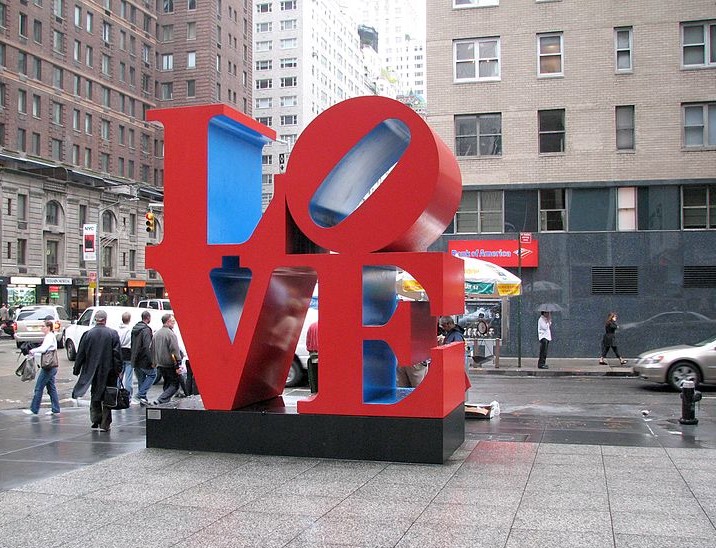
"Love."  Among four-letter words in the English language, it is one of the most spoken (and most sung).

A common word, even in a hard-edged city.
Sculpture by Robert Indiana,
 in Manhattan
Students of the New Testament are often taught that the Greek language has more than one word translatable as "love."  The Greek word eros is often used for sexual love but is more generally the experience of falling in love.  A second word, philia, expresses the fondness that can develop between people, as in friendships.  A third Greek word, agape, was less specific in the Hellenistic world, thus enabling New-Testament writers to sometimes use it in developing a concept of self-giving love.  Over time, Christianity used that word agape for emphasizing our ultimate experience -- that of knowing God's loving orientation toward the world.

The Greek language, however, also contains another world for love: storge.  It is used to speak of instinctual affection, one example being that of a mother for her child.  Christian writers today sometimes delineate the first three Greek words but make no mention of storge.  (An exception is C.S. Lewis, who in his book The Four Loves writes that "the human loves can be glorious images of Divine love.").  We should not underestimate the power of storge.

Although by using words, we can distinguish between this variety of meanings of the word "love," we can see especially in human relationships how the forms of love overlap:  Two people can love each other in more than one way.  Nevertheless, by possessing that fourth word -- storge -- we can explore better our relationships to non-human animals.

That fourth form of love, not usually mentioned by teachers of New-Testament Greek, is nevertheless implied at times in the Bible.  Being an instinctive response to the feelings of another living being, storge extends to our human affection for animals, which can evoke our care for them.  For example, in the Biblical book of Deuteronomy (25:4, NRSV), farmers are instructed, "You shall not muzzle an ox while it is treading out the grain," thus emphasizing that the ox gets hungry too.  And one verse in the book of Proverbs (12:10a, NRSV) states that people who live rightly "know the needs of their animals."

Much loved: children and pets
Victorian painting
by Joshua Reynolds
The treatment of animals down through European history is a long, complex story, not reducible to modern enlightenment overcoming medieval darkness.  Nevertheless, especially in England in the 1800’s, the movement of people into cities and the emergence of a middle class with some leisure hours meant that more people kept pets. That dog or cat, rather than being a working animal in the barn, would be kept right beside a person, even on the person’s lap, making it easier for the person to experience the animal’s emotions as being like their own.  In her Jubilee address in 1887, Queen Victoria (a dog owner) spoke of her "real pleasure [in] the growth of more human feelings towards the lower animals."  The contemporary writer Richard D. Ryder spotlights one major cause of that change:
"Was not the growing interest in animal protection also an effect of the increasing stability of society and the extension of affluence?  Never before had so many felt economically and
socially secure. They could afford to show some compassion for the underprivileged,
both human and nonhuman."

An additional advantage of having a word for animal-affection is that it can enable us to recognize that quality between animals of the same species -- not just among mammals, but also, for example, in parent birds' bonds with their offspring. Love is indeed a many-splendored thing!
~ ~ ~

As a child, did you have any pets that helped you learn how to care for others?


(The quotation by Lewis is from The Four Loves, © 1960, p. 9.)
(The quotation by Ryder is from his Animal Revolution, © 1989, p. 152.)
(Love is a Many-Splendored Thing was the title of a 1955 movie and song.
The phrase "many-splendored thing" dates back at least to a 1913 poem by James Kenneth Stephen.)

(Both photographs are in the public domain.)

Friday, March 2, 2018

The Up-Flight of Birds

English translation
of Le Petit Prince
"... for his escape he took advantage of
  the migration of a flock of wild birds."

With that imaginative explanation, Antoine de Saint-Exupéry tells how his title character in The Little Prince made his escape from the isolation of his own tiny planet to come to the planet Earth. That 1943 children's book weds that statement with Saint-Exupéry's charming drawing in which the little prince grips a cluster of strings that shoot up to eleven birds flying upward, lifting him off the ground -- in the way a cluster of helium-filled balloons might.  Even though the tiny planet and tethered birds are fanciful, the author's imagery takes advantage of something many people have seen in the real world:  The instant and virtually simultaneous flight up from the ground of a small flock of birds.

Birds in flight are not easy to capture convincingly with a camera.  Capturing a virtually simultaneous liftoff from the ground effectively is even harder.   If the shutter speed is too slow, the birds in the photograph will be only a blur, obscuring the gracefulness of their wings.  If the shutter is clicked prematurely, the birds will appear too close to the ground, seemingly leaden, as if they were having a hard time getting aloft.  The camera will not have captured that exhilarating burst of energy in which birds spray upward and outward.

So critical to many birds has been this ability to take to flight instantly as a group that it has been reinforced in some species with instinctive alarm cries.  In the case of white-winged doves, evolution has taken such group-protection to a higher level in two ways. First, white patches on the doves' wings flash when they take flight, thus adding a visual alarm.  Moreover, the white-winged doves need not cry vocally, because the doves' sudden flight upward causes their very wings to give off a sharp, twittering warning-sound made by the air passing through the feathers.

Some mornings on which I was driving to work, following my routine path that some days felt like a rut, I would occasionally see such a liftoff of social birds such as pigeons or grackles. Their sudden energy would give my own spirit a lift.

In a mysterious way, the up-flight of birds intersects with something that seems to be instinctive about our human nature.  Namely, that our own facial expressions and bodily bearings droop when we are discouraged, but then lift up when our spirits become encouraged.

There is something deeper here than individual human psychology. There is something here about being able to open ourselves to greater possibilities that lie unseen in this world.  This deeper level, for example, is evidenced by the way the facial and bodily bearings of "down" and "up" are employed in the Hebrew Bible (the Christian Old Testament).  When Cain is discouraged by the inequalities of human fortune, God intervenes as if to try to prevent vengeance, asking Cain, "Why are you angry, and why has your countenance fallen?" (Genesis 4:6, NRSV).  In many of the Biblical books, people are exhorted to lift up their heads.  And lift up their eyes.

~~~

Are there any ways birds lift your spirit?  How does looking up and about restore you?


(The Saint-Exupéry quote is from his The Little Prince, trans. from the French by Katherine Woods, © 1943.  p. 2.)
(The photo of the cover of The Little Prince is used under Fair Use.)
(The photo Pigeons is by Danko Durbić.)

Friday, January 5, 2018

Being and Becoming

Personally, I've never been hard-nosed about New Year's resolutions.  Although the first of the year does allow me an opportunity to reflect a bit more about my weaknesses and my abilities, I have always had a hard time carrying with me a fixed list of goals throughout an entire year. Even if I could write down a "to-become" list that would remain workable through the course of 12 months, I would probably forget where I put that piece of paper before the year was over.

Looking for new light as the year begins.
Part of the difficulty is that it is impossible to predict what circumstances will arise in the months ahead.  True, I can resolve to head into each day with a certain re-fortified spirit toward life, but I cannot always know what challenges I am going to have to respond to.  The late 20th-century poet Wendell Berry wrote about the contingencies of even a single day's outing that...
"The chances change and make a new way."

It can be scary thinking about this unpredictability of life. Fortunately, we have been at this process of becoming since the day we were born.  We have a lot of practice with it because becoming is built into our biological nature.  As the neurobiologist Steven Rose explains, "Every living creature is in constant flux, always at the same time both being and becoming.... [A] newborn infant has a suckling reflex; within a matter of months the developing infant begins to chew her food.... The paradox of development is that a baby has to be at the same time a competent suckler and to transform herself into a competent chewer.  To be, therefore, and to become...."

Faith-traditions place markers along the road of life to support us in our development:  Such as baptism, first Bible, and Bar Mitzvah.  Our faith-traditions also encourage us onward by reminding us that the ultimate Source of Life is also the very Ground of our Being that remains beneath us, supporting us even as we sometimes stumble.

Nurturing the new leaves.Interestingly, the idea that even God cannot predict exactly what will be and what will be demanded in our engagement with the Divine is expressed in a pivotal story in the Christian Old Testament (the Hebrew Bible). In Exodus 3:12-14, Moses, after being given a challenging long-term assignment by God, is promised by God, "I will be with you."  Nevertheless, Moses tries to gain more control over the situation by requesting to be told God's name.  Moses wants more control over the future than even God can promise.  And so, God provides to Moses the open-ended enigmatic reply, "I AM WHO I AM."  Translators sometimes add a footnote to this verse in order to express that God will be with Moses in both "being" and "becoming" -- just like that baby who both suckles and chews.  Such footnotes explain that what God has said could also be translated as "I WILL BE WHAT I WILL BE," or even "I WILL BECOME WHAT I WILL BECOME."

So too can our understanding of the Divine grow with us as we grow -- in both our being and our becoming.

~~~

Has your life ever taken an unpredicted path in a way that turned out to be fulfilling?


(The Berry line is from his poem "Traveling at Home," © 1988.)
(The Rose quote is from his chapter in Alas, Poor Darwined. by Hilary Rose and Steven Rose, © 2000. p. 310.)

Friday, November 10, 2017

Friendly Competition by Fahrenheit

The United States is positioned on latitudes that stretch from semitropical climates in the south to winter temperatures in the north that approach those of Russia.  That wide range within a single nation with one main language allows for some friendly competition during winters and summers. When winter extremes hit more northern states, those who live in balmier climates can tweet, email, or phone their northern friends, bragging about relatively comfortable environments.  Of course, the danger is that come next summer, those in the north will get their revenge by communicating long-distance about their refreshingly cool nighttime temperatures while those in the south are baking.  Another way to try to gain advantage in this friendly game is for me to turn my own weather extreme to my advantage by bragging about the hardship I am enduring!

Dealing with weather being nothing new.
 "Various Meteorological Phenomena" (1856)
Comparing weather notes in some fashion is nothing new.  The 18th-century British lexicographer Samuel Johnson observed:  "When two Englishmen meet, their first talk is of the weather."  Our modern means of communication, however, allow us to share simultaneous but dissimilar experiences of weather, all within our single nation.

Behind the extremes of winter and summer lies a larger truth about life on planet Earth.  Namely, that species on this planet have evolved so as to be able to usually live within such extremes.  Even more broadly, some scientists have put forward the "anthropic principle" as a way of pointing to a kind of "fine-tuning" of certain characteristics of the universe that match the conditions necessary for life.  Such as the forces that make possible certain chemical elements in the universe.  The extremes of weather and the extremes of what various species can tolerate are, however, one place we can observe directly a "fit" between life and its environments.

We humans, with our complex cultures, tool-making, and accumulation of knowledge have stretched our natural limits.  We have found ways to dress ourselves for extreme colds, and invented ways to artificially warm or cool our burrows.

We might ask though: Can we also extend ourselves spiritually to encompass the extremes that press in upon our lives?  The friendly game of contrasting temperatures sometimes needs to be set aside.  When the extremes of weather bring injury, or even death, we need to shift to another mode, remembering the religious leader Paul's reminder to "Rejoice with those who rejoice, weep with those who weep."

Now being able to get a picture of the whole.Thus, the extremes we endure can call us to rise above a concern centered just upon ourselves, recognizing that the element of unfortunate chance can strike any life.  Rising above a narrow self-concern can be something like rising above this planet's surface to see all of it as a whole. The Saudi Arabian astronaut Prince Sulatan Bin Salmon Al-Saud described his experience with fellow astronauts this way:
"The first day or so, we all pointed to our countries.
The third or fourth day,
 we were pointing to our continents.
By the fifth day, we were aware of only one Earth."

~~~

How do you deal with the shifting seasons psychologically or spiritually?


(The quote by Samuel Johnson [1709-1784] is taken from
 Bloomsbury Treasury of Quotations, ed. John Dainith, © 1994, p. 763.)
(The quote by Paul is from Christianity's New Testament, Romans 12:15 [NRSV].)
(The Prince Al-Saud quote is from Weather: How It Works and Why It Matters by Arthur Upgren, p. 42.)

Friday, October 27, 2017

Swimming with Hippos

Trying to convey the cuteness we see.
When I first heard about swimming with hippos, it evoked in my mind an animated-cartoon image of a child playfully floating in colorful, bubbly water.  The cartoonists would probably make the hippo bubble-shaped too -- chubby and cute, with tiny ears that would excitedly spin.  After my imagination got back down to Earth, I thought that it might not be that nice having potentially smelly hippos (maybe dirty too?) in the water in which people were swimming. But that was not how some people in Africa experienced it.  To them, having hippos in their swimming and bathing water was a true lifesaver.

I understood how that could be when I read about an experience described by C. Dean Freudenberger.  The people in Africa who swam and bathed in the river began to lose some hippos when the animals were shot by soldiers for food.  Without the usual hippo population feeding on marsh grasses and reeds, those plant populations exploded, trapping more silt, and thus slowing the water's flow a the edges of the river.  In that altered environment, snails flourished -- along with parasites called liver flukes, which need snails for part of their life cycles.  Sadly, humans are another part of the life cycle of liver flukes (Schistosomiasis). People began dying, ultimately due to the deaths of life-saving hippos in the water in which they bathed.

Like us, but so different.
I know this environmental story is one of many.  To me, though, there was an added poignancy as I pictured in my mind the relative sizes of the three creatures involved:  Microscopic fluke, human, and hippopotamus so huge it could be fangerous to people, but in this case was an ally against the tiny.

Reading Freudenberger's account made me remember seeing a mother hippo in a zoo with her baby, half-immersed in water.  I was struck by the massive solidity of their bodies.  Even the creature people were calling "the baby" seemed too large for the man-made pond.  And it seemed that a pond the size of Africa would be the right size for the mother.

Those solders in  Freudenberger's story were not the first people to have hunted hippos.  Most Biblical scholars think the Behemoth described in God's speech to Job in the Old Testament is a hippopotamus.  In that part of the narrative in the Hebrew Bible, God mentions the way hippos were hunted with harpoons.  God is not, however, interested in giving any hunting lesson. Instead, God seems to be trying to lift Job out of his self-centered perspective on himself.  God does so by describing such animals as the awe-inspiring hippo:
"Look at Behemoth, which I made just as I made you; it eats grass like an ox. 
 Its strength is in its loins, and its power in the muscles of its belly....
 It is the first of the great acts of God -- only its Maker can approach it with the sword.
 For the mountains yield food for it where all the wild animals play.
 Under the lotus plants it lies, in the covert of the reeds and in the marsh.
 The lotus trees cover it for shade; the willows of the wadi surround it.
 Even if the river is turbulent, it is not frightened"

~~~

Is there a particular animal you find awe-inspiring or humbling? Which one?


(Freudenberger's account about the hippos is related by
Calvin B. DeWitt in DeWitt's Song of a Scientist, © 2012.  p. 224,.)
(The Bible passage quoted is Job 40:15-16, 19-23a [NRSV] © 1989.)

Friday, July 7, 2017

Moving and Memories

Have you ever woken out of a dream in which you had been in a place where you previously lived?  Such dreams are not uncommon.  They were also the framework drawn upon by Marcel Proust to begin his masterwork novel Remembrance of Things Past.  The author tells of how, sometimes dozing in and out of sleep, he would awake disoriented, not sure at first where he was.  He easily imagined for a moment that he was in a childhood or other earlier bedroom. As Proust wrote, "When a man is asleep, he has in a circle round him the chain of the hours, the sequence of the years."

Such dreams fascinate me because they express so well how making sense of new experiences and challenges involves placing them within the context of something we already know.  New situations, particularly demanding ones, can be disorienting, just as Proust was momentarily disoriented.  Drawing upon abilities we already possess can help us orient ourselves in less familiar situations -- just as the dream of a familiar room and walls reveals our subconscious's drawing upon something deeply rooted within us.

Thinking back upon our lives, if we have lived in more then one location, we can recall times of transition that entailed moving.  Some moves can be exhilarating; others can be frightening. Leaving for college can be an exciting, hopeful time despite its uncertainties.  Being forced to move because of divorce is inevitably stressful, the atmosphere of a failed marriage suffocating for the time any joy that once was.

A mass move.
Reflecting upon this matter of moving leads me to thoughts of those non-human animals that must make frequent moves.  Twice a year, thousands of wildebeests make a mass migration covering many miles of East Africa.  Annual migrations by bird species, usually north and south, are an integral part of their lives.  Historians have sometimes employed the world "migration" to describe the movement of groups of people as they relocated, but those human "migrations" are in most cases once-in-a-lifetime, in contrast with the demand that instinct places upon such animal species every single year.  Nevertheless, in that instinct lies salvation, protecting the species against too severe weather, and offering the hope of food ahead.

I wonder if animals who migrate have dreams of previous homes.  I do know that researchers in laboratories have been able to detect through brain waves that rats dream about a new task they were challenged with the day before.  Birds are not as biologically close to us as such mammals, but might they also be dreaming of flying when their wings flutter while asleep?

Life, so fragile, yet so powerful.Ecologists speak of "niches" in which species have evolved, finding their place in a life-giving way.  Human beings, try to find their place spiritually in relation to a Higher Truth or Power. Thousands of years ago, one ancient Hebrew, going to the temple for spiritual reorientation, looked up and was encouraged to see that the temple had also provided niches in its walls for nesting birds:
"How lovely is your dwelling place, O LORD....
Even the sparrow finds a home, and the swallow a nest for herself,
 where she may lay her young."


~~~

Have you ever made a move that entailed not just relocation but also growth?


(The Proust quote is from the opening chapter, "Overture," of the first book, Swann's Way,
 in Marcel Proust's 1913-1927 opus, trans by C. K. Scott Moncrieff, © 1928.)
(The quotation about the temple niches is from the Hebrew Bible [Christian New Testament], Psalm 84:1, 3 [NRSV])
(Photo of wildebeests, by Bjørn Christian Tørrissen, used under a Creative Commons Attribution-Share Alike 3.0 license.)

Friday, March 17, 2017

Getting “the Combo”

You can hardly order an entree at a fast-food restaurant without being asked if you wouldn't prefer "the combo."  Especially in Western faith-traditions, which possess central books of scripture, there once was another type of "combo" that was both appealing and enduring: Namely, the Book of Scripture and the Book of Nature. They were viewed as being complementary sources for inspiration and guidance.  As just one example, Christopher Bamford writes regarding Celtic Christianity:  "Though ascetic... the Irish monks were hostile to neither learning nor nature and practiced greatly the contemplation of both of these."

Celtic Christianity, with deep roots in Nature.
Eglwys Pabo
Sant Llanbabo church
In one Celtic poem, we can readily hear the poet's love of natural sounds, with that loving perception creating its own kind of scripture:
"Over my head the woodland wall
Rises; the ousel sings to me;
Above my booklet lined for words
The woodland birds shake out their glee....
God keep me still!  for here I write
A scripture bright in great woods now."

Sometimes, Nature could be so appealing a "book" that it competed for attention with a book of psalms or other devotional book.  One poem by a monk describes how the sound of a bird calls the monk out of his room (customarily called his "cell"), thus making it impossible to continue reading his printed book indoors:

"Learned in music sings the lark,
I leave my cell to listen;
His open beak spills music, hark!
Where Heaven's bright cloudlets glisten.
And so I'll sing my morning psalm
That God bright Heaven may give me."

I myself think that all classrooms should have windows to make the experience of learning more refreshing.  Sometimes, however, even the view through the window can be a distraction.  I remember one congenial professor of religion being asked by a pupil at the beginning of class if we might move outside under the trees in the warm spring weather.  Although sympathetic, the professor replied (probably wisely) that if we did so, he would not be able to keep our attentions on the day's lesson.  We had to settle for the window.

Nourishment of another kind.I know full well how Nature, when it is congenial, can overpower the attraction of a book -- even for a book-lover such as myself. Sometimes in college, when the weather was lightly warm, I would find an isolated spot on a grassy slope behind one of the buildings. Lying on the grass, reading some assigned book, before long I would find myself falling asleep, overtaken by the peacefulness of my surroundings.  Perhaps the "combo" of Nature and a book is just too much to devour both simultaneously.  Perhaps we do better taking each one in turn, alternating between them, being nourished as our hearts and minds metabolize the ingredients of both.

~~~

Have you ever taken a book on a trip to the beach, a park, the woods, or mountains?


(All quotations are from Celtic Christianity:  Ecology and Holiness
by William Parker Marsh and Christopher Bamford, © 1982. [spelling Americanized]  p. 21, p. 22.)
(Photo of church by Alan Fryer used under a Creative Commons Attribution-Share Alike 2.0 Generic license.)

Friday, March 3, 2017

Healing and Being a Whole

Feeling the life within ourselves.
I hate being sick.  One of the best feelings in life is that of getting beyond an illness -- feeling again that solidity of life within oneself, even when not yet fully back to original strength.

Most people hate being sick.  Offhand, the only instances I think of in which illness is preferred are when a person is unconsciously trying to heal a larger psychological pain. Such as a child wanting to stay sick at home out of a fear of school.  Or an invalid wanting the psychological support of a family member.  Most people prefer physical wellness.  Therein lies a wonderful mystery of how organisms have evolved so as to make whole what is broken apart.

One of the most fascinating lessons biology students learn is how the bodies of organisms fight off injury microscopically -- similar to how a colony of individuals might fight off an invading army. One example is the way blood platelets barricade a break in the blood vessel's wall with their bodies and fibers, while white blood cells race to the site of invasive infection, attacking the alien bacteria. Microscopes reveal such cellular processes to be fascinatingly similar to how social insects respond to an invader's damaging the structure of their home. The two processes are so eerily alike that it can lead one to wonder where the line between an organism and a colony should be drawn.  The science-writer Lewis Thomas puts it eloquently:

[B]ees and termites and social wasps... seem to live two kinds of lives:  they are individuals, going about the day's business without much evidence of thought for tomorrow,
and they are at the same time component parts, cellular elements, in the huge, writhing,
ruminating organism of the Hill, the nest, the hive."

The commonality between healing and rebuilding a whole is also revealed in the origins of certain English words.  The word "whole" is derived from the Middle English hole, meaning "unharmed."  The words "whole" and "heal" both trace back to the "kailo" constellation of Germanic/Old English roots.  These word-origins show how even before microscopes, people could feel within themselves how getting well again was like being made whole.

Despite healing, we humans are mortals, something we also share with other living beings on this planet.  Even as our faith-traditions elevate us toward higher values, they remind us of our commonality with other mortal forms of life.  For example, the Buddhist Jataka stories tell animal-related tales with reminders about compassion for animals, remembering their continuity with the Buddha and humans.  In the Christian Bible (most of which is shared with Judaism), the word "mortals" is used 88 times to emphasize how both humans and animals are mortal beings (a notable contrast to the merely 4 times humans are described as being made "in the image of God").

Feeling not cut off.
We are mortals, and so sometimes no cure for an illness can be found. Even without a cure, however, there can still be a kind of healing in the sense of feeling not cut off -- feeling a part of a larger, beloved, sacred whole. Therein lies another word in that root constellation "kalio":  The Old English halig means "holy."

~~~

Have you found a way to be more whole by being a part of a larger whole?  How?


(The Thomas quote is from his essay "On Societies as Organisms"
 in The Lives of a Cell by Lewis Thomas, © 1974.  p. 12.)

Friday, March 4, 2016

Hope in a Hole in the Ground

It would seem to be a sad thing to have to bury one's hopes in a hole in the ground.  It would seem to be the final recourse when a person had to abandon a long-held hope, trying to put it out of sight.  Even Jesus tells his disciples not to behave like the servant who "went off and dug a hole in the ground and hid his master's money" (Matt. 25:18, NRSV).  Nevertheless, a hope of a kind is put in the ground and covered over trillions of time around this planet every year. That hope is encapsulated in a seed.

If ever there were a question about whether the earth were good, it would seem to be answered by that act.  As the early 20th-century poet Rainer Maria Rilke poignantly put it:
"In spite of all the farmer's work and worry,
he can't reach down to where the seed is slowly
transmuted into summer.  The earth bestows."

This connection between hope and the ground came to me when I encountered again a one-line quotation by someone much less known than Rilke. The quotation was by Lucy Larcom. Although few people know about her, a fair number of people may have encountered a statement of hers that is used by organizations such as the Arbor Day Foundation.  Larcom succinctly wrote:  "He who plants a tree / Plants a hope."  Of course, in this case, the "hope" is not completely buried, seedlings or young trees being the ways trees are usually planted.  Nevertheless, what dependence upon the earth and upon a tenuous life other than our own is embodied in that act of planting!  A number of U.S. cities are now more aware of how precarious the life of trees can be, because droughts over the past years have killed so many trees, both young and old.  And how even more dependent peoples' hopes must be in countries where water cannot be obtained through a garden hose or a transporting truck.

To be fair to Jesus, I should point out that when he guides his disciples not to put their "talents" in "a hole in the ground," he is using an agricultural metaphor to provoke insights about human behavior (as is often the case).   He is encouraging his followers not to remain holed up in their own houses, but instead to put their "talents" -- both money and abilities -- into circulation. His words could be paraphrased as, "Don't isolate. Interrelate!"

As I return my thoughts to those seeds being placed in the ground and covered over with soil, I now realize that the instructions we are giving them without words are very much the same.  We are in effect saying:  "Don't stay isolated in that sterile paper envelope where you've been. Instead, return to that world your family came from.  Get back in touch with the earth with all its nutrients and microbes.  Interrelate with the life-forms that are in the soil.  And soak up the rain that filters down, letting your life interrelate with the clouds and sun above.  Grow."

And upon that instructed seed, we humans place our sometimes frail hope.  It is a hope that has not been entirely disappointed billions and billions of times.

~~~

Have you ever gardened?  Have you ever thought about the wonder in those seeds?


(Rilke quote from "The Sonnets to Orpheus," XII, trans. Stephen Mitchell, in Ahead of all Parting, © 1995. p. 433)
(The quote by Lucy Larcom [1824-1893] is from "Plant a Tree,"
as quoted in A Dictionary of Environmental Quotations, ed. Barbara K. Rodes, © 1992.  130:8.)
(Both photos by Roger Culos, used under Creative Commons Attribution-Share Alike 3.0 Unported licenses.)