Showing posts with label spirituality. Show all posts

Tuesday, November 29, 2022

What is Most Valuable?

"Thanksgiving."  It's a single word designating in the U.S. a single-day holiday in November.  But that word "Thanksgiving" can be broken apart into two words that point forward to another U.S. holiday roughly a month later:  "Thanks" is the theme of Thanksgiving Day, and "Giving" is the theme of the gift-giving day of Christmas.

How to decorate for Christmas?
Those two words might lead us to meditate upon intangible spiritual values, but unfortunately, in that one-month period between the two holidays, we are deluged with mail-order catalogs, advertisements, store displays, and news stories that emphasize spending money.  The news media judge the very day after Thanksgiving ("Black Friday") as being a success if enough money is spent, and they call the weeks before Christmas not "Advent" but "the holiday shopping season."  The innovation of Giving Tuesday puts only a slight dent in the steamroller of consumerism heading toward Xmas.

Inflation, especially when it is rapid, understandably makes people more conscious of prices.  But over a century ago, the perceptive Oscar Wilde cautioned people that knowing "the price of everything and the value of nothing" is a cynical way to live.  Several decades ago, a handful of renegade economists tried to remind people that how the news media report economic statistics can be misleading.  Take for example how the GNP (Gross National Product) is usually treated as an indicator of progress if it is growing.  However, that indicator even goes up when a people are in car accidents, because hospital supplies and car parts are produced.  In contrast, the GNP indicator is untouched when a person uses knitting material they already had stored to create a lovely gift for a family member or friend.  Those are examples of why Donella Meadows writes:

The GNP is obviously not a measure of progress....
It is indiscriminate.  It lumps together joys and sorrows, triumphs and disasters,
 profundities and trivializes, everything that costs money and nothing that doesn't.

Perhaps during the one-month period between Thanksgiving and Christmas, besides making a shopping list, we might pause to create a mental list of intangibles we are able to give.  One starting place might be to think back upon what things other than purchased products we have been blessed with having been able to give to others.  I would put on my list my having been able to be a teacher about topics related to religion, spirituality, Nature, and science.  (For a decade, this website has served as one avenue for that teaching.)

Where is something larger than ourselves?
The reverse side of giving is getting.  During the month near Christmas -- and the other winter festivities of Hannukah and Kwanzaa -- we might also reflect upon the intangibles we receive.  Of course, we are grateful for the love that binds our lives with others.  But are there things we have received that are more specific to our individual identities?  Here again (perhaps because I am now in my 70's) I look to the past.  And I think that one of the greatest gifts my parents and teachers gave me were those values that gave me a habit of looking beneath the surface of things -- an eye for the intangibles, the immeasurables, that are crucial to spirituality.  Those intangibles are there, whether or not we notice them.

In addition to such reflections upon our lives during the weeks near Christmas Day, might we perhaps shift our reading to include something different than our usual routine?  Something that would be enhancing?  And during those weeks, might we turn our attention to the changing aspects of Nature as the year moves into winter?

~ ~ ~ 

Is there something you are reading during the weeks near Christmas that you would like to tell others about?  Have you noticed something in Nature during this period that has invigorated you?


(The quotation by Oscar Wilde is from his 1892 Lady Windermere's Fan,
 as cited in Familiar Quotations, 16th edition, edited by John Bartlett, p. 566 #23.)
(The quotation by Donella H. Meadows is from her book The Global Citizen, © 1991, p. 232.)

Friday, July 1, 2022

Yesterday, Today, and Tomorrow

Even though I love many aspects of Nature, I confess that I am not a very good gardener.  That is why the plants in my yard that have endured over the years are those than can survive with little care (except perhaps for a brief soaker-hose during extreme drought).  One plant that has just managed to endure through tough times is a plant with an unusual common name -- the "yesterday-today-tomorrow plant."  It is so named because each flower is a deep blueish purple when first appearing but changes to a light shade the next day. On the third day, the flower has turned white.  And so, when flowers come frequently enough, they display a range of three colors.

He also lived in changing times.
The scientific name for the yesterday-today-tomorrow plant is Brunfelsia, so named for Otto Brunfels, who lived in Germany during the first half of the 1500's.  Those were tumultuous times because in 1517 Martin Luther posted his famous theses on a Roman Catholic church, thus beginning the Protestant Reformation.  Otto Brunfels' life exemplifies those changes:  He had trained in a Catholic monastery but later became a pastor of a Protestant church.  One thing endured through those decades:  Brunfels' interest in herbs, which were one source of medicines.  Although the three-volume work on herbs he wrote included sometimes questionable folklore, it also displayed woodblock illustrations, which was a fairly new innovation for printed books.  As the contemporary commentator John Lienhard states about Brunfels' compendium, "The images long outlived the words."

I know that biologists have to name species with Latin names. Nevertheless, I do enjoy how the common name for that Brunfelsia plant expresses one aspect of how humans experience time.  We remember yesterday.  We are aware of today. And we think ahead to tomorrow.  How should we handle our awareness of those three periods of time?

I think it is a reasonable assumption that anybody who has lived any length of time is bound to have some regrets about the past (even if they don't like to admit it). However, as  the 5th-century B.C.E poet Agathon wisely reminds us, “Even God cannot change the past.”

What about tomorrow?  Our modern, Westernized technologized societies change so rapidly that it makes life harder than it otherwise might be.  Our uncertainties about tomorrow can make it easy to worry about what challenges will come next.  Yet Jesus encouraged his followers by saying "Do not worry about tomorrow... Today's trouble is enough for today." [Matt. 6:34, NRSV]  (Is a bit of wry humor perhaps being displayed in his second sentence?)

What about today?  Many spiritual advisers (ranging from yoga teachers to authors of self-help books) tell us to "be present" to what is happening right now.  Or they phrase it that we should "live in the present."  I do need to cultivate awareness.  Nevertheless, I also need to draw upon my memories of the past, sometimes being sustained by them.  And I need to think about future days and plan for them.  I cannot very well be isolated in the present.

Maybe I can learn something from that yesterday-today-tomorrow plant.  Despite its name's dividing time into three parts, it is the same flower that endured and evolved through the string of three days.  There was actually a continuity through the course of time.

~ ~ ~

As you reflect upon your life, are there some continuities you would like to sustain?

Inspiration for today, and for tomorrow.

(The quotation by John H. Lienhard is from his Engines of Our Ingenuity website, episode No. 2241, "Otto Brunfels.")
(The quotation by Agathon is taken from Bloomsbury Treasury of Quotations, edited by John Daintith, © 1994, p. 523.)
(The photo of flowers is by gailhampshire from Cradley, Malvern, U.K.
 and is used under a  Creative Commons Attribution 2.0 Generic license..)

Friday, September 3, 2021

More than Just an Art Critic

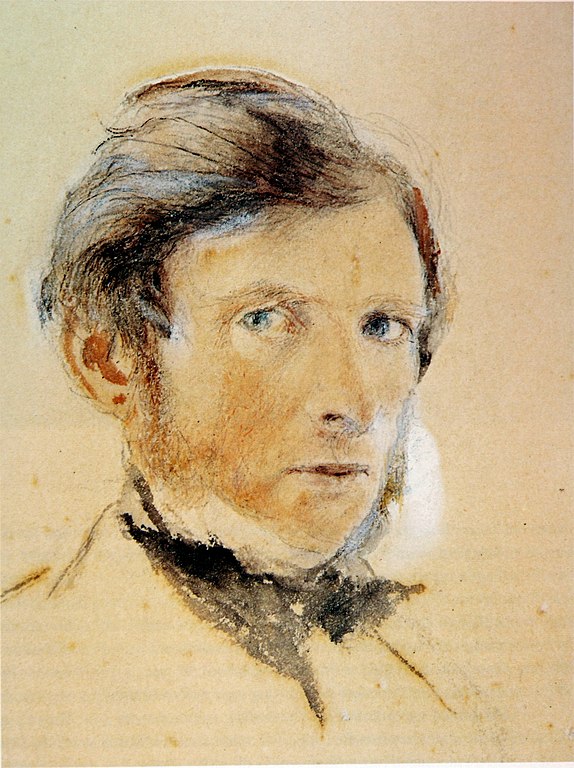
John Ruskin. He is usually identified as being an "art critic," such as in this typical entry from a dictionary:  "Ruskin, John. 1819-1900. British writer and art critic who considered a great painting to be one that conveys great ideas to the viewer.  His works include Modern Painters (1843-1860)."

John Ruskin,
self-portrait, 1861
But Ruskin thought about much more than art.  He even reflected deeply upon intellectual issues related to religion during the 19th century, during which he lived. It was a rapidly-changing, confusing time to many people in England.

The emergence of historically-oriented academic fields such as geology and paleontology had raised questions about the Bible's truth, which was being approached with a new, historical mindset (rather than symbolically or spiritually, as had been traditional).  Those sciences were revealing the Earth's age to be vastly older than traditionally imagined.  Ruskin confessed to a friend:

"If only the Geologists would let me alone, I could do very well, but those dreadful Hammers! I hear the clink of them
                                                 at the end of every cadence of the Bible verses."

For the first couple centuries after the rise of modern science in the 1600's, it had been hoped that scientific discoveries about the natural world would add new, overwhelming evidence to how Nature had been designed by a good, benevolent Creator.  But Ruskin was aware of the drawbacks in that approach because of the ambiguity of Nature.  Calling upon readers to view the natural world with a keen eye (the way they might examine a painting), he first lays out an idyllic scene:

"It is a little valley of soft turf, enclosed in its narrow oval by jutting rocks and broad flakes of nodding fern.... The autumn sun, low but clear, shines on the scarlet ash-berries and on the golden birch-leaves, which, fallen here and there, when the breeze has not caught them,
 rest quiet in the crannies of the purple rock."

But then, his camera-like eye pans slightly to the right:

"Beside the rock, in the hollow under the thicket, the carcase [carcass] of a ewe, drowned in the last flood, lies nearly bare to the bone, its white ribs protruding through
 the skin, raven-torn."

Ruskin (writing even before the after-effects of Darwin's Origin of Species) forces us to see the disturbing ambiguity of Nature: That which was death to the ewe is life to the ravens.

Nature as turbulent.
Despite Nature's not being able to be a straightforward moral guide to us, Ruskin does not think we should lose the compassionate capabilities of the human heart -- as demonstrated by the sympathetic manner in which he describes the next things his observant eye falls upon:

"I see a man fishing, with a boy and a dog -- a picturesque and pretty group enough certainly, if they had not been there all day starving. I know them, and I know the dog's ribs also, which are nearly as bare as the dead ewe's."                                                                 

These passages show how Ruskin viewed the face of Nature as being illuminative and yet turbulent.  Those qualities of Nature are also expressed in the paintings of J.M.W. Turner, which Ruskin greatly admired.

Nature as illuminative.

~ ~ ~ 

(Is there a way you view the presence of disturbing features in Nature and yet still derive inspiration from it?)


(The dictionary entry is from The American Heritage Dictionary, 3rd edition, © 1992.)
(Ruskin's statement about Bible verses was made in his letter of May 24, 1851 to Henry Acland.)
(Ruskin's descriptions of scenes in the natural world are from the 1860 edition of his Modern Painters, )

Friday, August 6, 2021

Being Inspired Even at a Distance

The Covid pandemic that began in 2020 put a kink in many people's usual plans for summer vacations, even in 2021, when vaccines were available for most adults in the U.S.  Life had changed, turning many in-person gatherings into virtual gatherings.  Adults had to depend more upon their memories of firsthand experiences they once had. And children needed to rely more on second-hand knowledge and their imaginations.  As I reflected on that situation, the following Wisdom in Leaves article, published four years previously, seemed particularly relevant.  It was titled "Hearing the Sea in a Shell."

~ ~ ~

A world of soft sand, sight, and sound.

It is an experience every child should have for the first time:  Holding a large shell to one's ear and hearing the sound of "the sea" supposedly still in the shell. How many parents or grandparents have initiated their child or grandchild to seashore wonders by instructing the child to "hear the ocean" in that way?  How many children have smiled upon first hearing the sound a large seashell makes, imagining for a moment they really heard the sea?  I recognize that an acoustical scientist could give a good, detailed explanation for the perhaps puzzling effect.  But I am more interested in how that experience can be an opening to how we and all things are part of a larger whole.  That is the very matter the poet William Wordsworth explored in his long poem The Excursion.

Even though the sea-in-seashell symbol could be a good literary opening, it appears in the middle of Wordsworth's poem when, in his memory, he sees himself as a boy:

"A curious child, who dwelt upon a tract
Of inland ground, applying to his ear
The convolutions of a smooth-lipped shell;
To which, in silence hushed, his very soul
Listened intensely; and his countenance soon
Brightened with joy; for from within were heard
Murmurings, whereby the monitor [the shell] expressed
Mysterious union with its native sea."

In the very next line, Wordsworth opens up the metaphor of how -- if we orient ourselves properly -- we can "hear" in the natural world intimations ("Murmurings") of a larger, deeper reality:  "Even such a shell the universe itself / Is to the ear of Faith...."  Moreover, Wordsworth later addresses his words to a larger divine Spirit that includes all of our own spirits, just "as the sea her waves."

The magic of children innocently believing (at least for a moment) they are hearing the sea in a shell derives from a child's wonderful delight in first discovering the world.  And so, a stanza early in the poem began with the statement "Such was the Boy."

Life-giving memories.

oil portrait of
William Wordsworth
by Benjamin Haydon

Even though we adults cannot actually return to our childhoods, Wordsworth expresses how, even in old age, our memory can restore to us some of our original exaltation. That ability of memory to recreate something not physically present is similar to the seashell's ability to recreate the physical ocean, which is not physically present:

"If the dear faculty of sight should fail,
Still, it may be allowed me to remember
What visionary powers of eye and soul
In youth were mine; when, stationed on the top
Of some huge hill -- expectant, I beheld
The sun rise up, from distant climes returned....
... my spirit was entranced
With joy exalted to beatitude...."

~~~


Are there ways you restore contact and communion with those who are not physically present?


(The two large excerpts are from Book IV, "Despondency Corrected" of The Excursion [1814]
That full section of the book-like poem can be read at this external link:  The Excursion, Book IV.)

Friday, April 2, 2021

Being Strengthened by Spring

The COVID pandemic beginning in 2020 brought so many types of losses. Losses of such things as:  Family members, friends, and acquaintances.  The ability to move about among people in public with ease and safety.  Gathering in indoor worship spaces to be inspired by beautiful music and words.  The relaxing conviviality of dining in restaurants while chatting with friends.

We can gain strength by naming those losses.  We can also be strengthened by turning our attention to the continuity of the cycles of Nature.  Such as spring's flowers -- which were the focus of the following article, first published in 2015.

~ ~ ~ 


A gift from Nature
The painter Georgia O'Keeffe once said, "A flower is relatively small."  And yet she depicted them as being enormous!  Her easily identifiable paintings of flowers, which were one of her favorite subjects later in her career, often depict a single, huge, brightly-colored flower spilling over the edges of the canvas.  One of O'Keeffe's flowers can cover a hundred times its square-area in real life.  A biologist could easily appreciate that out-of-scale depiction, although for biological rather than aesthetic reasons.  After all the flower was a revolution in the evolution of life on planet Earth.

Green plants with photosynthesizing chlorophyll did exist on our planet before there were flowers.  However, it could take those conifers over a year to produce seeds snugly nested in cones.  One revolution flowers brought (when they evolved 100 million years ago) was the ability to release a seed in only a month.  That was an explosion in reproductive capability. That flower-explosion also brought about a revolution in the prehistoric world of animals.  As flowers evolved into different shapes, the insect world evolved simultaneously, new insects being adapted to take advantage of new food-source shapes.  In turn, bird and mammal species found new food in the flowers, seeds, and insects, thus putting competitive pressure on the older species of dinosaurs.

“Beauty too rich for use”Today, understandably, few people are thinking about such significant events in the history of planet Earth when they purchase or pick a flower.  Flowers can be an earnest business for commercial flower-growers and florists.  But it is a flower's enjoyable color, fragrance, and shape that capture an average person's attention.

True, flowers do sometimes become a part of solemn ceremonies.  A wreath of flowers can soften the hard edge of a coffin, thus soothing the hearts of the bereaved.  Despite the flower's fragility, symbolizing the transitoriness of life, its reproductive associations bring a hint of life into the acceptance of death.

More frequently, however, flowers shout out "life!"  The humorist Mark Twain made the earnest observation that "Whatever a man's age, he can reduce it several years by putting a bright-colored flower in his buttonhole."  Over a century later, men wear boutonnieres much less often. But the symbolic tie between flowers and restored life endures.  All the way down to anti-war demonstrators inserting flowers into phalanxed soldiers' rifle barrels.

With their colorful intensity and their message of new life, specific flowers have gained a role as a prominent symbol in many of the world's faith-traditions:  The lily of Easter resurrection in Christianity. The lotus of life-giving tranquility in Buddhism. And the light-giving Golden Flower in Taoism.

For the billions of bees and other insects who search for food each day, flowers are a serious business.  But for most people, flowers are just plain fun!

Life can open up at spring.
~~~
Where do you encounter flowers?  Do you have any favorites?  What do they express?

Friday, December 4, 2020

A Little Light — But What a Light!

 It seems like such a little act:  lighting a candle.  But I have discovered in that act much to meditate upon.


An ungrand beauty.As the year heads into its last few months, more tiny flames are lit around the world as particular religious festivals arrive:  Diwali, Hanukah, Christmas, even the newcomer Kwanza.  All these celebrations light candles in some form as part of their ceremonies.  Sometimes the wicks being lit are at the tip of hard candles; sometimes in a tiny cup of liquid.  But the visual effect is the same.  And it is beautiful.

In the northern hemisphere, the lighting of candles on those holidays late in the year carries an added spiritual meaning through the warmth the candles bring in cold weather.  But even when those religious holidays are practiced in the southern hemisphere, with days getting longer, candle lights can bring a soft yellow glow to what was darkness.  Although I am not a Roman Catholic, I have (as long as I can remember) found pleasing any pictures of Catholics lighting candles in a sometimes dim sanctuary, often accompanied by private prayers.

Before electricity came to our modern world, candles were used where today we use tiny light bulbs.  I feel nervous when I see pictures of some Europeans lighting candles on the branches of evergreen Christmas trees.  And I know the firefighters at my local fire-department can sleep easier knowing that electric lights decorate our trees in the U.S.  But we still desire to light candles in other ways during these festive months.

Before our petroleum age, the material for candles was wax from bees or tallow from sheep or cattle.  We might do well to recognize the flame as also being a gift from Nature.

A power with a string attached.
Scientists who work in the area of evolutionary psychology try to project their thoughts back upon the path of human evolution.  Certainly a significant step in that story would have been being able to start a fire.  The European cultural heritage expresses how momentous that discovery was with its mythological story of Prometheus, who steals fire from the gods.  In the playwright Aeschylus's adaptation Prometheus Bound, Prometheus is also viewed as being the bringer of civilization.  But the god Zeus knew all too well how dangerous humans could be without bounds.  And so, Prometheus is bound to a rocky mountain as punishment.

That danger of possessing fire is why my reflections upon candle-lighting have led me to see it as an example of behaving in a restrained, respectful manner.  In humankind's use of candles, we have found a way to handle fire in a controlled way. If in mythology fire brings civilization, can lighting a candle be a civilizing act today?  In our religious and spiritual lighting of candles, can we—instead of fanning the flames of anger in ourselves and others—turn our hearts toward worship?

The commonality across faith-traditions of lighting candles (whether in sticks or cups of liquid) might enable us to share in the emotions of Howard Thurman, even if our faith-tradition is non-Christian, or if we have none.  He writes in part:
"I Will Light Candles This Christmas.
Candles of joy despite all sadness,
Candles of hope where despair keeps watch,
Candles of courage for fears ever present,
Candles of peace for tempest-tossed days,
Candles of grace to ease heavy burdens."

~ ~ ~

Do you light candles on particular occasions?  When?  What feelings does it bring?


(The lines from "Candles for Christmas" by Howard Thurman are from Meditations of the Heart, © 1953, used under Fair Use.)
(The painting of Prometheus by Jan Cossiers is in the Public Domain.)

Friday, October 2, 2020

Supporting Life through Letters

 Describing an often overlooked characteristic of 19th-century biologists, Joseph Kastner writes:  "Naturalists who never laid eyes on each other became intimate friends by virtue of the long and faithful letters they wrote to each other, year in and year out...."  Early British biologists' use of correspondence for research accelerated after the 1840 creation of the Penny Post within England, which set a fixed rate for a letter regardless of the distance it had to travel.  No biologist took greater advantage of the postal service for gathering scientific data than Charles Darwin, who penned over 14,000 letters.  But there is more than science in those early biologists' letters. There are also matters of the heart.


Being helped also by the beauty of Nature.
from Hooker's
Himalayan Journals
Appreciating the poignancy of some letters requires knowing about the state of 19th-century medicine.  Because there were virtually no vaccinations nor oral or injected antibiotics, a child was twenty-five times more likely to die before reaching early adolescence than is a child in Britain today.  Despite 19th-century biologists' accelerating knowledge about the natural world, they were not exempt from that statistic.

After the death of Darwin's beloved daughter Annie at the age of ten, the botanist Joseph Hooker, who helped Darwin study plant species, offered his condolences to Darwin.  Several years later, only an hour after Hooker's daughter died, Hooker was writing to Darwin to tell of his own grief.  Darwin wrote back at once.

Guided by books, and by friendship.
Thomas Henry Huxley
   
The leading British advocate for Darwin's theory of evolution for natural selection, Thomas Henry Huxley, also lost a child.  After Huxley's son Noel died at the age of three, Darwin drew upon his own experience of grief with Annie to reassure Huxley that grief could soften with time, writing, "I was indeed grieved to receive your news this morning....  I know well how intolerable is the bitterness of such grief.  Yet believe me, that time, and time alone, acts wonderfully....  I cannot think of one child without tears rising in my eyes; but the grief is become tenderer and I can even call up the smile of our lost darling...."

Inspired by those who have gone before us.
statue of
Jean Henri Fabre
Such personal expressions of grief and condolence, sometimes traveling in envelopes as part of scientific study, also crossed the English Channel.  The most difficult of emotions were sometimes even revealed in the pages of scientific books.  The eminent French entomologist Jean Henri Fabre closed his first volume on insects with a dedication to the memory of his own son, who had died when Fabre was working on the book. Charles Darwin, despite scientific disagreements,  wrote a cordial letter to Fabre, saying,  "Permit me to add, that when I read the last sentence in your book, I sympathised deeply with you."

I was moved even more by the tenderness and cordiality of these letters when I re-read them during the COVID pandemic.  With our own world's death-count increasing, it had become easy to be numbed by the numbers, so familiar had they become.  Even though we have electronic means of communication these 19th-century letter-writers did not have, these biologists' letters, with their warmth, transcended their limited technology.

~ ~ ~

Can you think of any way our communicating with others might become more spiritually supportive?


(The Kastner quote is from A Species of Eternity by Joseph Kastner, © 1977,
and is taken from The Naturalist's Path by Cathy Johnson, © 1991.  p. ix.)
(The Darwin quotes are taken from Annie's Box by Randal Keynes, © 2001.  pp. 221 & 285.)

Friday, September 4, 2020

Stepping In... to Step Deeper into the World

 I have met more than one person who very much likes StoryCorps stories, a brief weekly spot on Public Radio's Friday news programs.  The StoryCorps project traveled around the U.S. for years, recording ordinary Americans as they told about pivotal events in their life journeys. Many of what is shared is poignant.  When I take pen to paper to write my own thoughts about a wider world and reading, there is one particular StoryCorps spot that comes to mind.  As I imagine the experience in my mind, it also has to do with Nature.


Bringing richness to an arid land.
A woman explained to StoryCorps how a bookmobile became a life-changing experience for her.  As a little girl, she lived with her family in Native American migrant-worker camp.  Traveling so frequently, the girl was not allowed to have books, because they would have been too heavy to move.  But then one day, when the girl was 12, a traveling library (a bookmobile) stopped on its periodic rounds where the family was currently living.  And the girl was invited to step in.

As the now grown woman explained her childhood experience, when first told she could take home a book from the mobile, she wondered what was the catch.  Being told there was none other than returning the book in two weeks, she began to devour books.  And her having stepped (at first hesitantly) into the bookmobile made it possible for her to step into a whole new world. Or perhaps I should say "worlds," because the girl's selections ranged from volcanoes to dinosaurs.

Yearning for a larger world.
"The Journey" (1903)
by
Elizabeth Shippen Green
The child's stepping into that vehicle filled with books reminded me how each book can become for us a vehicle by which we step into the mind, and maybe the emotions of the author of that book. By so doing, we expand our world, even bringing hope to some corner of our lives where it previously could not be seen.  As the woman explained to StoryCorps, because of those books, "By the time I was 15, I knew there was a world outside of the camps.... I believed I could find a place in it.  And I did."

I am humbled by this story.  Although the family I grew up in was decidedly middle-class, we had a couple of filled bookcases in our house; and my mother periodically purchased an additional book so that our home library might grow as I grew.  I am also humbled because I know that it is upon the often hard lives of migrant workers that I depend for life when I purchase fruits or vegetables at the grocery store.

This woman's story came back to my mind during the COVID pandemic. Many of us had to step back into our homes in order to protect ourselves or others -- even when we would have preferred to go about freely. We turned to electronic means of communication to try to satisfy that human desire to learn and connect with more than our individual lives. Those methods were less satisfying than the "real thing." Nevertheless, the confinement of our circumstances could make us more aware of how much we needed each other, and how much other people depended upon us..

~~~

How have books widened your world?  Has there been a critical experience in your life that has made your life richer than it otherwise would have been?


(The quotation is from "Once Forbidden, Books Become A Lifeline
 For A Young Migrant Worker," by NPR Staff, May 30, 2014, and is used here under Fair Use.)
(The illustration by Green is in the Public 'Domain.)

Friday, August 7, 2020

A Shawl Wrapped All Around

Seeing farther by seeing the sky.

One of the first things I was taught about God (even before I entered elementary school) was that God loves me and everybody else.  Another of the earliest things I was taught about God (just as early in my life) was that God is everywhere.  I still hold to these two basic principles, even though I admit to the complexity of using that word "God."

But how can I ever imagine that God is everywhere?  (Especially when I have been cautioned against elevating anything in the world into a god, an idol.)  How can I ever imagine that anything is everywhere?

For me, growing up as a child, it was the sky that helped me envision how God could be everywhere at once.  God was invisible, but the sky, which I could see, expressed a kind of "everywhere."  When I stood outside and looked up and around me, the sky seemed to surround everything on the Earth.  As I scanned the sky and guided my sight back down to the Earth, the sky seemed to wrap around the edge of the Earth at the horizon, no matter which direction I was facing.

Today, I know of an open, inclusive church that has in its mission statement in the worship bulletin the phrase "God's all-encompassing love."  Even though I myself struggle with how anybody could actually love every person on this planet (so ornery do we humans often become), I do have a sense of what "all-encompassing" is.  I learned my sense of that from the over-arching, all-surrounding sky I could see when I was a child.

There was a second way, as a child, that the sky gave me a visual experience of "everywhere." For, after all, church-school had also reassured me that this God who loves me is with me no matter where I go.  I got a sense of "no-matter-where-I-go" by watching the sky as I rode in the car at night.  You can experience this yourself the next time you are riding in a vehicle at night (with someone else safely driving).  Look out the side window and notice how the objects here on Earth zip by.  A parked car flashes past the side window of your vehicle.  And there's a tree a little further away from the road, so it moves less quickly -- but even it first comes into view and then is gone!  That's how everything in life is:  Things come, and things go.

But now notice, in contrast, the moon or stars up in the sky.  Notice how they seem to travel with the vehicle you are in as it travels.  Just like God.

How can a bird be so loving?My high-school English teacher taught me not to mix metaphors.  But religion loves using multiple metaphors, and so I'm now going to do so.  I'm going to mix metaphors because I think this metaphor of the heavens wrapping all around us resonates with another metaphor used a few times in the Bible (such as Psalm 61:4 & Matthew 23:37).  Namely, the metaphor of God being like a caring mother bird sheltering her tiny chicks under her protective wings. We are like God's chicks.

~~~

Have you ever tried to imagine God "everywhere"?  How?

Friday, July 3, 2020

Cycles and Rhythms

A most ancient cycle.

Day and night. That must be the most common cycle we humans experience.  That dramatic contrast between light and dark has also encouraged the evolution of different species of animals to occupy the shifting scenes of day and night.

The next most common natural cycle on Earth is that of the annual seasons as our planet tips back and forth on its axis in relation to the sun.  In some places, that alternation is primarily between dry and wet seasons.  Familiar to more people are the seasons of summer, fall, winter and spring.  It is the plants that primarily mirror that cycle with their dramatic annual changes.

The sun's cycles of days and the Earth's cycle of seasons come together to make our secular calendar of one solar year.  So where did the months come from?  They are derived from the less obvious cycle of the moon -- from new moon, through crescent shapes, and into a full moon.  That cycle takes 29 to 30 days.  People who live their lives at the ocean's edge have been more familiar with that cycle because they have had to adjust to the rhythm of the tides, which are caused primarily by the moon's gravitational pull.  Other cultures have found it valuable in other ways to keep an eye on the moon with its luminous glow, so different than the sun's heat.  One town in Japan has arranged the placement of residential plots so that each house can have an inspiring window-view of the rising, full moon.

Round and round.So where did those seven-day weeks on our calendar come from?  That number seven is different:  There is no cycle of celestial bodies visible to the naked eye that completes its cycle at the number seven.  Nevertheless, there seems to be a human need to periodically take a break from the mere repetition of day and night, work and sleep.  Having nothing but that daily cycle can get monotonous.  People got a sample of that monotony when the coronavirus pandemic forced people who could work at home to do so.  Gone were the weekly cycles from Monday to Thank-Goodness-it's-Friday.  Also gone was weekend revitalization through sports, eating at a restaurant, and worship services.  Each day became tiringly the same.

Cycles can be comforting, but one rhythm alone in our lives can become oppressive.  In 1930, the dictator Joseph Stalin chopped off the two-day weekend from the Soviet calendar.  He was attempting to increase the nation's productivity by creating a five-day week filled only with work, and with no weekend-break.  How confining that would have been!

Down through history, various numbers have been tried by varying cultures for breaking up life into weeks.  The number of days has ranged from five to ten.  The seven-day week of today's secular calendar was established by Jewish people in ancient times as being six days of work followed by the Sabbath.  On that Sabbath, there was a mandated pause from work, commerce, and trying to get-ahead of other people financially.  As the 20th-century psychoanalyst Erich Fromm put it in the title of one of his books, the Sabbath was aimed at being a shift of mode from "To Have" to "To Be."  Similar to the way that the number seven transcends the natural cycles, the Sabbath was designed to transcend humans' easy habits.  It was an opportunity to bask in the grace of the world, and experience God's grace more deeply.

A peace beyond comprehension.Not that the Sabbath meant getting away from experiencing Nature.  To the contrary, it can be the opportunity to experience the renewing power of Nature more fully.  Oppressors have known that power too, and have tried to keep the oppressed away from Nature.  In George Bernard Shaw's play Saint Joan, the imprisoned Joan of Arc points to her being separated from Nature as evidence of her captors' evil character.  She says to them:
"It is not the bread and water I fear.... But to shut me from the light of the sky and
 the sight of the fields and flowers... and keep from me everything that brings me back to the love of God....  without these things I cannot live; and by your wanting to take them away from me, or from any human creature, I know that your counsel is of the devil,
 and that mine is of God."


~ ~ ~

(When and how have you found renewal through Nature?)


(The quotation is from Shaw's Saint Joan, Scene IV.)
(The picture of the Earth is used under a Creative Commons Attribution-Share Alike 3.0 Unported license.)

Friday, May 1, 2020

Myself as the Medium

Using the word "primacy" with its meaning of what is most important, Steven Roger Fischer writes:
" Everyone -- young and old, past and present -- has had to admit its primacy. 
For an ancient Egyptian official it was a "boat on water". 
For an aspiring Nigerian pupil four thousand years later
it is "a touch of light in a deep dark well". 
For most of us it will be the voice of civilization itself ...
Reading."
So begins Fischer's 350-page book A History of Reading.

There is something a bit amusing about reading a book about reading.  (In the same way that you are now reading an article about my reading a book about reading.)  It is a bit like one of the Möbius strips we made as kids, learning how to give the strip of paper a half-twist before gluing the two ends together.  When cut down its length, instead of falling apart into two bands, the Möbius strip becomes a single giant band. It thus reveals that it was not actually two-sided before it was cut.  If a fly had crawled along the strip before it was cut, it would have traversed both the seeming "outside" and the "inside" -- because it was all a single surface.

An ancient skill.Despite the circular irony of my reading A History of Reading -- becoming a part of that still ongoing history as I read -- Fischer's book provides a wealth of detail, along with a picture opening each chapter.  The picture facing chapter 1 is of a sculpture captioned, "Amenhotep-Son-of-Hapu, an eminent Egyptian scribe, reading a partially opened papyrus scroll. The statue dates from the 14th century BC."  The picture facing the final chapter 7 is of an adolescent woman today reading a message on a cellphone.  It is titled, "the future of reading . . .", with the three dots conveying the open-endedness of the still unfinished story of reading.  Facing that picture, Fischer continues that theme by titling that last chapter, "Reading the Future."

Being myself of an older generation than that young woman who grew up with electronic reading, I still prefer "the printed word" -- ink on nice, rectangular sheets of paper bound together.  Nevertheless, the Corona-virus pandemic of 2020 increased my appreciation of the quick connectivity of portable phones with texting capability.  Psychologists counseled us to guard against depression under the stay-at-home orders by staying in touch with family and friends.  Electronic media came to the rescue, and it included onscreen text-messages and emails to be read -- something that ancient Egyptian scribe could have never imagined!

But what do I put in my electronic messages?  Our modern fascination with the ever-changing forms of media can get ahead of transforming the content of what I write.  And ahead of transforming the content of myself.

Do I immediately re-send what presents itself as a "news" article just because it reinforces my personal gripes?  Do I quickly re-send it to those people who I know share my gripes -- thus creating a never-ending Möbius loop?  Or do I try to remember those friends and acquaintances I have not contacted in awhile, and create new loops of caring and comfort?  What is my primacy?

A pause amid the hubub.
And for self-care, when I am feeling isolated, I might even pull out one of those rectangular books of paper, and quietly turn its pages as I read.  The story of reading continues . . .

~ ~ ~

(What type of reading do you find to be restorative of your best self?)


(Quotations are from Steven Roger Fischer's
A History of Reading, © 2003, pp. 7, 10, 306, & 307.)
(The photo of the statue is by Olaf Tausch and is used under a Creative Commons Attribution 3.0 Unported License.)

Friday, March 6, 2020

Bound Together at the Root

We call them "pages" -- those rectangular sheets that form a book.  At one time, those pages were not infrequently called the "leaves" of a book.  Today, we employ that term less often (although we do still use "loose-leaf" notebooks, even in this digital age).  And occasionally we might say that a person is "leafing through" a magazine as they browse through its pages.

An eloquent pen.
John Donne
(1572-1631)
The employment of the same English word for both the pages of a book and those flat attachments to a tree we call "leaves" proved to be fertile ground for the pen of the early 17th-century poet and essayist John Donne.  His prose could at moments be as rich as poetry.  And he drew upon the "leaf" metaphor in "Meditation XVII" of his Devotions Upon Emergent Occasions.  That is the mediation in which he makes his more famous statement that "No man is an island, entire of itself."  But his expansion of the "leaf" metaphor is more intricate.

In his imagery, he turns a book into a living organism that goes through a season of rebirth -- the way a tree is reborn into a new spring of life, even though its leaves had fallen to the ground the autumn before.  In Donne's intricate picture, those "scattered leaves" are parts of our human lives, which can seem piecemeal.  But God is able to give new meaning to them, even though we are all mortals.  As Donne writes:
"When one man dies, one chapter is not torn out of the book,
 but translated into a better language."
One reason God is able to do that work of restoration is because "all mankind is of one author and is one volume."

Donne would doubtlessly have been aware of the long tradition in Christianity of describing the natural world as the "Book of Nature." Similar to the way that Christianity possessed a book -- the Bible -- as one source of revelation, the natural world was also viewed as being able to reveal things about God.  But in his "Meditation XVII," John Donne focuses just on humans and the challenge of our mortality.

All part of a whole.
"not torn out"
Death was a challenge he knew full well.  His wife Anne, at the age of 33, died after giving birth to a stillborn child.  Also, John Donne had to frequently deal with death as an Anglican pastor: ringing the bell to signal the loss, and then addressing the congregation through a sermon.  In his "leaf" metaphor, he takes advantage of the stitched edge of a book being called its "binding" to emphasize that we are all inescapably bound together.  In a more fascinating way, he describes death as not being removed from the "book" but as being "translated" as God reveals new meaning in each person's existence.  As Donne puts it:
"Some pieces are translated by age, some by sickness, some by war, some by justice;
 but God’s hand is in every translation, and his hand shall bind up
 all our scattered leaves again for that library
 where every book shall lie open to one another."

In the same way that the continuing work of the Creator recycles the minerals of a tree's fallen leaves back into the tree's new spring-life, the values of our human lives are not lost in Donne's vision.  Instead, at death, they are given new, deeper meanings as part of a larger whole.  Indeed, many of us have experienced how the lives of the people we have known but who have died can speak to us in a new way, even though they are physically gone from us.

Raising our sights.

~ ~ ~ 

(Is there a person no longer living whose life gives you additional understanding for your own life?  Who?  And how?)


(All the quotations are from John Donne's "Meditation XVII" from his Devotions Upon Emergent Occasions, 1624.)
(The portrait of Donne is in the public domain by virtue of its age beyond the artist's life.)

Friday, October 4, 2019

Halloween, and Civilizing Nature

Although I cannot remember her name, I remember hearing on the radio several years ago an Asian-American woman relating her immigrant family’s first encounter with Halloween.  As they experienced it, one evening in October, an unknown child knocked at their door.  And, as best they could understand it through the language barrier, the child was wanting something sweet to eat.  Although not having made any preparations for this unexpected visitor, the family did their best to satisfy the child's seeming hunger because they knew from their own background in Asia the dangers of malnutrition and starvation.

But within the hour, another child came to the door of the family's home!  And then still another child, again asking for something to eat.  The family, having soon exhausted their supply of sweets, went to their refrigerator to get more food, but had only some pickled cucumber to give to the child, which they did.  Hearing this story, I could not help but laugh as I imagined the expression of a trick-or-treating child being given pickled cucumber instead of a Snickers bar.

To act or to rest?This anecdote, besides providing humor, gives some insight into aspects of our human nature.  Our current-day Halloween has mostly lost any real threat that children will perform some practical joke against us (some "trick") if we do not provide a treat as requested.  The Halloween tradition has evolved into the form of giving candy to unknown children to match their preference for sweets.  And with that act of giving, we extend ourselves beyond our human tendencies to hoard for ourselves, or to share primarily with those closest to us, such as our own family.  Halloween thus embodies a suppression of some aspects of our human nature (selfishness) coupled with the encouragement of other aspects of our human nature (compassion for others).

Even in its earlier manifestation that included real tricks, Halloween embodied a channeling and civilizing of potentially troublesome aspects of human nature.  Namely, the danger of children acting out their powerlessness and frustration by destroying something adults own.  Instead of such destructiveness, on one night each year, children (if they did so anonymously) were allowed to perform practical jokes against adults, such as rubbing soap on a house's windows.  That sort of channeling of childhood powerlessness into tricks has been mostly dropped from the celebration.  The gifts of candy are now usually freely given to any child who rings the doorbell.

There is much argument today about what is our "human nature."  And the choices are often presented in terms of opposites.  This is nothing new.  Three centuries ago, Alexander Pope wrote of humans:
"Placed on this isthmus of a middle state,...
He hangs between, in doubt to act or rest;
In doubt to deem himself a god, or beast;"
It does not require much reflection to realize we have sometimes unjustly indicted animals ("beasts") for seeming faults that we possess as humans.  Nevertheless, Pope's point about the tension within our human natures still stands.  On Halloween night, some children do play the role of the "beast" within them by costuming themselves as monsters. And we adults aim to act out the more generous nature within us by giving candy.

Maybe there also lies waiting at the heart of Halloween a deeper mystery that we might know if we could develop a reverence within ourselves.  That reverence would be woven through with humility, because it would be the act of adults (with all their powers) leaning down to children in an act of giving.  The result could be an experience of self-transcendence.  A century ago, the Bengali poet Rabindranath Tagore captured the wonder of such a loving act in one of what he called his "song offerings."

A writer, and an advocate for childhood education.
Rabindranath Tagore
"When I bring sweet things to your greedy hands,
 I know why there is honey in the cup of the flower
 and why fruits are secretly filled with sweet juice -- 
when I bring sweet things to your greedy hands....
When I bring to you coloured toys, my child,
 I understand why there is such a play of colours on clouds,
 on water, and why flowers are painted in tints -- 
when I give coloured toys to you, my child."

~ ~ ~

(How do you think we might nurture the human qualities Tagore expresses, even if we do not have children of our own?)


(The Pope quotation is from Essay on Man, II, 1.)
(The Tagore quotation is from his book Gitanjali, © 1913, no. 62.)
(All the photos are in the Public Domain.)

Friday, July 5, 2019

A Better Question about Beauty

What do we see?
If anywhere today the matter of beauty comes up for discussion, almost inevitably someone asks, "Is beauty just in the eye of the beholder?"  (Sometimes, that question will be simply implied by someone repeating the stock phrase that "beauty is in the eye of the beholder.")  In our heavily scientific age, that phrase -- "eye of the beholder" -- casts a cloud of suspicion over beauty.  Modern science seeks empirical observations that can be made by multiple scientists.  In contrast, two people observing the same object can disagree about whether that object is beautiful.  And so, there is an air of suspicion about whether beauty is "really out there" or is just something our minds project upon the world.  Beauty is not easily nailed down.

Philosophers today spin in circles asking questions about beauty.  And most modern theologians usually don't even address the matter.  Meanwhile, ordinary people throughout the world make beauty a part of their lives.  And find beauty in Nature, and are inspired by it.  They pick flowers and make art.  They listen to birds and create songs.  They are not fooled by philosophical questions.  The contemporary writer Elaine Scarry makes a critical point:
[Beauty] seems to incite, even to require the act of replication.... It makes us draw it,
 take photographs of it, or describe it to other people."
Perhaps we would get deeper into appreciating and understanding beauty if instead of the usual question about "eye of the beholder" we asked why beauty entrances us.  And why we humans are drawn toward imitating it.

Another stock phrase that can be a stifling cliche is that "beauty is only skin-deep."  Admittedly, that phrase can remind us that we can be misled by some person's superficial beauty.  But the phrase "skin-deep" can discourage us from looking more deeply into the nature of beauty's power upon us -- including it's ability to bring us closer to our best true selves.  And its ability to draw us closer to the Divine.

Forgotten thoughts about beauty.
Before modern times, the eighteenth-century Christian theologian Jonathan Edwards believed that beauty was an essential part of his experience of God, who was revealed through the natural world.  He wrote:
"When we are delighted with flowery meadows and
 gentle breezes of wind, we may consider that
 we only see the emanations of the sweet benevolence of Jesus Christ ... his love and purity."

A few contemporary theologians are beginning to wake up to the fact that in modern times their field of theology has neglected the topic of beauty.  One such writer is the contemporary religion professor Frank Burch Brown.  He emphasizes that:
"Aesthetic experience is a pervasive factor in our sense of the sacred,
  
[and] in our delight in creation."

Asking the more productive question about beauty -- the one about our desire to replicate beauty -- is not just an academic matter.  It is a critical matter because we are confronted daily with so much ugliness.  Especially in the way humans often behave toward one another.  Everything from terrorists to ugly internet comments.  That gives us even greater reason to cultivate forms of beauty.

Beauty is not just something we perceive (or don't perceive).  It can also be something we do. A person can display beauty through loving and giving.  When we create beauty, and when we act in beautiful ways, we align our lives with the natural beauty in the world.  And thus transform ourselves.
~ ~ ~

What experiences of beauty in Nature linger in your memory?


(The Elaine Scarry quotation is taken from her book On Beauty and Being Just, © 1999, p. 3.)
(The Edwards quotation is taken from Open Secret by Alister E. McGrath, © 2009, p. 284.)
(The Frank Burch Brown quotation by is from “Aesthetics” in the New & Enlarged Handbook of Christian Theology,
 Donald W. Musser & Joseph L. Price, eds. © 2003. pp. 19 & 21.)
(Both pictures are in the public domain.)

Friday, May 3, 2019

Is there a Purpose for a Porpoise?

"Being put under water is fine for fish but bad for zebras."

A philosopher with perceptive insights.
Mary Midgley
That example, presented by the philosopher Mary Midgley, was such an unexpected scenario that it brought a smile to my face.  Although humorous, what she states is obviously true once it is stated.  And that was her intent -- to provide an example so obvious that it would support a more general point.  As she put it before giving her zebra example:
"Our own planet...is full of organisms,
beings which all steadily pursue
their own characteristic ways of life,
beings that can only be understood by grasping
the distinctive thing that each of them
is trying to be and do."
And behind that statement (which could be demonstrated by taking a tour of a zoo) lay Midgley's even broader philosophical point:
          "It is obvious that our own planet...is riddled with purpose."

Why was Mary Midgley having to jump through so many argumentative hoops (such as imagining zebras under water) in order to support her main point that there was purpose on our planet, and therefore purpose to be found in the universe?  It was because so many scientists with high media-profiles over the past few decades have been claiming that the world is without purpose.  One of the most quoted of such claims has been that of the atheist biologist Richard Dawkins, who wrote:
"The universe we observe has precisely the properties we should expect
if there is at bottom no design, no purpose, no evil and no good,
nothing but blind, pitiless indifference."

The whole problem can be traced back to the limitations our modern form of science placed upon itself as it began to develop in the 17th century: In order to obtain objective information that was clear and precise, it set out to exclude questions about value, meaning, and purpose.  The consequence is that if you more and more view the world solely through the lens of science’s knowledge, the world can easily come to look as if there is no purpose in it.  Similarly, it can come to look as if the world contains no values, consisting of only those objective facts science extracts from it.  But again, as Midgley points out:
"Value, in fact, is not an extra feature pasted onto the facts by human observers. 
It is a real emergent property of situations in the world. 
Each kind of organism acts according to its own values,...
the characteristic pattern of needs and capacities which determines its direction."

How many pieces?
What can make an overall pattern hard to discern is that there is such a multitude of entities in the world, each with its own capacities and direction.  Even though science can provide us fascinating and sometimes useful information about the world, we have to enlarge our vision beyond the limitations of science to perceive the larger patterns of the world.  We need more than scientific facts.  We also need a philosophical or spiritual vision that discerns a larger pattern in which facts and values coalesce, allowing meaning to emerge.

Another philosopher, Max Oelschlaeger, provides an example, writing:
"By using the telescope, Galileo’s eyes gathered additional light,
and the telescopic image itself was magnified, thus extending his mental vision....
What he lost was the sweeping field of view of the naked eye astronomy....
And perhaps, in his intense concentration,
he lost also the sounds and smells of the night
and the awareness of himself as a conscious man
beholding a grand and mysterious stellar spectacle."

~ ~ ~

(Do you have a way of "stepping back" to gain a broader, more meaningful perspective on our world?)


(The quotations by Mary Midgley are from "Why The Idea Of Purpose Won't Go Away,"
originally published in Philosophy, Oct., 2011. pp. 558 & 559.)
(The quotation by Richard Dawkins is from River Out of Eden, © 1995. p. 155.)
(The quotation by Max Oelschlaeger is from The Idea of Wilderness, © 1991. p. 78.)

Friday, February 1, 2019

Another Word for Love

"Love."  Among four-letter words in the English language, it is one of the most spoken (and most sung).

A common word, even in a hard-edged city.
Sculpture by Robert Indiana,
 in Manhattan
Students of the New Testament are often taught that the Greek language has more than one word translatable as "love."  The Greek word eros is often used for sexual love but is more generally the experience of falling in love.  A second word, philia, expresses the fondness that can develop between people, as in friendships.  A third Greek word, agape, was less specific in the Hellenistic world, thus enabling New-Testament writers to sometimes use it in developing a concept of self-giving love.  Over time, Christianity used that word agape for emphasizing our ultimate experience -- that of knowing God's loving orientation toward the world.

The Greek language, however, also contains another world for love: storge.  It is used to speak of instinctual affection, one example being that of a mother for her child.  Christian writers today sometimes delineate the first three Greek words but make no mention of storge.  (An exception is C.S. Lewis, who in his book The Four Loves writes that "the human loves can be glorious images of Divine love.").  We should not underestimate the power of storge.

Although by using words, we can distinguish between this variety of meanings of the word "love," we can see especially in human relationships how the forms of love overlap:  Two people can love each other in more than one way.  Nevertheless, by possessing that fourth word -- storge -- we can explore better our relationships to non-human animals.

That fourth form of love, not usually mentioned by teachers of New-Testament Greek, is nevertheless implied at times in the Bible.  Being an instinctive response to the feelings of another living being, storge extends to our human affection for animals, which can evoke our care for them.  For example, in the Biblical book of Deuteronomy (25:4, NRSV), farmers are instructed, "You shall not muzzle an ox while it is treading out the grain," thus emphasizing that the ox gets hungry too.  And one verse in the book of Proverbs (12:10a, NRSV) states that people who live rightly "know the needs of their animals."

Much loved: children and pets
Victorian painting
by Joshua Reynolds
The treatment of animals down through European history is a long, complex story, not reducible to modern enlightenment overcoming medieval darkness.  Nevertheless, especially in England in the 1800’s, the movement of people into cities and the emergence of a middle class with some leisure hours meant that more people kept pets. That dog or cat, rather than being a working animal in the barn, would be kept right beside a person, even on the person’s lap, making it easier for the person to experience the animal’s emotions as being like their own.  In her Jubilee address in 1887, Queen Victoria (a dog owner) spoke of her "real pleasure [in] the growth of more human feelings towards the lower animals."  The contemporary writer Richard D. Ryder spotlights one major cause of that change:
"Was not the growing interest in animal protection also an effect of the increasing stability of society and the extension of affluence?  Never before had so many felt economically and
socially secure. They could afford to show some compassion for the underprivileged,
both human and nonhuman."

An additional advantage of having a word for animal-affection is that it can enable us to recognize that quality between animals of the same species -- not just among mammals, but also, for example, in parent birds' bonds with their offspring. Love is indeed a many-splendored thing!
~ ~ ~

As a child, did you have any pets that helped you learn how to care for others?


(The quotation by Lewis is from The Four Loves, © 1960, p. 9.)
(The quotation by Ryder is from his Animal Revolution, © 1989, p. 152.)
(Love is a Many-Splendored Thing was the title of a 1955 movie and song.
The phrase "many-splendored thing" dates back at least to a 1913 poem by James Kenneth Stephen.)

(Both photographs are in the public domain.)