Showing posts with label time. Show all posts

Friday, October 1, 2021

Rachel Carson wrote that "There is something infinitely healing in these repeated refrains of nature -- the assurance that dawn comes after night, and spring after the winter."  So it is that we can be revived by the first signs of the return of fall -- whether it be the turning of color  in some leaves or the first drop in temperature.  The  recurring character of fall makes the following article, which was first published in Wisdom in Leaves in 2013, just as relevant today.

~ ~ ~
Having always been quite nearsighted, I could not appreciate trees as easily as I could appreciate leaves.  I could not readily identify which species a tree was from a distance, the way my parents could.  Nor could I see detail in the distant treetops.  But I could look at a leaf closely, even hold it in my hand, and feel its texture.


I am still fascinated by the shapes of leaves.  Not just the variety, but the way that each one looks like something else.  What child has not noticed the resemblance between a maple leaf and their own hand, even fitting their hand upon it?  Another leaf I examine (from what tree I do not know) looks like a spear.  Still another leaf has the outline of a scoop.  And the stiff, large leaf of the southern magnolia tree seems perfectly designed for fanning oneself during a hot southern summer.

To the botanist, the shape of the leaf tells a story about its tree having evolved to flourish in a particular environment.  Even without knowing the details about such variations, I can be amazed to know that it is within those thin leaves that plants magically convert carbon dioxide and water into solid material, thus enabling the plant to grow.  Green leaves are truly miniature factories powered by the sun.

I am fascinated not only by the shapes of leaves but also by their colors.  How many shades of green can there be?  Even more fascinating are the turnings of color as autumn comes.  Like an alarm clock that has gone off, the shock of seeing some trees no longer green can wake us up to the approaching winter.  The change in foliage can even make us think about our own use of time, and whether our time might be short.

In the author O. Henry's amusing story "The Cop and the Anthem," a dead leaf falling into the lap of the main character, a hobo, signals to him that he needs to make a change in his living arrangements in order to make it through the winter.  That warning, coupled with the moving chords of church music that waft outdoors, inspire the hobo to make a good change in his life -- "to turn over a new leaf," as we say.

As fall continues and winter gets even closer, the leaves we see on the ground change colors even more, becoming mottled, creating a quilt of yellows, browns, reds, and even purples.  The leaves are then ready to be recycled into the earth, to become the substance of plants and trees yet again.  The leaves also "turn over a new leaf."

With the passage of time, I am also probably reprocessing things from my past into my future, shedding some things as a way of growing new leaves.  But it is harder for me to see those changes happening in me than it is for me to observe the changes in leaves.  In leaves, I see life and change made manifest.

~~~

Do you have memories about leaves?  How do you experience your life changing with the cycle of a year?


(The Carson quotation is from her talk “A Statement of Belief,” quoted in Paul Brooks's book
  The House of Life: Rachel Carson at Work, © 1972, 1989.)


Friday, June 22, 2018

A Rocky History Read Backwards

Writers in Western culture have long employed the metaphor of a "book" for depicting the natural world, with we being "readers" of that "book."  Theologians in both Christianity and Islam have said that the "Book of Nature" might even speak to us something about God.  It was a famous scientist, however, who in 1859 drew upon the "book" metaphor to explain an aspect of the geological record.  In Origin of Species, Charles Darwin wrote:
"I look at the natural geological record... as a history of the world imperfectly kept,
 and written in a changing dialect; of this history we possess the last volume alone....
 Of this volume, only here and there a short chapter has been preserved;
 and of each page, only here and there a few lines."

Darwin was having to explain why -- unlike, other books that we haven't finished reading -- we know more about the last pages of the book of the Earth's geology than about the first.  Today, geologists have succeeded in reading more and more of those pages, going further and further back, despite the fragility of many fossils, and the fact that fossils were created only under special circumstances.  This geological "history book" is being read from the back towards the front.

Almost like glass.
It was not along a book-like, historical narrative that I first encountered the science of geology.  Instead, I first experienced the identity of rocks in compartmentalized categories. When I was of upper elementary-school age, I was given a boxed set of rocks.  It consisted of a white, plastic tray of 15 thumb-size rocks, each one in its open-topped compartment.  The makers of the set, knowing that children would want to take the rocks out of their cubbyholes, wisely managed to adhere a small, identifying nametag to each rock.

An intense yellow.
 I found the differences between those unpolished rocks fascinating.  White gypsum.  Yellow sulfur.  Black coal.  Even the feel of each one was different.  Despite that childhood enjoyment, when I had some brief encounters with geology books in high-school and college, I could never get the rocks to "speak" to me.  When those books tried to explain geological history, I could not create a powerful enough mental picture because those geological layers were out of sight, underground.

That changed one day when my wife and I were driving slowly through a mostly desert area of Big Bend Natl. Park in southwest Texas.  When our car turned around the corner of  a small projecting mass of rock that had been hiding part of our view, my wife exclaimed, "That field's growing boulders!"  And how striking indeed was that area of desert beside our car.  It was a flat, tan area of desert, on which it looked as if a giant had been playing with a set of dark-brown marbles ranging from one foot to several feet in diameter.  It was if the surface of the Earth had been turned inside out, with those out-of-place boulders shouting a message about how their lives that had once been underground.  Yet they now stood there before us, unmoving, like a moment frozen in time. A book held open to one page so that we might read it more carefully

~~~

Have you ever seen rocks or geological structures that were fascinating to you?


(The Darwin quote is from the last paragraph of
 Chapter IX of Origin of Species [orig. 1859].)

Friday, January 9, 2015

Making a Day

Some lines from movies catch on seemingly instantly.  One such line is the angry threat, "Make my day!"  Originating in Clint Eastwood's line in Sudden Impact, it has become either a humorous or an earnest response to the challenges that rear their head -- challenges which can seem to be embodied in some other person.

There is a quite different sense, however, in which it can be said that a day is "made."   That other sense is demonstrated in lines from a song I've sung in my head for many years, without until recently knowing the song was written by John W. Peterson.  The lines are taken from the Bible's Psalm 118:24, which reads (in the NRSV translation):
"This is the day that the Lord has made....
Let us rejoice and be glad in it."

Although the impact would be slow, I think we would be better off if everybody repeated to themselves those two song lines at least as often as our society repeats the Clint Eastwood line. By that I do not mean I think our society would be better off if everybody believed in God. What I am trying to express is applicable to everybody, whether believer, agnostic, or atheist.  I am referring instead to cultivating an ability to recognize that each new day is something that has, in a sense, been given to us.  And I am referring to the possible effects if we oriented ourselves so as to more often find within ourselves a spot from which some bit of gratefulness or joy might emerge.

What "makes" a day, anyway?  In elementary school (or before) I was taught what makes a day arithmetically:  24 hours make up one day and night; 60 minutes make up one hour.  It seemed so simple then -- just a matter of memorizing some numbers.  Now, countless days later, it seems so much more complicated.  I can only begin to sketch out how for me days have been made up of different mixtures of the routine, the slightly unusual, and the truly unexpected.  Not to mention the mixtures of challenges, sadness, joy, and gladness.

It is not the mathematical measurement but those emotions that can enable me to expand my awareness to other people, to other animals, and even other plants.  And, with just a bit of imagination, I can reflect upon what makes up the days of other kinds of creatures.

I can think, for example, about the routines of birds, waking at dawn, dispersing outward to explore for food, resting on telephone lines, and returning home as sunset approaches.  I can think about the boredom of animals confined in zoos, and how their lives must be made up of even more predictable routines (in the same way that I can try to empathize with the lives of people in prison).  Using my imagination a little further, I can even think of how, in slow motion, a tree's day is made up of the rising sun filtering through its branches, the rain later trickling down through its leaves, and its microscopic inner growth.  I would prefer to use my imagination in those ways than to use it to think about ways the Eastwood dare might be employed.

~~~

Life is indeed challenging, but is there some means by which you try to shape your days?

Friday, December 12, 2014

Nature’s Time Machine

"Let's set the Way-Back Machine to the year...."  Many a person in the U.S. of my generation, upon hearing that line, will recall the Peabody cartoons that were part of the Bullwinkle TV show. With that periodic segment, the Bullwinkle show joined the long line of plot-writers (primarily science-fiction) who employed the device of time travel.  It's a literary tradition that can be traced all the way back to H. G. Wells's 1895 appropriately titled novel The Time Machine.

When we look at species of plants and animals, if we have some knowledge of evolutionary biology, we can also be taken back in time.  We Homo sapiens are late arrivers on this planet (150,00 yrs. ago).  And so, knowing other species sets the dial of the time machine farther back.  To use another metaphor, if evolution is thought of as a huge tree of life with numerous levels of branches, as we look at branches that began lower on the tree, we are taken further back in time.

leaf of
a ginkgo biloba tree
Despite many extinctions, most species still around today have endured an incredibly long time.  I remember the day I noticed the unusually shaped leaves of a tree beside the sidewalk in a southern city I was visiting.  The person I was with explained that it was a ginkgo, which, unlike other trees in the U.S., was of a type that dated back a quarter-billion years.  Another example of going way back are some species of marsupials, such as ancient opossum species.  Marsupials (which include kangaroos) represent an early state of mammalian evolution, having no placenta. They bear young that are extremely small, and carry the young in a pouch for the remainder of their early development.

A nautilus,
another ancient species
For those of us who think of God as the Giver of Life and as the Fountain out of which all possibilities come, evolution can be seen as the way by which the Divine manifests its power and wonder.  Although evolution, seemingly paradoxically, requires elements of chance (such as mutations and chance experiences), there is in evolution a discernible direction toward a richer diversity of life.

Although Peabody and Star Trek episodes took the audience back in time (to such periods as Prohibition or ancient Rome), H. G. Wells's The Time Machine actually took the reader forward in time.  That is a harder task when it comes to evolution. No one studying the varieties of species 100 million years ago could have predicted that a meteor would hit the earth off the Yucatan, bringing such thick clouds that plants would die, thus cornering all the great species of dinosaurs into extinction.

We do know however, that we are suffering a loss of biodiversity -- a reduction of the number of branch-tips at evolution's treetop of the present.  The main cause is human:  the stresses of loss of habitats and climate change.  It is not yet determined in what way this plot will turn out.  Whenever we work to preserve the rich diversity of inter-species relationships that strengthen life, we try to write a happy ending for the story of life.

~~~

Does it add something to your perspective or your life to imagine way back in time?


(The photograph of the leaf is by Daniel MiƂaczewski.  That of the nautilus is by Lee R Berger.
Both are used under Creative Commons Attribution-Share Alike 3.0 Unported licenses.)

Friday, November 28, 2014

Painting the Universe by the Numbers

Some people are clearly better working with words; other people are clearly better with numbers. All of us, however, have to at some point think about the huge universe that surrounds our lives and planet Earth if we want to add a cosmic dimension to our thought.  And modern science's knowledge of the universe cannot be explained without resorting to numbers in some fashion. That is especially true when it comes to talking about the age of the universe.

The human limitation we run into here is that we humans have not evolved with any instinctive need to comprehend the kinds of immense numbers modern astronomy must employ.  For example, I have a ready, physical sense of any number up to ten because of my having ten fingers.  But how do I have a gut sense of what a million is?  I know abstractly that it is 1000 x 1000, but I have a hard time envisioning one thousand of anything repeated a thousand times over.  The difficulty of comprehension is even greater when trying to truly grasp what a billion is.

Thus it is that some metaphor using words becomes handy.  You may have heard of one often-repeated metaphor of the entire age of the universe fitting into a 24-hour clock. Personally, that common model of a 24-hour clock gets me only a little way towards imagining the immensity of the universe's age.  One problem for me with it is that I don't have a mental picture of a clock containing 24 hours.  (Our traditional circular clock-faces only go up to 12.) Also, on clocks the numbers go round and round repetitively -- but the universe's age stretches out in linear fashion far into the past with no repetition.

the universe's timeline as a row of books
A better model for me has been presented by the contemporary Christian evolutionary theologian John Haught.  He uses the model of a set of books on a shelf, something that I, with my literary bent, can more readily imagine.  Haught explains:  "Imagine that you have thirty large volumes.... Each tome is 450 pages long....  Let this set of books represent the scientific story of our 13.7-billion-year-old universe.  The narrative begins with the Big Bang on page 1 of volume 1, but the first twenty-one [of the 30] books show no obvious signs of life at all....  [L]ife doesn't appear until volume 22....  Even then, living organisms do not become particularly interesting... until almost the end of volume 29.  There the famous Cambrian explosion occurs....  Only during the last sixty-five pages of volume 30 [the last volume] does mammalian life begin to flourish....  [M]odern humans do not appear until the bottom of the final page."

With this picture in my mind, one thing in particular stands out:  That immense gap between the beginning of our universe and when life finally emerges out of formerly inorganic molecules.  Although I know it is my human-centered viewpoint, I cannot help but think of that gap as a time of waiting -- the universe working and "waiting" to make life finally appear.  On the other hand, I can look at that relatively short time in which life on Earth has existed and see graphically the power of life itself.  It only required life to finally get started before it could take off, leading to millions of species in a relatively short time.

~~~

Do you have any thoughts about humans' being such a short part of the universe's history?


(The Haught quote is from
 Christianity and Science by John F. Haught, © 2007, p. xii.)

Friday, January 10, 2014

Our Time, and Nature’s Time

Humankind, over the course of centuries, has figured out how to measure time with progressively greater precision. From ancient water clocks that marked off only hours to contemporary atomic clocks that can divide a mere second into billionths, the desire to mark off time more precisely has been part of the human story. Nevertheless, in our everyday lives, we often don't know how to handle time in a way that satisfies us perfectly. That ancient human challenge endures, despite all our Day-Timers and appointment software.

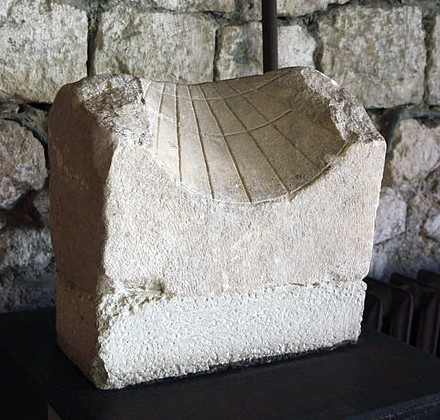
ancient sundial
In 2nd-century Rome, where public sundials became unusually widespread, the playwright Plautus complained:
"The gods confound the man who first found out
How to distinguish hours!
Who in this place set up a sun-dial,
To cut and hack my days so wretchedly
Into small portions."
I'm glad, for his sake, that Plautus is not alive today, experiencing how we cut up time into quarter-hours and, in the case of athletes, fractions of a second.

I was provided a quite different perspective on time when my wife told me about something she observed on a T.V. cooking show.  The chef showed the viewers a clam the size of my wife's fist, pointing out the rings on the shell that marked off periods of growth.  Then -- after explaining that the clam was 200 years old -- the chef opened it, pulled out the small body inside, and chopped it into a few pieces for consumption.  My wife said she felt there was something not right about it:  200 years of life gone, and in just a few gulps.  (I have imagined what a different scenario it would be if the little clam had been kept alive in an aquarium for fascinated visitors to peer in at it and be amazed.)

So what are we to make of time?  What is time itself, after all?  It is not something easily thought about in the abstract by average minds.  Even the quite intelligent St. Augustine in the 4th century said that he thought he easily knew what time was -- until he tried to say exactly what it was. Indeed, when we want to think about time, we have to either mark off time in measurements or compare ourselves to something like a mountain or a clam.  And as we do so, the sun rises and sets, and the Earth tilts back and forth on its axis, both unaffected, but encompassing our lives in regular natural cycles.

Despite all our measuring of time, despite all the synchronizations demanded by our modern urban societies, there is also a phenomenon almost every person has noticed:  Namely, that time, in fact, seems to drag at times and at other times go by so quickly.  The early 20th-century Christian writer Henry Van Dyke put it so insightfully and poetically:
"Time is
Too Slow for those who Wait,
Too Swift for those who Fear,
Too Long for those who Grieve,
Too Short for those who Rejoice;
But for those who Love
Time is not."

~~~
Does time ever challenge you?  How?

(The Plautus quote is taken from
The Discoverers by Daniel J. Boorstin, © 1983.)
(The original form of Van Dyke's poem [the last word of which is frequently misquoted as "eternity"]
 can be read at this external link: The Works of Henry Van Dyke, Vol 1. © 1921.  p. 259)

Friday, November 1, 2013

Leaves Old and New

Having always been quite nearsighted, I could not appreciate trees as easily as I could appreciate leaves.  I could not readily identify which species a tree was from a distance, the way my parents could.  Nor could I see detail in the distant treetops.  But I could look at a leaf closely, even hold it in my hand, and feel its texture.

I am still fascinated by the shapes of leaves.  Not just the variety, but the way that each one looks like something else.  What child has not noticed the resemblance between a maple leaf and their own hand, even fitting their hand upon it?  Another leaf I examine (from what tree I do not know) looks like a spear.  Still another leaf has the outline of a scoop.  And the stiff, large leaf of the southern magnolia tree seems perfectly designed for fanning oneself during a hot southern summer.

To the botanist, the shape of the leaf tells a story about its tree having evolved to flourish in a particular environment.  Even without knowing the details about such variations, I can be amazed to know that it is within those thin leaves that plants magically convert carbon dioxide and water into solid material, thus enabling the plant to grow.  Green leaves are truly miniature factories powered by the sun.

I am fascinated not only by the shapes of leaves but also by their colors.  How many shades of green can there be?  Even more fascinating are the turnings of color as autumn comes.  Like an alarm clock that has gone off, the shock of seeing some trees no longer green can wake us up to the approaching winter.  The change in foliage can even make us think about our own use of time, and whether our time might be short.

In the author O. Henry's amusing story "The Cop and the Anthem," a dead leaf falling into the lap of the main character, a hobo, signals to him that he needs to make a change in his living arrangements in order to make it through the winter.  That warning, coupled with the moving chords of church music that waft outdoors, inspire the hobo to make a good change in his life -- "to turn over a new leaf," as we say.

As fall continues and winter gets even closer, the leaves we see on the ground change colors even more, becoming mottled, creating a quilt of yellows, browns, reds, and even purples.  The leaves are then ready to be recycled into the earth, to become the substance of plants and trees yet again.  The leaves also "turn over a new leaf."

With the passage of time, I am also probably reprocessing things from my past into my future, shedding some things as a way of growing new leaves.  But it is harder for me to see those changes happening in me than it is for me to observe the changes in leaves.  In leaves, I see life and change made manifest.

~~~

Do you have memories about leaves?  How do you experience your life changing with the cycle of a year?

Friday, October 18, 2013

Trees, Time, and Passing By

Trees rarely make the front page.  That did happen, however, in 2004 when Wangari Maathai won the Nobel Peace Prize for her Green Belt Movement begun in Kenya.  Knowing a bit about ecology, I was not surprised to hear about the physical side effects that resulted from that movement's planting trees, such as cleaner streams due to reduced soil erosion.  What intrigued me more were the intangible benefits those trees brought.  For example, friendships between Kenyan women developed because, as they made their daily trips in the hot sun carrying water, they stopped to converse in the shade of trees.

As I have reflected about trees in general, I've concluded that the most enduring intangible benefits trees bring derive from the way they serve as tabernacles of time.  Many species of trees can have life spans longer than ours can ever reach.  Trees, therefore, help families and communities hold onto life-giving memories from generation to generation.  That role trees can serve is made explicit in these lines from the early 20th-century poet Stephen Vincent Benet as he describes Richmond, Virginia:
"The trees in the streets are old trees used to living with people,
Family trees that remember your grandfather's name."

In Sequoia Natl. Park in California, I stretched my neck far back to look up at a tree that was young and growing long before Jesus was born.  Such pine trees and sequoias help us transcend our normal sense of time.  We usually think of time in terms of human generations, but that is subjective and human-centered. The 20th-century American Buddhist poet Gary Snyder speaks to the relativity of time scales in this way:
"As the crickets' soft autumn hum
is to us,
so are we to the trees
as are they
to the rocks and the hills."

Compared to many long-living species of trees, we humans are just passing by.  We are to them passers-by in time, similar to the way we pass by a tree beside the sidewalk or walking path. In countries where people do not get virtually all their food from the grocery story, people can also be more aware of the other, tangible benefits those trees provide.  The Hindu Upadesa Tarangini brings together those tangible benefits with trees' intangible reminder that we are passers-by in the following benediction placed upon a tree:

"Oh tree!  You are standing on the path.  Live for a long time and be happy, because with your blossoms the cuckoo is happy, and with your pollen the bumblebees are happy, and passers by are happy with your fruits.  So live long!"

~~~

Is there any tree in particular that you remember? What is your memory of it?


(The Snyder poem is taken from
Buddhism and Ecology, ed. Mary Evelyn Tucker, et al., © 1997.)
(The Hindu blessing is taken from Hinduism and Ecology,
 by Ranchor Prime, © 1992.)

Friday, July 26, 2013

Eternity Carried Within

Mention the name Marie Curie, and the image that immediately comes to my mind is the interior of an old-style, dimly-lit chemistry laboratory, with glass flasks, dark countertops, and drawers. (There have to be drawers so that Marie Curie's mentor Antoine Becquerel can make his crucial discovery of how uranium can make an image on a photographic plate even when shut in a drawer away from sunlight.)

It was because of my mental picture of an enclosed, interior space that I was surprised by a quotation which, if unattributed, would have made me think instead of the outdoors.  Curie wrote:  "All my life through, the new sights of Nature made me rejoice like a child."  Of course, from her perspective as a physical chemist, Curie would have thought of her investigation of the radioactivity of different rocks as being part of an investigation of "nature," that is, the natural world.  Her wording, however, particularly "All my life" and "rejoice like a child," made me recall the way other writers have expressed how observing and remembering Nature has been an enduring source of rejuvenation.

Wilfred Owen, who was a soldier in World War I, turned his poet's pen to the task of conveying the horrors of a war touted as being a glorious war to end all wars.  As a result, his poems, are predominantly somber in tone.  In one poem, however, a terribly ill patient lying in an army hospital is "helped by the yellow may-flowers by his head."  Indeed, countless patients in hospitals have been given a lift by the bright colors of flowers, which, being natural, speak without words to the value and wonder of each life, even though each life passes.

Marie Curie's statement suggests to me that her ability to rejoice because of Nature was something she carried within herself throughout her life.  That idea of an inner source of strength from loving Nature is the very idea Rachel Carson put forward over half a century later.  In The Sense of Wonder, Carson wrote:  "I should ask [as] a gift to each child in the world... a sense of wonder so indestructible that it would last throughout life, as an unfailing antidote against the boredom and disenchantments of later years, the sterile preoccupation with things that are artificial."

That quotation in particular has made me reflect upon what might make a love of Nature so enduringly beneficial.  For one thing, if a person develops the ability to view the world with a childlike sense of wonder and delight, that ability can remain youth-giving.  Carson also points to the artificiality of too many human activities. They cannot satisfy the way the naturalness of Nature can.  We cannot feel at home in our world if the world around is made too sterile.

There is also the element of love.  As I cultivate a love for Nature, I cultivate an ability to love things that are unlike me, many of which have no immediate benefit to me.  I thus gain a form of self-transcendence.  I know of one church that put a twist on the more familiar Christian phrase "eternal life" by coining the slogan "love eternally."  Loving Nature can be a way of carrying within oneself a love to the very end of one's life.

~~~

Has there been a way that observing or remembering Nature has been of benefit to you?


(The Marie Curie quote is from Pierre Curie, by Marie Curie,
 as translated by Charlotte Kellogg and Vernon Lyman Kellogg, © 1923. p. 162.)
The Wilfred Owen poem referred to is "Conscious," in The Collected Poems of Wilfred Owen, © 1963.)
(The Carson quote is from The Sense of Wonder by Rachel Carson, © 1956.)

Friday, January 25, 2013

An “Island” Larger than Land

Some of my most delightful opportunities to see the other-worldliness of Nature have been when I've gone to certain restaurants.  No, it was not the samples of Homo sapiens I was watching (although people-watching can be interesting too).  Instead, these were restaurants that had a saltwater aquarium on display for the entertainment of customers.

After dining, I spend time peering into this saltwater world, watching for movement so that I can spot the life-forms other than the obvious fish.  Did I as a child think of all animals as being symmetrical with a right and left side?  Here, in this salt-water world, that idea is disproved. Here, circular is the game.  Circularity allows creatures that have no obvious face to be sensitive to the world in a full 360-degree perimeter.

I spot a sea anemone, its innumerable tiny arms ready to grab some passing prey.  Most camouflaged is the coral, which has taken evolution's advice to look like a rock most seriously, building its own rock-like castle for a colony of nearly microscopic beings to share.  Eventually, I have to leave this bit of ocean world trapped behind glass and come back to our human world of restaurant and city.

Of course, I have a number of times gone to the beach.  But those seashells strewn on the sand are only stone monuments to the dead, the living organisms that once inhabited them having passed on.  Those seashells are merely hints of the life that lives out beyond the water's edge.  They are only inanimate fragments hinting of the life beyond.

I did once get a closer glimpse into ocean life than an aquarium provides when my wife and I visited the tide pools on the Pacific coast of Olympic Natl. Park.  Roaming the beach, we stopped at each small depression of sand that held some temporarily trapped seawater with living inhabitants.  The best find were tiny starfish with five 1-inch arms.  However, as we examined the life-forms in the tide pools, we knew they would soon be covered over with the rising tide, thus being taken back into their rightful ocean home.

The oceans on this planet are to me something like giant tide pools, pocketed away from our life here on land.  The oceans are like isolated islands of life, even though they cover a greater area of the Earth's surface than does land.

Locked away in their own world of life, the oceans whisper to me some message of eternity for a reason I cannot quite explain.  However, Rachel Carson heard, I think, the same whisper when she wrote:  "To stand at the edge of the sea, to sense the ebb and the flow of the tides... is to have knowledge of things that are as nearly eternal as any earthly life can be.  These things were before ever man stood on the shore of the ocean .... They continue year in, year out, through the centuries and the ages, while man's kingdoms rise and fall."

~~~

How has it felt to you to go to a beach or the ocean?


(The Carson quote is from Under the Sea Wind, © 1941.)