Showing posts with label biodiversity. Show all posts

Friday, June 5, 2020

Bubbles within a Great Bubble

Hopes enclosed under glass.It reads like a modern parable, even though all the details come from newspaper archives.  In September of 1991, eight men and women, outfitted in blue jumpsuits, made an appearance before an excited press.  The small team was about to embark upon an experiment -- not going into space, but entering a human-made ecosystem called Biosphere 2.  Sunlight would enter the glass windows of the 3-acre complex of domes and pyramids.  But other than that solar intervention, Biosphere 2 was designed to grow its own food, create its own oxygen naturally, and filter its wastewater through the soil for purification.  A New York Times headline described it as a "Man-Made World."  An ABC news program held out the hope that the project might "save the world" -- because after all, Biosphere 2 would be sealing out the environmentally damaged, polluted world that the Earth had become.  The team in jumpsuits entered the Biosphere, and the airlock was sealed.

Any sci-fi writers worth their salt would know what should happen next if this were to be made into a Hollywood movie:  Competitiveness, jealousies, and sexual attractions would emerge among members of the team.  One member would turn into a Captain Bligh, fomenting a mutiny among the crew, who had been wanting the bountiful Biosphere to be an enchanted island of Tahiti.

As it turned out, the real Biosphere 2 soon had problems of a more ecological nature.  Even though its sealed world had included a miniature rainforest, coral reefs, and numerous species of animals, growing crops was difficult.  The team had to break into an emergency 3-month food supply they had kept a secret.  Despite that surreptitiousness, reporters discovered that deliveries were being made to the Biosphere twice a month -- seeds, vitamins, and mousetraps.  Mice were not the only pest needing controlling.  There were also cockroaches (no surprise), and nematode worms and mites attacking the crops.  Moreover, the honeybees and hummingbirds that were to have pollinated the crops had died.

Of more immediate danger, a surge of bacteria was reducing the oxygen level to such a point that it was as if the team were living at an altitude of 14,000 feet.  A truckload of liquid oxygen had to be called in and sprayed into the Biosphere.

As the ecologist Rebecca Stewart summarized it, “The Biosphere 2 experiment failed to generate sufficient breathable air, drinkable water and adequate food for just eight humans, despite an expenditure of $200 million.”  The bubble had burst.  Reflecting upon our scientific knowledge, the scientists Joel Cohen and David Tilman wrote:
“No one yet knows how to engineer systems that provide humans with
 the life-supporting services that natural ecosystems produce for free.”

Hopes grounded in a larger sphere.
A rare look at a rare planet
A century earlier, it was the idea of a much more immense "bubble" that had initially prompted the word "biosphere."  In the 1800's, scientists had coined that word to refer to the network of integrated living species, from microscopic to large, that surround the Earth.  In 1926, the Russian scientist Vladimir Vernadsky published a book about this living "skin" that surrounds our planet. The living beings in the biosphere not only draw upon the chemical elements of the Earth and air;  they also re-create the oxygen, nitrogen, and carbon dioxide.

Expressing appreciation for the Earth.
We must marvel at what this Earth-Bubble, our home, can do.  But we might also draw upon the failed bubble-world of Biosphere 2 to ask if there isn't an intangible "bubble' we sometimes live in.  When we live in our high-tech human-made world without an awareness of how it is being sustained by the systems of Nature, are we not living in a mental bubble?  The danger of such a mental bubble is why our faith-traditions have cultivated prayers of gratefulness to use upon awakening, before eating, and when going to sleep, awaiting the sun's next rising.

~ ~ ~

(Do you have a way of remembering Nature in an appreciative way?  What is it?)


(Quotations and details are taken from "The Lost History of One of the World’s Strangest Science Experiments"
 by Carl Zimmer, The New York Times, March 29, 2019.)
(The picture of Biosphere 2 and of the Earth are used under Creative Commons Attribution 2.0 Generic licenses.
 The picture of the nomad is in the public domain because of its age.)

Friday, August 2, 2019

Gift about Life on a Deathbed

What would you want to be given as a gift if you were not likely to live much longer?  Of course, if in pain, medicine to alleviate that suffering would be welcome.  But in this instance, the bedridden man -- Charles Darwin -- had learned to live with a chronic illness through most of his adult life (even during his most fruitful years of scientific research and writing).  So, what turned out to be a welcome gift was a book to read.  And the book was on Darwin's favorite subject:  Nature.

Ancient (but not perfect) knowledge passed down.
Aristotle,
in an
old Latin translation
The gift, from William Ogle, was his new translation of a work by Aristotle titled The Parts of Animals.  That ancient Greek scientist's collection of observations about animals would have been of particular interest to Darwin.  Even though Aristotle's way of doing science was not grounded in the experimental methods of modern science, Aristotle's collection of investigations about animals had been part of the corpus of Western education for centuries.  Aristotle recognized the temptation researchers might have of not investigating animals they might consider useless, ugly, or even disgusting.  Therefore, in the book Darwin had received, Aristotle cautioned:
"For this reason we should not be childishly disgusted at the examination of the less valuable animals.
For in all natural things there is something marvelous."
Those words would have gone straight to Darwin's heart because they mirrored his own endless fascination with Nature's intricacies (something Darwin had commented on in the eloquent closing passage of his own book Origin of Species).

Thanks to the rapid growth of the railway system in England during the 19th century, frequent correspondence by mail had become a mainstay of life among many Brits, and Darwin had throughout his career relied upon a network of correspondents (some of whom became good friends) in order to ground his scientific studies.  Darwin always wrote cordially, expressing his appreciation.  And now, he did so again, expressing how even near the end of his own life he was grateful for the new perspective the gift of a book had provided.  Darwin wrote to Ogle, who had sent him the book:
"From quotations I had seen I had a high notion of Aristotle's merits, but I had not the most remote notion what a wonderful man he was.  Linnaeus and Cuvier
 [two pivotal 18th-century biologists] have been my two gods... 
but they were mere school-boys to old Aristotle."

William Ogle, upon receiving Darwin's letter with its complimentary remark about Aristotle, wrote back, saying:
"Thank you for your kind and eulogistic letter re [Aristotle's book].
It gave me much pleasure.  I am glad also to have added a third person to your gods."

Darwin died only three days after Ogle sent off his letter.  But Ogle's, Darwin's, and Aristotle's lives had all become tied together through a chain of correspondence.  And also through a mutual fascination with the forms of animal life in which Aristotle had found "something marvelous."

Virtually countless animals to see!

~~~
Are there any animals you find particularly fascinating?  Which ones?


(All of the quotations are taken from the "Aristotle" entry by James G. Lennox in
Evolution:  The First Four Billion Years, ed. Michael Ruse, et al., © 2009.  p. 427.)
(The images are in the public domain.)

Friday, September 15, 2017

Doing Without a Brain,
or Just a Little One

My musings on this matter of the size or absence of brains began when I was confirming another fact with a retired biology teacher.  I had been wanting to make sure my description of the size of tiny coral animals was correct.  Although I had not requested the additional information, my adviser added:  "The coral are invertebrates, like sea anemones.  They have no brains."  It sounded like just the setup line for a joke by a late-night TV comedian (particularly if our elected officials had done something seemingly nonsensical earlier in the week).

Not of the bathroom type.
Another brainless invertebrate,
a freshwater sponge
Nevertheless, my adviser on biology had simply been making the factual observation that corals, sea anemones, and other invertebrates such as sea sponges make do without a spinal cord or brain.  They do quite well without such "extras."  Sea anemones, being much larger than the nearly microscopic coral animals, are easier candidates for observation if you have a chance to watch a saltwater aquarium.  They have a mouth on top, surrounded by numerous paralyzing tentacles that detour passing food into the mouth.  The creatures, although continuously hungry, seem quite content in having no brain.  Although we humans might think that having brains is a "no brainer," evolution tells us brains are not really necessary for being a plant or even an animal.

Besides that TV-comedian joke about some people apparently not having a brain, another derisive brain-related joke is to call some person a "bird brain."  Here again, birds -- as well as many other small vertebrates -- seem quite capable of getting along with a quite small brain and skull compared to the human race.

So tiny, yet a real "thinker."
On one occasion, I was pitted brain-to-brain against a creature of sparrow-sized brain, and I lost the competition.  My challenger had been a bat.  I was standing on a second-story balcony in the early evening, at the balcony's rail, looking out upon the open grounds before me.  In literally less than a second, a bat flew straight at my face.  Even though the whole incident happened in an instant, I was able afterward to clearly remember seeing the rapidly flying bat no more than two feet in front of my face -- and aimed right at me.  But then, the miraculous occurred:  The bat, securely guided by it's sonar system that I could not hear, instantaneously made a sharp left turn, thus preventing a collision.  I could never have been able to react that quickly.  But its tiny brain did.

We need not stop with the example of a bat's brain if we want examples of forms of intelligence packaged in a small size.  In his poem "A Considerable Speck," Robert Frost observes the behavior of a nearly microscopic "mite" (as he calls it) on a sheet of white paper on his desk. Watching the tiny animal's response to the movements of his writing pen. Frost drolly concludes:
"Plainly with an intelligence I dealt....
I have a mind myself and recognize
Mind when I meet with it in any guise
No one can know how glad I am to find
On any sheet the least display of mind."

~~~

Is there a non-human species you admire?  What species is that?  Why do you admire it?

(The excerpt from the Frost poem is taken from
"A Considerable Speck" in Complete Poems of Robert Frost, © 1967.)

Friday, February 17, 2017

Tiny Tanks

Tiny army tanks -- that's what they often look like.  Beetles, that is.  The way these particular insects, often with bulky bodies, plow ahead over rough terrain can easily remind a child of army tanks they've seen on TV.  (One subgroup is even called "soldier beetles.")

One 20th-century evolutionary biologist, J. B. S. Haldane, suggested that a different type of mindset might lie behind this Coleoptera category of insects, and his comment has entered the canon of science-humor stories.  After a distinguished career in biology, a reporter asked Haldane what conclusion about the mind of the Maker he had drawn from his vast, scientific knowledge of Nature.  Haldane replied, "an inordinate fondness for beetles."

So small yet so hardy!
Indeed, there are over 400,000 species of these little creatures (almost half of all insect species), identifiable by their pair of hard forewings serving as armor.  Some beetles click; some emit blinking light; some are like whirligigs.  Although the word "beetle" derives from the Old English "bitela," meaning "biting," very few would bite you.

 I know God did not invent beetles just to entertain us.  (They and many other insects were, after all, around for at least 50 million years before hominids came along.) Nevertheless, more than one science-humor story revolves around them.

A frequently repeated anecdote is about the young Charles Darwin when he was alone, collecting beetles (one of his favorite hobbies).  Spotting an unusual beetle, he picked it up, but then spotted one of a different species, which he picked up with his other hand.  But then he spotted a third beetle, and so popped the second beetle into his mouth to quickly free a hand.  As Darwin later recalled, "Alas, [the beetle in my mouth] ejected some intensely acrid fluid, which burnt my tongue so that I was forced to spit the beetle out."  The author of a juvenile-level biography concludes this story with the straight-faced comment, "Bugs don't always do what you want them to, and not all beetles want to be caught."

It would be fun to think that God had invented Darwin's squirting beetle so that writers of biographies for youth would have a funny story to insert into their manuscript.  But I expect God has larger concerns in mind than the entertainment of readers.  (Even if the 19th-century novelist William Makepeace Thackeray was able to wittily turn "beetle" into a verb by saying in Vanity Fair that "Chambermaids... beetled from bedroom to bedroom loaded with... champagne.")

Surmounting obstacles.No, my hunch is that the plenitude of beetle species has more to do with the strength of their body type and its adaptability to many different environments.  Hopefully, our human sense of humor will remain just as strong and adaptable.

~~~

Even if you don't know what type they were, have you ever noticed any insects around the entrance to where you live?

(The Haldane quote was in an article by G. Evelyn Hutchinson
 in The American Naturalist in 1959 [93, 870]: 145-159.)
(The Darwin remembrance, originally in Life and Letters, Vol. 1, p. 43, and comment about it
 are from Charles and Emma by Deborah Heiligman, © 2009.  p. 24.)

Friday, July 22, 2016

Flowers Against the Stereotype

Many a poet has drawn upon the delicate beauty of flowers for literary inspiration.  The softness of the petals.  The sweet fragrance.  Flowers thus lend themselves to being a symbol of femininity. (Also, notice how in our U.S. culture, women will be given a corsage to wear vastly more often than men are given boutonnieres.)

Here are some poetic examples of flowers in an inspiring role:  Shakespeare's Juliet, in the balcony scene of Romeo and Juliet, depicted herself as "a beauteous flower."   Alfred, Lord Tennyson connected the physical characteristics of a flower even more explicitly to those of a woman, writing:
"Lightly was her slender nose
Tip-tilted like the petal of a flower."
The 19th-century German writer Heinrich Heine went straight to the point, titling one of his poems "Du Bist Wie eine Blume," which translates to "You are Like a Flower."

Hard to believe it's a real flower!I wonder what such poets -- who thought of flowers as being delicate and feminine -- would have thought about a flower from Sumatra that I heard about on the radio. Far from sounding feminine, it was described as being "like a giant finger jutting straight up... eight feet tall and [weighing] 250 pounds."  Nor would a person want to extract the essence of the aroma this flower gave off, because it had a "distinctive rotting-corpse-like odor."  The evolutionary explanation behind that flower (scientific name Titan arum) is that the putrid odor enables it to attract insects who believe they are coming to the carcass of an animal on which they might feed.  The insects flocking to the flower get tricked, while the clever flower gets itself pollinated.

It was not only insects who have been disappointed in the case of this particular flower, which was on display at the U.S. Botanic Garden in Washington, D.C.  Many of the museum-goers who flocked to the flower, hoping to get a whiff of its repellent odor, were disappointed because the colossal flower emitted its odor for only a few hours, and did not have the courtesy to schedule its opening so as to align with the museum's daytime hours.

The finger-shaped Titan arum is not the only tropical Asian flower to have evolved such a trick of deception.  Another species, the Rafflesia arnoldii, has a more typical floral shape, being circular with petaled edges.  But it is similarly oversized (two or three feet in diameter) and also smells like a carcass during part of its blooming period, even if only briefly.

I was not among either the disappointed or the pleased museum-goers at the U.S. Botanic Garden. Nevertheless, I take delight in that news story about the non-stereotypical flower for two reasons.  I take delight first in being reminded again about how evolution, with all its immense variety, has developed a living being that defies our human expectations, particularly our cultural associations.  Secondly, I am pleased to hear that so many people can themselves take delight in an example of biodiversity that we ourselves would not have designed, and might have usually found repulsive.

~~~

Do you have any thoughts about these huge, putrid flowers?


(The Tennyson lines are from "Gareth and Lynette," line 574, in Idylls of the King. 1859-1885.)
(The news story was "Lure of Flower's Putrid Essence Draws Crowd," July 22, 2013. © NPR.)
(Second photo, by Henrik Ishihara Globaljuggler, used under Creative Commons Attribution-Share Alike 3.0 Unported license.) 

Friday, December 25, 2015

Playing with the Nativity

Focus of a child's imagination
​
​
One luxury of our modern Western societies is that many of us are able to have a plenitude of Christmas decorations.  The selections in Christmas stories reveal the enduring popularity of nativity scenes, from folk pottery of South America to wood carvings of Asia.  My wife says that as a child her favorites were nativity scenes that allowed her to move unattached figures about.  And, of  course, some of the favorites of children in those scenes are, understandably, the animals.


Keeping life afloat
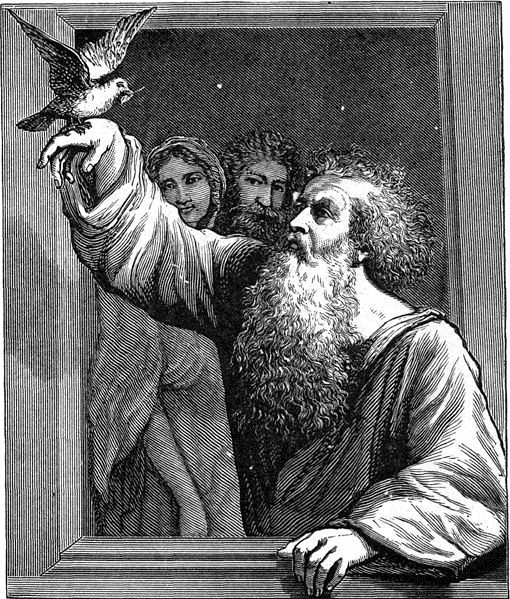
Seeing a child play with those animals that are a part of Jesus's birth-scene often makes me think of a similar children's toy:  the arks with pairs of animals, based on the story of the flood in the Bible's book of Genesis.  (Christianity shares with Judaism that version of the story of animals being saved; and the figure of Noah as rescuer is also in Islam's Qur'an.)  Young children enjoy animating the animals by moving them about.  And figuring out how to fit all the animals into the ark can be a learning experience.

Our contemporary dictionaries have several definitions for "ark," but one older use of the word endures only in history-recording dictionaries such as the Oxford English.  In the 1700's and 1800's, English gentlemen (and their counterparts in U.S.'s New England) were often collectors of objects from nature:  fossils, plant samples, bones, insects, etc.  If the collector could afford it, he kept those samples in a multi-drawered cabinet that came to be called an "ark."  The Biblical connection was so strong that the wood cabinets were sometimes even designed with a sloping top -- the way the roof of Noah's ark would have to have been sloped so the rain would run off.

Natural scientists of that time period had a "fitting" problem that was even greater than how to fit their growing number of samples into their arks (and even more challenging than children getting toy animals back into their ark).  Namely, figuring out how all the fossils, plants, and animals represented by their samples fit together historically and biologically.  Eventually, Darwin's discovery would prove to be a breakthrough.

This story of the resourcefulness of natural science converges with the resourcefulness of Christianity with its nativity scenes.  That is because the Bible itself does not explicitly depict any animals surrounding baby Jesus in the manger.  Sheep are only referred to indirectly in the Bible's book of Luke; camels are never mentioned in the story of the magi in Matthew; and no donkey is mentioned.  All those animals around the Christmas manger are thus the product of humans' imaginatively interpreting the meaning of the Biblical stories.  It seems as if representing the glory of new creation and the glory of God demanded a more holistic picture -- one that involved a range of animals.

Knowing how to careToday, for some of us, another dimension -- another aura -- surrounds those nativity scenes.  Just like Noah, we humans today are trying to rescue animals from extinction by trying to evoke in our human hearts a new birth of the spirit of Creation-Care.  On this ark of planet Earth.

~~~

Do you have any childhood memories involving crèches or living nativity scenes?


(The picture of a nativity is used under a
Creative Commons Attribution-Share Alike 3.0 Unported license by L.Kenzel.
Both illustrations of Noah are in the public domain because their copyrights have expired.)

Friday, August 7, 2015

The Restraint of Insects

Most people in the U.S., I would guess, have heard of the cartoonist Charles Schulz, creator of "Peanuts."  A fair number of people have heard of Pogo's creator Walt Kelly.  Few people, however, know the name Don Marquis, who, in the first part of the 20th century, created the serialized humor of "Archy and Mehitabel."  In its time, that series provided witty comment on the human condition, usually through the eyes of an otherwise harmless cockroach named Archy.  I was struck by the perceptiveness of one of Archy's observations I recently came across in an anthology:
"if all the bugs
in all the worlds...
should sharpen up
their little stings
and turn their feelings loose
they soon would show
all human beans...
their relative significance
among the spinning stars."


How can some insects seem lighter than air?
green damselfly

Indeed, if human beings ("beans," as Archy pronounces it) could actually experience firsthand the bottled-up energy of every single insect in the world, we would quickly know we are outnumbered.  The best calculations are that insects outnumber the human population a million to one, and in total body mass outweigh the human population twelve times over. Moreover, what an enduring as well as versatile form evolution found when it developed the insect structure. We human beings walking upright are only one species; but the basic insect structure (3-sectioned body & 6 legs) comes in a fantastic array of a million species.  Some are as delicate as a damselfly.  Others, such as Goliath beetles, look like army tanks in comparison. Still others, such as walking sticks, are camouflaged as twigs.

A "bug" to inspire children's verse.
ladybug
Given the incomprehensible number of insects worldwide, and the versatility of the class Insecta to evolve in almost any condition, the "if" that introduces Archy's poem is significant: Archy's scenario is imaginary. Insects are, for the greater part, much more concerned with leading their own lives than they are with harassing humans. Moreover, a mindless desire on our part to indiscriminately rid our planet of insects would mean the loss of bees and other insects that pollinate fruit and nut trees, and help pollinate other crops. Their roles as pollinators only hint at the vital links insects serve overall, being food for birds, some fishes, and many mammals.  Those animals in turn nurture the many cycles of air and soil. Not to mention the delight many children can get as they discover the animated wonders of usually harmless insects.

Archy, in his own restraint, merely implied another point.  Namely that, on the whole, the class Insecta has demonstrated more restraint in its behavior than has Homo sapiens.  Although we do need to find better ways to regulate the dangerous effects of certain insects, maybe we can add to our more restrained behavior a greater appreciation of the benefits of insects.

~~~

Have you every imagined what it would be like to be a certain insect?  Which one?


(The poem of Archy is from
  The Lives and Times of Arch & Mehitabel by Don Marquis, © 1935.)
(The photo of the damselfly by JDP90 [Joydeep] used under a Creative Commons Attribution-Share Alike 3.0 Unported license)

Friday, July 10, 2015

Stranger and Truer than Science Fiction

Sometimes after watching an episode of the Star Trek TV series, I think that the designers of the space aliens' costumes and makeup need to go back to school, so to speak.  Not to a costuming course in drama school.  And not to a makeup academy.  Instead, they need to return to fiction-writing school to give more thought to what an alien that developed on another planet might even be like.

I tend to think this way not after reading an astronomer's analysis of conditions on other planets.  Instead, my thoughts incline this way after seeing pictures or reading about forms of life in the ocean on our very own planet Earth.  Evolution has come up with some "costumes" and "makeup" far beyond the imagination of any science-fiction writer or director.  And the strangest ways of being a living being can be found in our oceans.

Musical inspiration for naming a crab.Just take the matter of virtually all space aliens on Star Trek having two symmetrical sides, right and left (just as do humans and all other vertebrates).  A simple exception in the ocean to such symmetry are male fiddler crabs, which have a claw on one side of their bodies much larger than the claw on the opposite side.  (Thus the whimsical appellation "fiddler" we have given them.)

Nature had already gone a step even further away from requiring animals to have two sides when the invertebrates previously evolved.  Sea anemones, sponges, and jellyfish are all circular in design.  Imagine a Star Trek director instructing a person in a spherical costume to "face the camera."  Evolution had an even greater imagination when it came up with the starfish's "costume," giving it five arms -- an odd number, of all things.

Another area in which I think science-fiction writers have been outdone by Nature has been in that of eyes.  I have seen a TV space alien made up with one additional eye on its forehead, or even with an extra pair.  (It would take more work to mask over the actor's real eyes and give them a single, centered eye, like the Cyclops in the ancient Greek epic Homer's Odyssey.)

What might a scallop see?Contrast that prosaic eye-on-forehead thinking with the idea of a whole ring of small eyes around a circular cookie-shaped body.  To make that many-eyed circular costume even stranger, don't space the tiny eyes at even intervals, but place some a little closer together and others a little farther apart.  That is the approach actually taken by the blue-eyed scallop of Australia. Moreover, what a colorful touch in the pinhead eyes being blue!

Now, please don't misunderstand me.  I am not really trying to criticize science-fiction writers.  I do recognize that science fiction is really more about our human societies than it is about what exists on other planets.  (I also recognize the limitation of trying to make an alien costume that allows a person to fit inside.)  My aim is not criticism but amazement.  I am amazed at the immense variety of "costumes" of the beings in our oceans, demonstrating again that life's possibilities are even greater than our own human imaginations.

~~~

Do you think we might draw a lesson from the strange variety of species?  Or would that be carrying our imaginations too far?

Friday, December 12, 2014

Nature’s Time Machine

"Let's set the Way-Back Machine to the year...."  Many a person in the U.S. of my generation, upon hearing that line, will recall the Peabody cartoons that were part of the Bullwinkle TV show. With that periodic segment, the Bullwinkle show joined the long line of plot-writers (primarily science-fiction) who employed the device of time travel.  It's a literary tradition that can be traced all the way back to H. G. Wells's 1895 appropriately titled novel The Time Machine.

When we look at species of plants and animals, if we have some knowledge of evolutionary biology, we can also be taken back in time.  We Homo sapiens are late arrivers on this planet (150,00 yrs. ago).  And so, knowing other species sets the dial of the time machine farther back.  To use another metaphor, if evolution is thought of as a huge tree of life with numerous levels of branches, as we look at branches that began lower on the tree, we are taken further back in time.

leaf of
a ginkgo biloba tree
Despite many extinctions, most species still around today have endured an incredibly long time.  I remember the day I noticed the unusually shaped leaves of a tree beside the sidewalk in a southern city I was visiting.  The person I was with explained that it was a ginkgo, which, unlike other trees in the U.S., was of a type that dated back a quarter-billion years.  Another example of going way back are some species of marsupials, such as ancient opossum species.  Marsupials (which include kangaroos) represent an early state of mammalian evolution, having no placenta. They bear young that are extremely small, and carry the young in a pouch for the remainder of their early development.

A nautilus,
another ancient species
For those of us who think of God as the Giver of Life and as the Fountain out of which all possibilities come, evolution can be seen as the way by which the Divine manifests its power and wonder.  Although evolution, seemingly paradoxically, requires elements of chance (such as mutations and chance experiences), there is in evolution a discernible direction toward a richer diversity of life.

Although Peabody and Star Trek episodes took the audience back in time (to such periods as Prohibition or ancient Rome), H. G. Wells's The Time Machine actually took the reader forward in time.  That is a harder task when it comes to evolution. No one studying the varieties of species 100 million years ago could have predicted that a meteor would hit the earth off the Yucatan, bringing such thick clouds that plants would die, thus cornering all the great species of dinosaurs into extinction.

We do know however, that we are suffering a loss of biodiversity -- a reduction of the number of branch-tips at evolution's treetop of the present.  The main cause is human:  the stresses of loss of habitats and climate change.  It is not yet determined in what way this plot will turn out.  Whenever we work to preserve the rich diversity of inter-species relationships that strengthen life, we try to write a happy ending for the story of life.

~~~

Does it add something to your perspective or your life to imagine way back in time?


(The photograph of the leaf is by Daniel MiÅ‚aczewski.  That of the nautilus is by Lee R Berger.
Both are used under Creative Commons Attribution-Share Alike 3.0 Unported licenses.)

Friday, October 3, 2014

Comedy with Animals

Most people love their dogs.  Also, fortunately, we humans do often display a sense of fun and humor, despite our difficulties.  So I guess it is no surprise that dog owners sometimes dress up their dogs with hats and other costumes, finding the result comic and fun.  I know there is now in the U.S. more than one group of dog-owners who organize Halloween events with dogs appropriately attired.

However, when it comes to finding matters where comedy and animals intersect, I find more fascinating those incidents that were not contrived.  I especially get a laugh out of incidents where animals had the last laugh.

For example, I've read, about an incident when city officials in Paris gathered up thousands of pigeons and transported them into the countryside over 120 miles away.  Little did the officials realize that the urbanized pigeons still possessed the directional abilities, homing instincts, and speed of their ancient ancestors.  When the human officials got back to Paris, they found that the exiled pigeons had beaten them back home.

Such stories serve as more than amusement; They also keep us from becoming too arrogant. One ancient example is the Biblical story of a man named Balaam, who cannot see an angel blocking the road ahead, even though the donkey he is riding can.  And so the donkey resists moving forward.  Even though the story is wryly crafted to be comedy for its human audience, the donkey might consider the story to be tragicomedy.  The donkey, beaten by Balaam for its stubbornness, protests to Balaam by saying "Am I not your donkey, which you have ridden all your life to this day? Have I been in the habit of treating you this way?"  (Num. 22:30, NRSV)  After Balaam admits his error, he can see the angel.

Konrad Lorenz
Another form in which our laughter and animals intersect is when visitors to a zoo stand before the cages and laugh at the seemingly peculiar appearance or behavior of some animals.  The animal behaviorist Konrad Lorenz, however, takes a humble stance when he writes:  "It is seldom that I laugh at an animal, and when I do, I usually find out afterwards that it was at myself, at the human being whom the animal has portrayed in a more or less pitiless caricature, that I have laughed."

There are thus different ways that our laughter and the animal world can intersect. Costuming dogs, although unusual, is benign.  Laughing at animals' appearances can be an obstacle to appreciating wonderful biodiversity.  Laughing at ourselves seems to me to be the safest approach.

There must be many contemporary stories from backyard-birdwatchers who tried to keep squirrels from raiding birdfeeders.  But recording all those stories would mean that the humans involved would have to admit they were outwitted by a squirrel!

~~~

Have animals helped you lighten the burden of life in any way?  How?


(The quotation by Lorenz is from
King Solomon's Ring, by Konrad Z. Lorenz, © 1952.)

Friday, July 25, 2014

Tested by Toads and Frogs

I feel sympathetic toward children, with the multitude of tests they have to endure.  Not just those academic standard tests that have been so much in the news in recent years, but also the tests that come in the form of taunts and insults from other children.  Name-calling is the quickest way to insult.  And among the animal epithets one child can lay on another is, "You toad!"  How the toad got into the childhood lexicon is not hard to discern.  After all, what child would want their face to look like a lumpy, bug-eyed, warty animal?

There were other ways that toads were part of the tests of my childhood.  When one child did catch a toad, it could be a challenge to pass it from one pair of cupped hands to another without the toad escaping -- especially when the animal's strange, leathery skin could feel distasteful ("yucky," to use a child's word).

illustration for
"The Frog Prince"
Whether or not toads or their near look-alikes frogs were more prevalent in your childhood would have probably depended upon the dryness or wetness of the habitat that surrounded you.  (The categories "toad" and "frog" almost blend one into the other in the great variety worldwide, especially when tree-toads and tree-frogs are included.)  The similarity of shape and appearance between toads and frogs has meant that both entered folklore and fairy tales as a distasteful test to be overcome.  Would you want to kiss a frog?  Even if it might turn into a prince, thus fulfilling your heart's desires?

The fact that some frogs and most toads do have a toxic, protective liquid in the bulging sacks behind their eyes could make putting one's face too close to the animal a real fear.  People could be wary of approaching toads even if they believed the legend that a toad's body might hold the wondrous toadstone that could grant magical powers.  Shakespeare captured the tension about toads in these lines from As You Like It:
"Sweet are the uses of adversity,
Which, like the toad, ugly and venomous,
Wears yet a precious jewel in his head."

The ways toads and frogs test us extend beyond childhood and even beyond the pages of fiction. Today, the populations of frogs are truly in perilous decline.  Their permeable skins mean that they are early indicators of the spread of our human-made chemicals, especially when compounded by viruses and habitat loss.

When frogs are plentiful, it can also be a challenge for us humans to put up with the loud choruses of frogs finding mates in springtime.  One story from the Christian tradition, however, might inspire us to tolerance.  The story tells how St. Benno, searching outdoors for a place for prayer, was at first tempted to bid the frogs to be silent.  But then, Benno recalled a Bible passage expressing how animals too praise God.  And so, the saint commanded the frogs to "praise God in their accustomed fashion; and soon the air and fields were vehement with their conversation."


~~~

Do you have any childhood memories of toads or frogs?  Adult memories?


(The Shakespeare quote is from As You Like It, II, i.)
(The quote about the St. Benno story is from Beasts and Saints by Helen Waddell, © 1995, p. 66.)