Showing posts with label Christianity. Show all posts

Tuesday, November 29, 2022

What is Most Valuable?

"Thanksgiving."  It's a single word designating in the U.S. a single-day holiday in November.  But that word "Thanksgiving" can be broken apart into two words that point forward to another U.S. holiday roughly a month later:  "Thanks" is the theme of Thanksgiving Day, and "Giving" is the theme of the gift-giving day of Christmas.

How to decorate for Christmas?
Those two words might lead us to meditate upon intangible spiritual values, but unfortunately, in that one-month period between the two holidays, we are deluged with mail-order catalogs, advertisements, store displays, and news stories that emphasize spending money.  The news media judge the very day after Thanksgiving ("Black Friday") as being a success if enough money is spent, and they call the weeks before Christmas not "Advent" but "the holiday shopping season."  The innovation of Giving Tuesday puts only a slight dent in the steamroller of consumerism heading toward Xmas.

Inflation, especially when it is rapid, understandably makes people more conscious of prices.  But over a century ago, the perceptive Oscar Wilde cautioned people that knowing "the price of everything and the value of nothing" is a cynical way to live.  Several decades ago, a handful of renegade economists tried to remind people that how the news media report economic statistics can be misleading.  Take for example how the GNP (Gross National Product) is usually treated as an indicator of progress if it is growing.  However, that indicator even goes up when a people are in car accidents, because hospital supplies and car parts are produced.  In contrast, the GNP indicator is untouched when a person uses knitting material they already had stored to create a lovely gift for a family member or friend.  Those are examples of why Donella Meadows writes:

The GNP is obviously not a measure of progress....
It is indiscriminate.  It lumps together joys and sorrows, triumphs and disasters,
 profundities and trivializes, everything that costs money and nothing that doesn't.

Perhaps during the one-month period between Thanksgiving and Christmas, besides making a shopping list, we might pause to create a mental list of intangibles we are able to give.  One starting place might be to think back upon what things other than purchased products we have been blessed with having been able to give to others.  I would put on my list my having been able to be a teacher about topics related to religion, spirituality, Nature, and science.  (For a decade, this website has served as one avenue for that teaching.)

Where is something larger than ourselves?
The reverse side of giving is getting.  During the month near Christmas -- and the other winter festivities of Hannukah and Kwanzaa -- we might also reflect upon the intangibles we receive.  Of course, we are grateful for the love that binds our lives with others.  But are there things we have received that are more specific to our individual identities?  Here again (perhaps because I am now in my 70's) I look to the past.  And I think that one of the greatest gifts my parents and teachers gave me were those values that gave me a habit of looking beneath the surface of things -- an eye for the intangibles, the immeasurables, that are crucial to spirituality.  Those intangibles are there, whether or not we notice them.

In addition to such reflections upon our lives during the weeks near Christmas Day, might we perhaps shift our reading to include something different than our usual routine?  Something that would be enhancing?  And during those weeks, might we turn our attention to the changing aspects of Nature as the year moves into winter?

~ ~ ~ 

Is there something you are reading during the weeks near Christmas that you would like to tell others about?  Have you noticed something in Nature during this period that has invigorated you?


(The quotation by Oscar Wilde is from his 1892 Lady Windermere's Fan,
 as cited in Familiar Quotations, 16th edition, edited by John Bartlett, p. 566 #23.)
(The quotation by Donella H. Meadows is from her book The Global Citizen, © 1991, p. 232.)

Friday, July 1, 2022

Yesterday, Today, and Tomorrow

Even though I love many aspects of Nature, I confess that I am not a very good gardener.  That is why the plants in my yard that have endured over the years are those than can survive with little care (except perhaps for a brief soaker-hose during extreme drought).  One plant that has just managed to endure through tough times is a plant with an unusual common name -- the "yesterday-today-tomorrow plant."  It is so named because each flower is a deep blueish purple when first appearing but changes to a light shade the next day. On the third day, the flower has turned white.  And so, when flowers come frequently enough, they display a range of three colors.

He also lived in changing times.
The scientific name for the yesterday-today-tomorrow plant is Brunfelsia, so named for Otto Brunfels, who lived in Germany during the first half of the 1500's.  Those were tumultuous times because in 1517 Martin Luther posted his famous theses on a Roman Catholic church, thus beginning the Protestant Reformation.  Otto Brunfels' life exemplifies those changes:  He had trained in a Catholic monastery but later became a pastor of a Protestant church.  One thing endured through those decades:  Brunfels' interest in herbs, which were one source of medicines.  Although the three-volume work on herbs he wrote included sometimes questionable folklore, it also displayed woodblock illustrations, which was a fairly new innovation for printed books.  As the contemporary commentator John Lienhard states about Brunfels' compendium, "The images long outlived the words."

I know that biologists have to name species with Latin names. Nevertheless, I do enjoy how the common name for that Brunfelsia plant expresses one aspect of how humans experience time.  We remember yesterday.  We are aware of today. And we think ahead to tomorrow.  How should we handle our awareness of those three periods of time?

I think it is a reasonable assumption that anybody who has lived any length of time is bound to have some regrets about the past (even if they don't like to admit it). However, as  the 5th-century B.C.E poet Agathon wisely reminds us, “Even God cannot change the past.”

What about tomorrow?  Our modern, Westernized technologized societies change so rapidly that it makes life harder than it otherwise might be.  Our uncertainties about tomorrow can make it easy to worry about what challenges will come next.  Yet Jesus encouraged his followers by saying "Do not worry about tomorrow... Today's trouble is enough for today." [Matt. 6:34, NRSV]  (Is a bit of wry humor perhaps being displayed in his second sentence?)

What about today?  Many spiritual advisers (ranging from yoga teachers to authors of self-help books) tell us to "be present" to what is happening right now.  Or they phrase it that we should "live in the present."  I do need to cultivate awareness.  Nevertheless, I also need to draw upon my memories of the past, sometimes being sustained by them.  And I need to think about future days and plan for them.  I cannot very well be isolated in the present.

Maybe I can learn something from that yesterday-today-tomorrow plant.  Despite its name's dividing time into three parts, it is the same flower that endured and evolved through the string of three days.  There was actually a continuity through the course of time.

~ ~ ~

As you reflect upon your life, are there some continuities you would like to sustain?

Inspiration for today, and for tomorrow.

(The quotation by John H. Lienhard is from his Engines of Our Ingenuity website, episode No. 2241, "Otto Brunfels.")
(The quotation by Agathon is taken from Bloomsbury Treasury of Quotations, edited by John Daintith, © 1994, p. 523.)
(The photo of flowers is by gailhampshire from Cradley, Malvern, U.K.
 and is used under a  Creative Commons Attribution 2.0 Generic license..)

Friday, November 5, 2021

Being Forgiving about the “Little Things”

Oops!  I forgot!
It seemed at first like such a little thing.  But as I listened further to the brief segment on radio (and later read the transcript), the seemingly small bit of news grew in significance and importance. The news story's title announced that "New York City's Public Libraries Abolish Fines on Overdue Materials."

The news moderator, inquiring about the mechanics of the new plan, asked the inevitable question:  Aren't fines necessary to get people to bring books back to the library/? The answer was "No."  As Tony Marx, president of the New York Public Library system, explained:

"It turns out late fees for books don't work. They don't bring the books back.
 Almost all the books come back anyway because people respect that if they are treated
 with respect and trust, they respond in kind."

Here, the brief news story about one city's libraries seemed to be turning into a much larger moral lesson.

Not that New York's library system was advocating total suspension of human responsibility:  A person would still have to pay for any books that were lost.  Nevertheless, besides abolishing any future late-fees, all library-card holders' accounts were being cleared of any accumulated late-fees.  That was because the library administrators recognized that accounts that had been blocked because of late-fees "are vastly disproportionately in the poorest neighborhoods.  And that's exactly where we need people using the library."  The news segment now seemed to be turning into a Biblical parable involving the tendency of human societies to become out of balance -- making the rich richer and the poor poorer, unless some correctives in behavior were regularly made.

Dennis Walcott, the president of Queens Public Library (part of New York City's public libraries) added a final comment that shifted the little news story into an even higher gear, turning it into something like a prophetic vision of hope.  Of the library's aim with its new rules to get especially the younger back into libraries, he declared:

"That's the goal, to have our children participate in the American Dream.
And the American Dream is through our libraries."

Not penalizing people so as to hold them responsible for little mistakes can seem "unnatural," as we might say.  But is it really so unnatural?  Is a mother's loving tolerance of her toddler's weaknesses really unnatural? Is it really against her nature?

And what about that larger, non-human realm of Nature that our lives are a part of?  Nature can seem to be totally unforgiving when hurricanes come.  But hurricanes hit a specific area of land only a few days out of the many days of the year.  On most days, Nature displays more regular, sustaining rhythms that could be called "forgiving."

In the Bible's Gospel of Matthew, Jesus presents to his disciples what must be one of the most difficult of his instructions.  He tells them to "love your enemies."  And what does Jesus put forward to inspire his disciples in such a difficult challenge (a challenge even harder than forgiving people's ordinary mistakes)?  Does Jesus point to some very noble person around him?  No. Does he point to himself?  No, not even that.  Instead, he points to the reliable rising of the sun every morning, saying that we should be inspired by our "Father in heaven; for he makes his sun rise on the evil and on the good."  The sun regularly rises, despite all humans' mistakes of the previous day (even if it was just being ashamed to return a late library book).  Thus it is that Jesus encourages his disciples to turn their attention to the non-human sphere -- Nature -- that they might deepen their appreciation of God, and thereby be inspired to be more loving.

Given another chance.

~ ~ ~

(Do you see any qualities in Nature that  you think we humans should emulate?)


(Quotations by the librarians are from radio segment "New York City's Public Libraries
 Abolish Fines on Overdue Materials," on National Public Radio's Morning Edition show of Oct. 7, 2021.)
(The Biblical verses cited are Matthew 5:44a & 45a [NRSV].)

Friday, September 3, 2021

More than Just an Art Critic

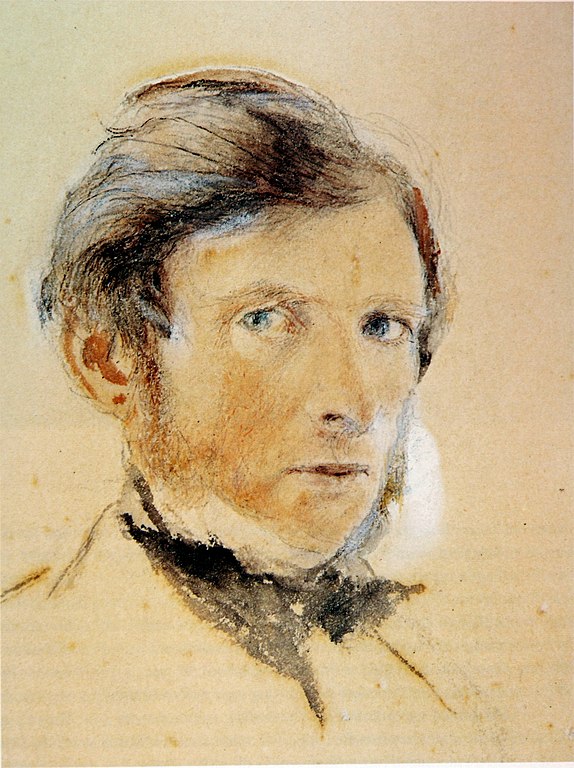
John Ruskin. He is usually identified as being an "art critic," such as in this typical entry from a dictionary:  "Ruskin, John. 1819-1900. British writer and art critic who considered a great painting to be one that conveys great ideas to the viewer.  His works include Modern Painters (1843-1860)."

John Ruskin,
self-portrait, 1861
But Ruskin thought about much more than art.  He even reflected deeply upon intellectual issues related to religion during the 19th century, during which he lived. It was a rapidly-changing, confusing time to many people in England.

The emergence of historically-oriented academic fields such as geology and paleontology had raised questions about the Bible's truth, which was being approached with a new, historical mindset (rather than symbolically or spiritually, as had been traditional).  Those sciences were revealing the Earth's age to be vastly older than traditionally imagined.  Ruskin confessed to a friend:

"If only the Geologists would let me alone, I could do very well, but those dreadful Hammers! I hear the clink of them
                                                 at the end of every cadence of the Bible verses."

For the first couple centuries after the rise of modern science in the 1600's, it had been hoped that scientific discoveries about the natural world would add new, overwhelming evidence to how Nature had been designed by a good, benevolent Creator.  But Ruskin was aware of the drawbacks in that approach because of the ambiguity of Nature.  Calling upon readers to view the natural world with a keen eye (the way they might examine a painting), he first lays out an idyllic scene:

"It is a little valley of soft turf, enclosed in its narrow oval by jutting rocks and broad flakes of nodding fern.... The autumn sun, low but clear, shines on the scarlet ash-berries and on the golden birch-leaves, which, fallen here and there, when the breeze has not caught them,
 rest quiet in the crannies of the purple rock."

But then, his camera-like eye pans slightly to the right:

"Beside the rock, in the hollow under the thicket, the carcase [carcass] of a ewe, drowned in the last flood, lies nearly bare to the bone, its white ribs protruding through
 the skin, raven-torn."

Ruskin (writing even before the after-effects of Darwin's Origin of Species) forces us to see the disturbing ambiguity of Nature: That which was death to the ewe is life to the ravens.

Nature as turbulent.
Despite Nature's not being able to be a straightforward moral guide to us, Ruskin does not think we should lose the compassionate capabilities of the human heart -- as demonstrated by the sympathetic manner in which he describes the next things his observant eye falls upon:

"I see a man fishing, with a boy and a dog -- a picturesque and pretty group enough certainly, if they had not been there all day starving. I know them, and I know the dog's ribs also, which are nearly as bare as the dead ewe's."                                                                 

These passages show how Ruskin viewed the face of Nature as being illuminative and yet turbulent.  Those qualities of Nature are also expressed in the paintings of J.M.W. Turner, which Ruskin greatly admired.

Nature as illuminative.

~ ~ ~ 

(Is there a way you view the presence of disturbing features in Nature and yet still derive inspiration from it?)


(The dictionary entry is from The American Heritage Dictionary, 3rd edition, © 1992.)
(Ruskin's statement about Bible verses was made in his letter of May 24, 1851 to Henry Acland.)
(Ruskin's descriptions of scenes in the natural world are from the 1860 edition of his Modern Painters, )

Friday, July 2, 2021

There's More to Penn and His Pen

A child's learning involves being able to identify things. (Spoon. Ball.)  And it involves being able to recognize recurring patterns.  (That ball and spoon both go down when pushed off the edge of the table.)  However, that wonderful human ability to identify things and discern recurring patterns has a drawback: It easily results in our simplified classifying and stereotyping of people.

Not only do we easily group people by race or ethnic background, we also classify historical personages by what they are most famous for.  For example, one person becomes "a scientist" in the historical record, even though that "scientist" might have most enjoyed playing with their children. Or, another famous person becomes "a singer," even though that "singer" might have most enjoyed tinkering with old clocks.

Can classify the people by their clothes.
One historical figure in early North American history has become indelibly linked to the state of Pennsylvania:  William Penn, whose last name is the first part of that state's name.  There is a bit of irony here, because even after getting the king of England's permission to establish a colony in the "New World," William Penn spent more years in Germany and England than in the future U.S.  Because most education in the U.S. today is secularized, American-history textbooks classify the man as a political leader.  Books on the history of Christianity, in contrast, classify him as a leader of a religious movement, the Quakers.  As a result of such classifications, neither type of textbook is likely to tell the reader about Penn's thoughts and writings about Nature.

William Penn's enjoyment of Nature is demonstrated by the name he had preferred for the colony he founded in 1691: "Sylvania," meaning "forest" in Latin.  It is from the same Latin root for "Sylvania" that we get the little-used English word "sylvan," meaning related to wooded areas.  (It was King Charles II who stuck "Penn" on the front end of the colony's name in honor of William Penn's father, an admiral.)

Even though on national holidays such as the Fourth of July, patriotic Pennsylvanians might focus only on William Penn's interest in founding a colony, that man's appreciation of Nature is revealed in words like these that flowed from his pen:

"The world is certainly a great and stately volume of natural things, 
and may be styled the hieroglyphics of a better one, 
But, alas, how very few leaves of it do we seriously turn over!
... The country is both the philosopher’s garden and his library, 
in which he reads and contemplates 
The power, wisdom and goodness of God."

With those words in Penn's book "Some Fruits of Solitude," he is sharing in a long tradition within Christianity of viewing the natural world  as a revelatory "Book of Nature" that supplements and complements another book, the Bible.

Artists' portraits of Penn and his fellow 17th and 18th-century Quakers frequently portray them wearing their distinctive flat-topped black hats as an aid to picture-viewers in identifying them as being Quakers.  (The Quaker Oats Company has stated that one such portrait on their trademarked cereal boxes is not William Penn, as they once claimed, but is just a generic Quaker.)  Those flat-topped hats with two projections to the side look out of fashion today.

A sparkle of beauty added to our life.

But perhaps not out of fashion might be William Penn's additional thought that,"It would go a long way to caution and direct people in their use of the world" if "they were better studied" in the natural world as revealing the Divine.  He continues: 

"For how could man find the confidence to abuse it,
While they should see the Great Creator stare them in the face, 
in all and every part thereof?"

~ ~ ~

(Is there any way that you feel you "see the Great Creator" in Nature?)


(Both quotations are from William Penn's book "Some Fruits of Solitude" [1682, 1693], capitalization modernized.)

Friday, December 4, 2020

A Little Light — But What a Light!

 It seems like such a little act:  lighting a candle.  But I have discovered in that act much to meditate upon.


An ungrand beauty.As the year heads into its last few months, more tiny flames are lit around the world as particular religious festivals arrive:  Diwali, Hanukah, Christmas, even the newcomer Kwanza.  All these celebrations light candles in some form as part of their ceremonies.  Sometimes the wicks being lit are at the tip of hard candles; sometimes in a tiny cup of liquid.  But the visual effect is the same.  And it is beautiful.

In the northern hemisphere, the lighting of candles on those holidays late in the year carries an added spiritual meaning through the warmth the candles bring in cold weather.  But even when those religious holidays are practiced in the southern hemisphere, with days getting longer, candle lights can bring a soft yellow glow to what was darkness.  Although I am not a Roman Catholic, I have (as long as I can remember) found pleasing any pictures of Catholics lighting candles in a sometimes dim sanctuary, often accompanied by private prayers.

Before electricity came to our modern world, candles were used where today we use tiny light bulbs.  I feel nervous when I see pictures of some Europeans lighting candles on the branches of evergreen Christmas trees.  And I know the firefighters at my local fire-department can sleep easier knowing that electric lights decorate our trees in the U.S.  But we still desire to light candles in other ways during these festive months.

Before our petroleum age, the material for candles was wax from bees or tallow from sheep or cattle.  We might do well to recognize the flame as also being a gift from Nature.

A power with a string attached.
Scientists who work in the area of evolutionary psychology try to project their thoughts back upon the path of human evolution.  Certainly a significant step in that story would have been being able to start a fire.  The European cultural heritage expresses how momentous that discovery was with its mythological story of Prometheus, who steals fire from the gods.  In the playwright Aeschylus's adaptation Prometheus Bound, Prometheus is also viewed as being the bringer of civilization.  But the god Zeus knew all too well how dangerous humans could be without bounds.  And so, Prometheus is bound to a rocky mountain as punishment.

That danger of possessing fire is why my reflections upon candle-lighting have led me to see it as an example of behaving in a restrained, respectful manner.  In humankind's use of candles, we have found a way to handle fire in a controlled way. If in mythology fire brings civilization, can lighting a candle be a civilizing act today?  In our religious and spiritual lighting of candles, can we—instead of fanning the flames of anger in ourselves and others—turn our hearts toward worship?

The commonality across faith-traditions of lighting candles (whether in sticks or cups of liquid) might enable us to share in the emotions of Howard Thurman, even if our faith-tradition is non-Christian, or if we have none.  He writes in part:
"I Will Light Candles This Christmas.
Candles of joy despite all sadness,
Candles of hope where despair keeps watch,
Candles of courage for fears ever present,
Candles of peace for tempest-tossed days,
Candles of grace to ease heavy burdens."

~ ~ ~

Do you light candles on particular occasions?  When?  What feelings does it bring?


(The lines from "Candles for Christmas" by Howard Thurman are from Meditations of the Heart, © 1953, used under Fair Use.)
(The painting of Prometheus by Jan Cossiers is in the Public Domain.)

Friday, November 6, 2020

Yearning for Something Better

"We pursue the true, the good, and the beautiful,
even though the false, the nasty, and the messy 
might have been just as useful to our genes."

What was it that attracted me to this statement by the contemporary philosopher Roger Scruton?  In part, it was my knowing that Truth, Goodness, and Beauty have been held by Christianity to be the three classic avenues through which we come to know God.  But something more immediate influenced me, something about human society today.  In a world in which we are told by some people not that there are additional facts but that there are "alternative facts," and told by still others that "truth isn't truth," it can be hard to find our bearings.  Hard to restore our grounding.  Scruton's statement reminded me that there is something within us that yearns for something better.

My responses to Scruton's words began to resonate with the picture on the cover of Scruton's book The Soul of the World.  It was a painting by the great 17th-century master Nicolas Poussin titled "Landscape with a Calm."  That painting (see below) does indeed convey an air of calm, with a herder and animals in the foreground, still water and sheep in mid-ground, and a gentle slope and stable architecture in the background.  A diffused sunlight bonds all the elements together.

Researching in an art book, I found out that although Poussin lived in the era of effusive baroque art, there was in Poussin a "conscious attempt to suppress feeling....[Nevertheless,] his paintings are hardly ever cold or lifeless."  That is because there is in them, even if it is subtle, "an emotional tension -- a tension developed between the imaginative force of the informing idea and the strict discipline of the means used to control and express it."  Poussin sought with his landscape paintings to convey more than a landscape.  He sought to convey not the surface complexity (or possible chaos) of the world but to hint at enduring truths obscured by our human disorders.  Even in his twenties, he had written:
"My nature leads me to seek out and cherish things that are well ordered,
shunning confusion which is as contrary and menacing to me
as dark shadows are to the light of day."

There it was: Echoing down from centuries ago, a statement of Poussin that there was also in his nature a yearning for an orderly, truthful dimension that lies beneath the visible surface of this too-often darkened world.

Moreover, isn't the yearning within us for some stable ground a yearning for more than truth? Isn't it also a yearning for something we can trust?  And for people we can trust?  (The chief cause of broken friendships is betrayal.)  If the yearning is for more than truth, it would be a yearning also for goodness in our relationships to the world.  And a yearning for a kind of beauty that is not always visible to our physical eyes.  Truth, Goodness, and Beauty.

~ ~ ~

Is there a way you try to restore your bearings in a world in which, it seems, "anything goes"?

Seeing more than the surface of this world.


(The quotes by Scruton are from The Soul of the World, © 2014, pp. 5 & 6.)
(The quotes by and about Poussin are from The Age of Baroque by Michael Kitson
in the series Landmarks of the World’s Art, © 1966 p. 73.)

Friday, March 6, 2020

Bound Together at the Root

We call them "pages" -- those rectangular sheets that form a book.  At one time, those pages were not infrequently called the "leaves" of a book.  Today, we employ that term less often (although we do still use "loose-leaf" notebooks, even in this digital age).  And occasionally we might say that a person is "leafing through" a magazine as they browse through its pages.

An eloquent pen.
John Donne
(1572-1631)
The employment of the same English word for both the pages of a book and those flat attachments to a tree we call "leaves" proved to be fertile ground for the pen of the early 17th-century poet and essayist John Donne.  His prose could at moments be as rich as poetry.  And he drew upon the "leaf" metaphor in "Meditation XVII" of his Devotions Upon Emergent Occasions.  That is the mediation in which he makes his more famous statement that "No man is an island, entire of itself."  But his expansion of the "leaf" metaphor is more intricate.

In his imagery, he turns a book into a living organism that goes through a season of rebirth -- the way a tree is reborn into a new spring of life, even though its leaves had fallen to the ground the autumn before.  In Donne's intricate picture, those "scattered leaves" are parts of our human lives, which can seem piecemeal.  But God is able to give new meaning to them, even though we are all mortals.  As Donne writes:
"When one man dies, one chapter is not torn out of the book,
 but translated into a better language."
One reason God is able to do that work of restoration is because "all mankind is of one author and is one volume."

Donne would doubtlessly have been aware of the long tradition in Christianity of describing the natural world as the "Book of Nature." Similar to the way that Christianity possessed a book -- the Bible -- as one source of revelation, the natural world was also viewed as being able to reveal things about God.  But in his "Meditation XVII," John Donne focuses just on humans and the challenge of our mortality.

All part of a whole.
"not torn out"
Death was a challenge he knew full well.  His wife Anne, at the age of 33, died after giving birth to a stillborn child.  Also, John Donne had to frequently deal with death as an Anglican pastor: ringing the bell to signal the loss, and then addressing the congregation through a sermon.  In his "leaf" metaphor, he takes advantage of the stitched edge of a book being called its "binding" to emphasize that we are all inescapably bound together.  In a more fascinating way, he describes death as not being removed from the "book" but as being "translated" as God reveals new meaning in each person's existence.  As Donne puts it:
"Some pieces are translated by age, some by sickness, some by war, some by justice;
 but God’s hand is in every translation, and his hand shall bind up
 all our scattered leaves again for that library
 where every book shall lie open to one another."

In the same way that the continuing work of the Creator recycles the minerals of a tree's fallen leaves back into the tree's new spring-life, the values of our human lives are not lost in Donne's vision.  Instead, at death, they are given new, deeper meanings as part of a larger whole.  Indeed, many of us have experienced how the lives of the people we have known but who have died can speak to us in a new way, even though they are physically gone from us.

Raising our sights.

~ ~ ~ 

(Is there a person no longer living whose life gives you additional understanding for your own life?  Who?  And how?)


(All the quotations are from John Donne's "Meditation XVII" from his Devotions Upon Emergent Occasions, 1624.)
(The portrait of Donne is in the public domain by virtue of its age beyond the artist's life.)

Friday, November 1, 2019

Knowing Water

Transparent, but a lot to be seen there.All of us have known water since before our earliest memories of anything.  Maybe that first taste of water was from a nippled bottle, maybe from a small cup.  But we encountered water long before we could have thought about it.  Water is basic.

Despite its being so basic, there are many ways that we know water.  Thus there are many ways -- all valid -- of answering the question, "What is water?"  And they demonstrate the variety of ways we know this world.

On a beginning chemistry exam, if I am asked what water is, I know to answer that water is composed of two atoms of hydrogen and one atom of oxygen -- H2O.  I understand water chemically as I understand that formula, along with knowing what a molecule is.  But that is a very abstract type of knowledge.  Long before modern chemistry, humans knew what water is when they were refreshed by drinking it or bathing with it.

Writers of the Bible knew those immediate ways of knowing water.  They also knew how those ways of knowing water are not confined to the human race but are also experienced by other
animals. The writers of the Bible knew how experiencing water’s life-giving properties could open a person to remembering and re-encountering God.  As a typical psalm of creation, Psalm 104 (1--11a, NRSV), puts it, speaking to God:
"You make springs gush forth in the valleys;
they flow between the hills,
giving drink to every wild animal."

We can know more about water as we come to know it through our religious traditions. As a Christian, I understand religiously what water is in several ways:  By attending baptisms. By singing hymns and hearing scriptures containing the word “thirst.”  And by joining with other people of faith to see that homeless people are provided water.  Christianity and Judaism are not unique in their integration of the theme of water into their theological reflections.  In the Islamic tradition, the Qur’an (Koran) states:
"In the water that Allah sends down from the clouds and quickens therewith
the earth after its death and scatters therein all kind of beasts,
and in... the clouds pressed into service between the heaven and the earth,
are indeed Signs for a people who understand."

The telling presence of water.Scientists, in their own way, know which planets might have had forms of life by finding indications that the planet has had water -- water being essential for life.  If I pause to reflect upon water, which I often take for granted, I can re-discovery my commonality with all of life.  A commonality not just in needing water, but also a commonality in yearning, longing, and striving. Also, it is through a recognition of types of striving in other kinds of living beings (animals and plants) that we intuit that they are alive too.

Gabriel García Márquez's novel One Hundred Years of Solitude is set in a town in a tropical jungle. In a memorable scene, the protagonists' encounter with a new form of water becomes an encounter of a miraculous kind.  A gypsy opens a chest, revealing to the protagonist and his father José Arcadio "an enormous, transparent block with infinite internal needles in which the light of the sunset was broken up into colored stars."  José  Arcadio ventures a guess as to what it might be:
" ' It's the largest diamond in the world.'
'No,' the gypsy countered. 'It's ice.' "

~ ~ ~

(Can you recall a particular occasion when you had no water handy, and recall how it felt to take that first drink when you were so thirsty?)


(Qur’an quotation is from sura 26, trans. Muhammad Zafrulla Khan, quoted in Matthew Fox's One River, Many Wells, p. 38.)
(Quotation from Márquez's One Hundred Years of Solitude, © 1970, p. 18.)
(Photographs are in the Public Domain.)

Friday, July 5, 2019

A Better Question about Beauty

What do we see?
If anywhere today the matter of beauty comes up for discussion, almost inevitably someone asks, "Is beauty just in the eye of the beholder?"  (Sometimes, that question will be simply implied by someone repeating the stock phrase that "beauty is in the eye of the beholder.")  In our heavily scientific age, that phrase -- "eye of the beholder" -- casts a cloud of suspicion over beauty.  Modern science seeks empirical observations that can be made by multiple scientists.  In contrast, two people observing the same object can disagree about whether that object is beautiful.  And so, there is an air of suspicion about whether beauty is "really out there" or is just something our minds project upon the world.  Beauty is not easily nailed down.

Philosophers today spin in circles asking questions about beauty.  And most modern theologians usually don't even address the matter.  Meanwhile, ordinary people throughout the world make beauty a part of their lives.  And find beauty in Nature, and are inspired by it.  They pick flowers and make art.  They listen to birds and create songs.  They are not fooled by philosophical questions.  The contemporary writer Elaine Scarry makes a critical point:
[Beauty] seems to incite, even to require the act of replication.... It makes us draw it,
 take photographs of it, or describe it to other people."
Perhaps we would get deeper into appreciating and understanding beauty if instead of the usual question about "eye of the beholder" we asked why beauty entrances us.  And why we humans are drawn toward imitating it.

Another stock phrase that can be a stifling cliche is that "beauty is only skin-deep."  Admittedly, that phrase can remind us that we can be misled by some person's superficial beauty.  But the phrase "skin-deep" can discourage us from looking more deeply into the nature of beauty's power upon us -- including it's ability to bring us closer to our best true selves.  And its ability to draw us closer to the Divine.

Forgotten thoughts about beauty.
Before modern times, the eighteenth-century Christian theologian Jonathan Edwards believed that beauty was an essential part of his experience of God, who was revealed through the natural world.  He wrote:
"When we are delighted with flowery meadows and
 gentle breezes of wind, we may consider that
 we only see the emanations of the sweet benevolence of Jesus Christ ... his love and purity."

A few contemporary theologians are beginning to wake up to the fact that in modern times their field of theology has neglected the topic of beauty.  One such writer is the contemporary religion professor Frank Burch Brown.  He emphasizes that:
"Aesthetic experience is a pervasive factor in our sense of the sacred,
  
[and] in our delight in creation."

Asking the more productive question about beauty -- the one about our desire to replicate beauty -- is not just an academic matter.  It is a critical matter because we are confronted daily with so much ugliness.  Especially in the way humans often behave toward one another.  Everything from terrorists to ugly internet comments.  That gives us even greater reason to cultivate forms of beauty.

Beauty is not just something we perceive (or don't perceive).  It can also be something we do. A person can display beauty through loving and giving.  When we create beauty, and when we act in beautiful ways, we align our lives with the natural beauty in the world.  And thus transform ourselves.
~ ~ ~

What experiences of beauty in Nature linger in your memory?


(The Elaine Scarry quotation is taken from her book On Beauty and Being Just, © 1999, p. 3.)
(The Edwards quotation is taken from Open Secret by Alister E. McGrath, © 2009, p. 284.)
(The Frank Burch Brown quotation by is from “Aesthetics” in the New & Enlarged Handbook of Christian Theology,
 Donald W. Musser & Joseph L. Price, eds. © 2003. pp. 19 & 21.)
(Both pictures are in the public domain.)

Friday, June 7, 2019

As Busy as... You Know What

The artist's and scientist's eye as one.
Melissographia (1625)
Our contemporary academic fields chop our one world into many pieces.  We classify a matter as falling within the area of history or biology or religion.  But such categorization can obscure the wholeness of our complex lives.  I was reminded of that drawback when I read the news story about three beehives of honeybees having survived the terrible fire in Notre-dame Cathedral in 2019. As the beehives on the roof had been part of a project to restore Paris's  population of critical pollinators, was the news story about environmentalism?  Or was it a story about biology because it testified to bees' natural durability?  Or, given the centuries-long history of that cathedral -- involving religious, political, and secular events -- does the bee story fall within the category of "history"?

Even within our category of "history," we create sub-categories.  And textbooks on the history of Christianity will be employed more often by religion professors than by the history department.  That sidelining of church history in our secular age means that the historical contributions of the church to preserving bees might go overlooked.  But monks and other church employees whose names have been forgotten cultivated bees for both tasty honey and the tallow to make church candles.  The environmental writer Paul Shepard informs us that:
"In Wittenburg, Germany, before the [Protestant] Reformation, some churches used 35,000 pounds of wax a year. On Candlemas Eve, hives were decked with ribbon and a song...beginning, ' Bees awake.' [was] sung as people carried wax candles,"

Bees have also navigated their way into the field of literary lore.  Many a Sherlockian enthusiast knows that Sherlock Holmes dreamed of eventually leaving stimulating London to retire to the English countryside -- where he would enjoy taking care of honeybee hives.

Bee geometry.
We also need to reserve a page in the mathematics textbook for bee geometry.  That is because the distinctive six-sided perimeter around each cell of honeycomb fits the greatest number of those tiny compartments into a hive.  It requires some higher mathematics to prove that an equivalent number of eight-sided cells would require greater space.  How do the bees "know" to go for hexagons? What pressures drive them?  To answer that puzzle, we would also need specialists in animal behavior.  And maybe a physicist too.

Bees also show up in the field of genetics.  Forget the familiar picture of two sexes coming together to create offspring with a 50-50 chance of being male or female.  In the peculiar world of honeybees, only the queen lays eggs, the numerous worker bees are undeveloped females, and the very few males that exist come from unfertilized eggs!

Bees have also buzzed their way into art books.  The complicated clash of circumstances and
personalities that occurred between Galileo and Pope Urban VIII is too often misrepresented
Golden bees survive grace a tomb.
 as a stereotyped battle of truth vs. ignorance.  But if we follow the path of bees, we would find that before their conflict, Urban had praised Galileo's scientific writings and was a promoter of the arts and architecture.  Urban was from the Barberini family, whose signature symbol was bees.  A triad of bees mark many buildings in Roman built under that Pope's patronage; and golden bees grace Urban's tomb.

So numerous have been bees interconnections with the human race that we could develop a course titled "Honeybee History."  But then we'd have to argue over whether it should be handled by the history, biology, or environmental studies department.  Any professors up for co-teaching an interdisciplinary course?
~ ~ ~

Specialization suits bees quite well. Do you think it suits humans?


(The Paul Shepard quotation is from his book The Others: How Animals Made Us Human, © 1996, p. 124.)

Friday, February 1, 2019

Another Word for Love

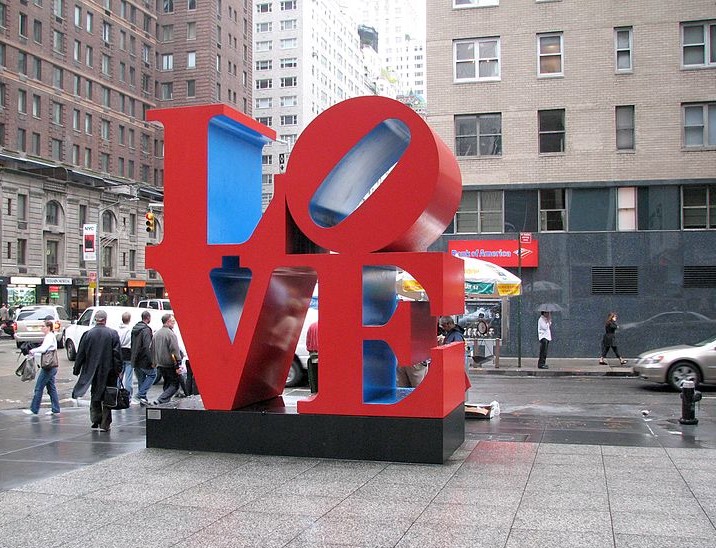
"Love."  Among four-letter words in the English language, it is one of the most spoken (and most sung).

A common word, even in a hard-edged city.
Sculpture by Robert Indiana,
 in Manhattan
Students of the New Testament are often taught that the Greek language has more than one word translatable as "love."  The Greek word eros is often used for sexual love but is more generally the experience of falling in love.  A second word, philia, expresses the fondness that can develop between people, as in friendships.  A third Greek word, agape, was less specific in the Hellenistic world, thus enabling New-Testament writers to sometimes use it in developing a concept of self-giving love.  Over time, Christianity used that word agape for emphasizing our ultimate experience -- that of knowing God's loving orientation toward the world.

The Greek language, however, also contains another world for love: storge.  It is used to speak of instinctual affection, one example being that of a mother for her child.  Christian writers today sometimes delineate the first three Greek words but make no mention of storge.  (An exception is C.S. Lewis, who in his book The Four Loves writes that "the human loves can be glorious images of Divine love.").  We should not underestimate the power of storge.

Although by using words, we can distinguish between this variety of meanings of the word "love," we can see especially in human relationships how the forms of love overlap:  Two people can love each other in more than one way.  Nevertheless, by possessing that fourth word -- storge -- we can explore better our relationships to non-human animals.

That fourth form of love, not usually mentioned by teachers of New-Testament Greek, is nevertheless implied at times in the Bible.  Being an instinctive response to the feelings of another living being, storge extends to our human affection for animals, which can evoke our care for them.  For example, in the Biblical book of Deuteronomy (25:4, NRSV), farmers are instructed, "You shall not muzzle an ox while it is treading out the grain," thus emphasizing that the ox gets hungry too.  And one verse in the book of Proverbs (12:10a, NRSV) states that people who live rightly "know the needs of their animals."

Much loved: children and pets
Victorian painting
by Joshua Reynolds
The treatment of animals down through European history is a long, complex story, not reducible to modern enlightenment overcoming medieval darkness.  Nevertheless, especially in England in the 1800’s, the movement of people into cities and the emergence of a middle class with some leisure hours meant that more people kept pets. That dog or cat, rather than being a working animal in the barn, would be kept right beside a person, even on the person’s lap, making it easier for the person to experience the animal’s emotions as being like their own.  In her Jubilee address in 1887, Queen Victoria (a dog owner) spoke of her "real pleasure [in] the growth of more human feelings towards the lower animals."  The contemporary writer Richard D. Ryder spotlights one major cause of that change:
"Was not the growing interest in animal protection also an effect of the increasing stability of society and the extension of affluence?  Never before had so many felt economically and
socially secure. They could afford to show some compassion for the underprivileged,
both human and nonhuman."

An additional advantage of having a word for animal-affection is that it can enable us to recognize that quality between animals of the same species -- not just among mammals, but also, for example, in parent birds' bonds with their offspring. Love is indeed a many-splendored thing!
~ ~ ~

As a child, did you have any pets that helped you learn how to care for others?


(The quotation by Lewis is from The Four Loves, © 1960, p. 9.)
(The quotation by Ryder is from his Animal Revolution, © 1989, p. 152.)
(Love is a Many-Splendored Thing was the title of a 1955 movie and song.
The phrase "many-splendored thing" dates back at least to a 1913 poem by James Kenneth Stephen.)

(Both photographs are in the public domain.)

Friday, December 7, 2018

A Little Light — But What a Light!

It seems like such a little act:  lighting a candle.  But I have discovered in that act much to meditate upon.

An ungrand beauty.As the year heads into its last few months, more tiny flames are lit around the world as particular religious festivals arrive:  Diwali, Hanukah, Christmas, even the newcomer Kwanza.  All these celebrations light candles in some form as part of their ceremonies.  Sometimes the wicks being lit are at the tip of hard candles; sometimes in a tiny cup of liquid.  But the visual effect is the same.  And it is beautiful.

In the northern hemisphere, the lighting of candles on those holidays late in the year carries an added spiritual meaning through the warmth the candles bring in cold weather.  But even when those religious holidays are practiced in the southern hemisphere, with days getting longer, candle lights can bring a soft yellow glow to what was darkness.  Although I am not a Roman Catholic, I have (as long as I can remember) found pleasing any pictures of Catholics lighting candles in a sometimes dim sanctuary, often accompanied by private prayers.

Before electricity came to our modern world, candles were used where today we use tiny light bulbs.  I feel nervous when I see pictures of some Europeans lighting candles on the branches of evergreen Christmas trees.  And I know the firefighters at my local fire-department can sleep easier knowing that electric lights decorate our trees in the U.S.  But we still desire to light candles in other ways during these festive months.

Before our petroleum age, the material for candles was wax from bees or tallow from sheep or cattle.  We might do well to recognize the flame as also being a gift from Nature.

A power with a string attached.
Scientists who work in the area of evolutionary psychology try to project their thoughts back upon the path of human evolution.  Certainly a significant step in that story would have been being able to start a fire.  The European cultural heritage expresses how momentous that discovery was with its mythological story of Prometheus, who steals fire from the gods.  In the playwright Aeschylus's adaptation Prometheus Bound, Prometheus is also viewed as being the bringer of civilization.  But the god Zeus knew all too well how dangerous humans could be without bounds.  And so, Prometheus is bound to a rocky mountain as punishment.

That danger of possessing fire is why my reflections upon candle-lighting have led me to see it as an example of behaving in a restrained, respectful manner.  In humankind's use of candles, we have found a way to handle fire in a controlled way. If in mythology fire brings civilization, can lighting a candle be a civilizing act today?  In our religious and spiritual lighting of candles, can we—instead of fanning the flames of anger in ourselves and others—turn our hearts toward worship?

The commonality across faith-traditions of lighting candles (whether in sticks or cups of liquid) might enable us to share in the emotions of Howard Thurman, even if our faith-tradition is non-Christian, or if we have none.  He writes in part:
"I Will Light Candles This Christmas.
Candles of joy despite all sadness,
Candles of hope where despair keeps watch,
Candles of courage for fears ever present,
Candles of peace for tempest-tossed days,
Candles of grace to ease heavy burdens."

~ ~ ~

Do you light candles on particular occasions?  When?  What feelings does it bring?


(The lines from "Candles for Christmas" by Howard Thurman are from Meditations of the Heart, © 1953, used under Fair Use.)
(The painting of Prometheus by Jan Cossiers is in the Public Domain.)

Friday, September 7, 2018

Yearning for Something Better

"We pursue the true, the good, and the beautiful,
even though the false, the nasty, and the messy 
might have been just as useful to our genes."

What was it that attracted me to this statement by the contemporary philosopher Roger Scruton?  In part, it was my knowing that Truth, Goodness, and Beauty have been held by Christianity to be the three classic avenues through which we come to know God.  But something more immediate influenced me, something about human society today.  In a world in which we are told by some people not that there are additional facts but that there are "alternative facts," and told by still others that "truth isn't truth," it can be hard to find our bearings.  Hard to restore our grounding.  Scruton's statement reminded me that there is something within us that yearns for something better.

My responses to Scruton's words began to resonate with the picture on the cover of Scruton's book The Soul of the World.  It was a painting by the great 17th-century master Nicolas Poussin titled "Landscape with a Calm."  That painting (see below) does indeed convey an air of calm, with a herder and animals in the foreground, still water and sheep in mid-ground, and a gentle slope and stable architecture in the background.  A diffused sunlight bonds all the elements together.

Researching in an art book, I found out that although Poussin lived in the era of effusive baroque art, there was in Poussin a "conscious attempt to suppress feeling....[Nevertheless,] his paintings are hardly ever cold or lifeless."  That is because there is in them, even if it is subtle, "an emotional tension -- a tension developed between the imaginative force of the informing idea and the strict discipline of the means used to control and express it."  Poussin sought with his landscape paintings to convey more than a landscape.  He sought to convey not the surface complexity (or possible chaos) of the world but to hint at enduring truths obscured by our human disorders.  Even in his twenties, he had written:
"My nature leads me to seek out and cherish things that are well ordered,
shunning confusion which is as contrary and menacing to me
as dark shadows are to the light of day."

There it was: Echoing down from centuries ago, a statement of Poussin that there was also in his nature a yearning for an orderly, truthful dimension that lies beneath the visible surface of this too-often darkened world.

Moreover, isn't the yearning within us for some stable ground a yearning for more than truth? Isn't it also a yearning for something we can trust?  And for people we can trust?  (The chief cause of broken friendships is betrayal.)  If the yearning is for more than truth, it would be a yearning also for goodness in our relationships to the world.  And a yearning for a kind of beauty that is not always visible to our physical eyes.  Truth, Goodness, and Beauty.

~ ~ ~

Is there a way you try to restore your bearings in a world in which, it seems, "anything goes"?

Seeing more than the surface of this world.


(The quotes by Scruton are from The Soul of the World, © 2014, pp. 5 & 6.)
(The quotes by and about Poussin are from The Age of Baroque by Michael Kitson
in the series Landmarks of the World’s Art, © 1966 p. 73.)

Friday, June 22, 2018

A Rocky History Read Backwards

Writers in Western culture have long employed the metaphor of a "book" for depicting the natural world, with we being "readers" of that "book."  Theologians in both Christianity and Islam have said that the "Book of Nature" might even speak to us something about God.  It was a famous scientist, however, who in 1859 drew upon the "book" metaphor to explain an aspect of the geological record.  In Origin of Species, Charles Darwin wrote:
"I look at the natural geological record... as a history of the world imperfectly kept,
 and written in a changing dialect; of this history we possess the last volume alone....
 Of this volume, only here and there a short chapter has been preserved;
 and of each page, only here and there a few lines."

Darwin was having to explain why -- unlike, other books that we haven't finished reading -- we know more about the last pages of the book of the Earth's geology than about the first.  Today, geologists have succeeded in reading more and more of those pages, going further and further back, despite the fragility of many fossils, and the fact that fossils were created only under special circumstances.  This geological "history book" is being read from the back towards the front.

Almost like glass.
It was not along a book-like, historical narrative that I first encountered the science of geology.  Instead, I first experienced the identity of rocks in compartmentalized categories. When I was of upper elementary-school age, I was given a boxed set of rocks.  It consisted of a white, plastic tray of 15 thumb-size rocks, each one in its open-topped compartment.  The makers of the set, knowing that children would want to take the rocks out of their cubbyholes, wisely managed to adhere a small, identifying nametag to each rock.

An intense yellow.
 I found the differences between those unpolished rocks fascinating.  White gypsum.  Yellow sulfur.  Black coal.  Even the feel of each one was different.  Despite that childhood enjoyment, when I had some brief encounters with geology books in high-school and college, I could never get the rocks to "speak" to me.  When those books tried to explain geological history, I could not create a powerful enough mental picture because those geological layers were out of sight, underground.

That changed one day when my wife and I were driving slowly through a mostly desert area of Big Bend Natl. Park in southwest Texas.  When our car turned around the corner of  a small projecting mass of rock that had been hiding part of our view, my wife exclaimed, "That field's growing boulders!"  And how striking indeed was that area of desert beside our car.  It was a flat, tan area of desert, on which it looked as if a giant had been playing with a set of dark-brown marbles ranging from one foot to several feet in diameter.  It was if the surface of the Earth had been turned inside out, with those out-of-place boulders shouting a message about how their lives that had once been underground.  Yet they now stood there before us, unmoving, like a moment frozen in time. A book held open to one page so that we might read it more carefully

~~~

Have you ever seen rocks or geological structures that were fascinating to you?


(The Darwin quote is from the last paragraph of
 Chapter IX of Origin of Species [orig. 1859].)

Friday, June 8, 2018

The Mathematics of Miracles

Although most people have never read Walt Whitman's long poem "Song of Myself" in its entirety, many people have heard or read stanzas taken from it.  One such stanza concerns a mouse.  The poem as a whole is Whitman's celebration of all people and all of the natural world as they resonate through Whitman's experience of himself in the world.  The mouse appears in these lines:
"I believe a leaf of grass is no less than the journeywork of the stars,
... And the cow crunching with depressed head surpasses any statue,
And a mouse is miracle enough to stagger sextillions of infidels."

So small, yet so complex.Whitman has, of course, chosen a mouse in part because of its small size -- in contrast to many Christians of his day citing grand events as miracles. But when I first read that line in college, I was able to appreciate his choice of a mouse because I had for awhile had a pet white mouse when I was in high-school.  My mouse was part of a science project.  (The mouse was not going to be harmed in any way -- I was too soft-hearted for that.  I was just going to try to measure its output of carbon dioxide.)

Whitman's statement "a mouse is miracle" evoked my memory of my little white mouse's miraculous features when observed up close:  The slender flexibility of its tail.  The softness of its body despite so much energy.  Its countless white hairs.  Its small round eyes. (Can they really see like mine, although being so tiny?).  Its pointed nose, always seemingly sniffing.  The way it bent its body slightly from side to side as it explored its world.

Poet and church-cleric
John Donne
Whitman's line about the mouse came back to me recently when I read a quotation by a poet who lived two centuries before Whitman.  It was an observation by the poet and church minister John Donne, which struck me as being insightful:  "There is nothing that God hath established in a constant course of Nature, and which is therefore done every day, but would seem a miracle and exercise our admiration, if it were done but once;... The ordinary thing in Nature would be greater miracles than the extraordinary, which we admire most, if they were done but once... and only the daily doing takes off the admiration."  Donne points us toward everyday miracles.

Today, most mainstream Christian, Jewish, and Islamic theologians would join John Donne in cautioning against searching for the miraculous in some rare interruption of the working of natural laws that science has discovered.  As I go about my day, from getting out of bed to going back to sleep at night, everything going on about me can on some level be described as being natural processes.  I might never find God if I expect to find the Divine only in some interruptions of natural laws.

Donne's theological observation, coupled with my memory of Whitman's mentioning a mouse, made me think about the sextillions of little mice throughout the world, sometimes labeled "pests," but each a little miracle in its own right if seen up close.

~~~

Is there something in Nature you encounter everyday that you think is marvelous?

(The Whitman line is from "Song of Myself,"
 originally in his 1855 collection Leaves of Grass.)
(The Donne line is from a March 25, 1627 sermon, as quoted in Rebuilding the Matrix by Denis Alexander, © 2001, p. 426.)

Friday, May 25, 2018

Among Friends, Books, and Plants

It is the midsummer of 1866.  Five-thousand Prussian troops move into the city of Brünn (in the present-day Czech Republic) as one step in their invasion of the Austro-Hungarian Empire.  Forcing themselves upon the civilian community, sixteen army officers house themselves at the Abbey of St. Thomas, where ninety-four horses of the military are also moved onto the grounds.  The abbey is required to feed everybody at its own expense.  With the city's sanitation pushed to its limits, cholera breaks out, spreading through the terrified city.  Over six weeks, three-thousand civilians and soldiers die.  And on one of those dark days, observing it all from his window at the abbey, would have been a friar with a now famous name: Gregor Mendel.
A dignified-looking friar.
This is not the setting in which most books place Mendel.  Almost invariably, they put him in the abbey's seemingly idyllic garden in which Mendel grew his now famous pea plants -- leading to his scientific discovery of the basic patterns of inheritance.  Placing him in that idyllic garden cultivates a contrast between science and stereotyped religion, especially given our modern myth that science and religion have usually been in conflict.  I still remember my own surprise in middle school upon reading in my biology textbook that a "monk" made one of the pivotal discoveries of modern science.

A peaceful-seeming abbey.
More precisely, the religious order Mendel was part of was a Roman Catholic order of friars (the Augustinian order). That classification meant that its members were more integrated into the surrounding secular community, primarily as teachers, even though in this case living in an abbey.  And the friars of the Abbey of St. Thomas were especially engaged.  The Abbey had a 30,000 volume library with books on botany, horticulture, agriculture, physics, and, of course, theology.  Among Gregor's friar-colleagues were a musical maestro, a Goethe scholar, and a noted philosopher. The head abbot, Cyrill Franz Napp, was current on the latest scientific discoveries. It was in this abbey setting -- more conducive to enlightenment than being surrounded by occupying troops -- that "Mendel found a supportive scientific community," as the contemporary biographer Simon Mawer puts it.

Gregor Mendel was fond of logging statistics on many things, not just his famous pea-plant hybrids.  He also kept data on the weather and astronomy.  His being educated in probability and combinational mathematics doubtlessly encouraged his applying those types of skills to the study of plants.  The data led him to discovery.

A seemingly simple plant.Despite the temporary distraction of an occupying army, Mendel's now famous scientific paper on plant hybridization was published that same year of 1866.  It was the culmination of eight years of work, hand-pollinating and logging seven pairs of traits in 28,000 pea plants, their 40,000 flowers, and nearly 400,000 seeds.

May we in our own small ways show determination in wanting to observe and appreciate the world of Nature, even when human conflict and chaos might dishearten us.

~ ~ ~

Have there been friends who have been part of your learning or your appreciating more the world of Nature?

(The quotation by Simon Mawer is taken from 
Gregor Mendel: Planting the Seeds of Genetics, © 2006. p. 30.)
(The drawing of pea plants, Pisum sativum, is from the book Flora von Deutschland, Österreich und der Schweiz, 1885,
 by Prof. Dr. Otto Wilhelm Thomé, and is used under a Creative Commons Attribution-Share Alike 3.0 Unported license.)