Showing posts with label trees. Show all posts

Friday, April 1, 2022

The Colors of New

I know it dates me, but I remember well when physical card catalogs were the means of locating a book in a library. The 3 in. x 5 in. cards were kept in small, deep drawers that had a rod running though the cards near their bottom edge so they could not be spilled, disrupting their alphabetical order. In middle school, when my fellow students' class and I were taken to the library, we were taught how to use its card catalog. (In elementary school, simply browsing in the books had been sufficient.) The middle-school librarian taught us that for every book in the library, there were three types of cards in the catalog's wooden drawers: Title card, Author card, and one or more Subject cards.

Having learned that system, when my father took my sister and me to the city's central library, I was delighted upon seeing the massive wall of inviting brown drawers. I could browse through the creme-colored cards with almost as much enjoyment as browsing in the books themselves.

A recent book put out by the Library of Congress informs me that, "Harvard's assistant librarian, Ezra Abbot, is credited with creating the first modern card catalog designed for readers" in the 1860's. Previously, books that were being added to a library had often been merely listed in a librarian's ledger book -- making locating a listing as hard as locating the book itself. Another invention of that time-period was the book's card-pocket, in which a checkout card was kept, removed as a record when the book was borrowed, and replaced upon the book's being returned.

I marvel at not only the efficiency but also the simplicity of these two inventions: They were something any librarian could easily adopt and create on their own. (In contrast, imagine trying to build a computer and write cataloging software, or trying to draw today's barcodes by hand!)

Thinking back upon these changes in libraries, I become more aware of how countless new inventions have appeared during my lifetime. Even staying within the walls of a library, microfilm replaced paper newsprint, but was then itself replaced. Long-playing records were added to some libraries, but then became outdated. Changes in technology have come so fast that two historians, Andrew Pettegree and Arthur der Weduwen (in The Library: A Fragile History) caution today's librarians against jumping too quickly on the bandwagon of the new. Today's innovation can become tomorrow's antique artifact. A newer technology seems to always be just around the corner. Changes occur even more rapidly beyond a library's walls.
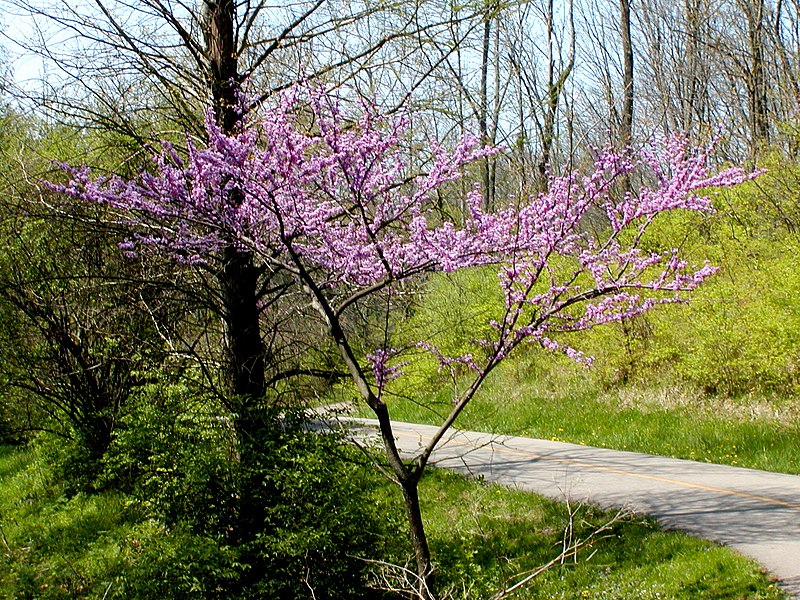
A joyful sign
When I turn away from human societies and look at Nature, I also find the new, but it is a different type of newness.  I see the bright yellow-green spring-leaves emerging on a tree that had been bare for months. And I see the brilliant pink blooms on an otherwise bare redbud tree. This is a type of newness that is different from human inventions. It is the newness of renewal and rebirth. It is a type of newness that is ancient. And it is reassuring amid a world of human struggle and destruction. For, as the 19th-century poet Gerard Manley Hopkins wrote:
"... nature is never spent;
There lives the dearest freshness deep down things...."
Hopkins saw that type of newness as a gift of God's Spirit, which "broods with warm breast and with ah! bright wings."

The newspaper's headlines might be only bad news, but the view of spring out my kitchen window is very good news.

~ ~ ~

Is there a way you find a renewal that lies deeper than human innovation?


(The quotation about the catalog is from the book
 The Card Catalog: Books, Cards, and Literary Treasures, © 2007, p. 82.)
(The lines by Hopkins are from his poem "God's Grandeur.")

Friday, October 1, 2021

Rachel Carson wrote that "There is something infinitely healing in these repeated refrains of nature -- the assurance that dawn comes after night, and spring after the winter."  So it is that we can be revived by the first signs of the return of fall -- whether it be the turning of color  in some leaves or the first drop in temperature.  The  recurring character of fall makes the following article, which was first published in Wisdom in Leaves in 2013, just as relevant today.

~ ~ ~
Having always been quite nearsighted, I could not appreciate trees as easily as I could appreciate leaves.  I could not readily identify which species a tree was from a distance, the way my parents could.  Nor could I see detail in the distant treetops.  But I could look at a leaf closely, even hold it in my hand, and feel its texture.


I am still fascinated by the shapes of leaves.  Not just the variety, but the way that each one looks like something else.  What child has not noticed the resemblance between a maple leaf and their own hand, even fitting their hand upon it?  Another leaf I examine (from what tree I do not know) looks like a spear.  Still another leaf has the outline of a scoop.  And the stiff, large leaf of the southern magnolia tree seems perfectly designed for fanning oneself during a hot southern summer.

To the botanist, the shape of the leaf tells a story about its tree having evolved to flourish in a particular environment.  Even without knowing the details about such variations, I can be amazed to know that it is within those thin leaves that plants magically convert carbon dioxide and water into solid material, thus enabling the plant to grow.  Green leaves are truly miniature factories powered by the sun.

I am fascinated not only by the shapes of leaves but also by their colors.  How many shades of green can there be?  Even more fascinating are the turnings of color as autumn comes.  Like an alarm clock that has gone off, the shock of seeing some trees no longer green can wake us up to the approaching winter.  The change in foliage can even make us think about our own use of time, and whether our time might be short.

In the author O. Henry's amusing story "The Cop and the Anthem," a dead leaf falling into the lap of the main character, a hobo, signals to him that he needs to make a change in his living arrangements in order to make it through the winter.  That warning, coupled with the moving chords of church music that waft outdoors, inspire the hobo to make a good change in his life -- "to turn over a new leaf," as we say.

As fall continues and winter gets even closer, the leaves we see on the ground change colors even more, becoming mottled, creating a quilt of yellows, browns, reds, and even purples.  The leaves are then ready to be recycled into the earth, to become the substance of plants and trees yet again.  The leaves also "turn over a new leaf."

With the passage of time, I am also probably reprocessing things from my past into my future, shedding some things as a way of growing new leaves.  But it is harder for me to see those changes happening in me than it is for me to observe the changes in leaves.  In leaves, I see life and change made manifest.

~~~

Do you have memories about leaves?  How do you experience your life changing with the cycle of a year?


(The Carson quotation is from her talk “A Statement of Belief,” quoted in Paul Brooks's book
  The House of Life: Rachel Carson at Work, © 1972, 1989.)


Friday, November 25, 2016

Looking Up to Trees

Down the block from the house where my wife grew up, there is a modest but nice park.  There is only a little bit of playground equipment.  Instead the park is mostly a place for kids to run and adults to walk beneath the tall, very old trees.

One evening near sunset, I strolled alone into the park, and found myself for some reason pausing before one of the trees.  With no one else around to make me feel embarrassed, I felt a desire to unhurriedly contemplate the tree.  At first I saw up close the rough texture of its bark and the pockmarks from where life's diseases had left scars.  Despite those signs of the tree's vulnerability, I was next struck by the tree's massiveness.  It's height and solidity.  I thought about how the tree had endured countless nights, standing there unattended through wind, rain, and dangerous lightning.

I found myself not only looking up at the tree in its immense height, but also looking up to the tree for its virtues.

To some people, it might seem strange to turn to trees to look for virtues to inspire.  But Tennessee Williams, in his play The Night of the Iguana, turned to a tree for guidance on the distinctly human challenge of facing one's mortality.  In that play (superbly adapted into a movie), a middle-aged spinster artist is traveling through Mexico with her 97-year old grandfather, who is a poet.  The two are broke, trying to hang on by her drawing portraits of tourists and by his recitation of poems for tips.

Intermittently throughout the play, the now nearly deaf and nearly blind grandfather repeats the opening lines of a poem he has been working on but has been unable to complete:
"How calmly does the orange branch
Observe the sky begin to blanch..."
The play's climax is expressed poetically through the grandfather finally having completed his
poem mentally, which he then recites while his granddaughter transcribes it.  The completed poem expresses how the tree, even though it lives "without a prayer" (unlike humans), nonetheless shows "no betrayal of despair" in the face of its future:
grandfather reciting poem
in The Night of the Iguana
"Sometime while night obscures the tree...
A second history will commence.
...the broken stem
The plummeting to earth...."
This return to the earth is:
"An intercourse not well designed
For beings of a golden kind."
It is instead [a] bargaining with mist and mould."

And yet, despite that altered future, the living tree still holds its head high.  So much so that the soon-to-die grandfather looks up to the tree, expressing in the final stanza of the poem his desire to live like it:
"O Courage, could you not as well
Select a second place to dwell,
Not only in that golden tree
But in the frightened heart of me?"
~~~

Are there any qualities of trees that you would like to share in?


(The poem quoted is recited by Nonno in The Night of the Iguana by Tennessee Williams, © 1961.  Act. 3.)
(The movie-still from The Night of the Iguana [1964], directed by John Huston, is used under Fair Use.)
(The full poem by Tennessee Williams, in print and read by a different actor, is at this external link:  "How calmly does....")

Friday, April 1, 2016

Lively Trees

One memorable scene in the movie Wizard of Oz comes fairly early in the story, when Dorothy has met only one of her road companions on the yellow brick road.  Being hungry, she tries to eat an apple from a tree beside the road, only to have the trees take revenge for the seeming theft.  Although the trees remain planted in place like real trees, their gnarled barks become faces, just like a person's, angrily shouting insults. And their branches turn into arms that hurl apples at Dorothy and the scarecrow.

I recalled this scene when I read some religious texts celebrating the totally opposite spirit of real tress -- their graciousness toward humankind.  As the 9th-century Srimad Bhagavatam puts it:  "The whole life of these trees are spent in service.  With their leaves, fruits, flowers, branches, roots, fragrance, sap, bark, wood, and finally even their ashes as coal, they exist purely for others."

tree of life
in church in Sweden
All of the world's major faith-traditions have employed the tree as a symbol in some fashion, recognizing how important trees are to humans.  In Christianity, the "tree of life" has symbolized both the source of life (such as in Genesis 2:9) and the network of living relationships that cover the Earth.  However, I have encountered the most poetic expressions of gratitude for the practical benefits of trees in writings of Hinduism.

We humans are able to verbally communicate gratitude to another human being in ways we cannot to other species.  And so some Hindu writings personify trees as a way of expressing their goodness.  For example, the Vikrama Charitram says:  "Trees are like good people who care for others."  The contemporary writer Kamala Vasudevan interprets this verse, explaining why trees can be pictured as being altruistic.  He writes:  "They have to keep standing in the sun but they give shade to others.  Whatever fruits they bear, they do not eat themselves, but give it to others.  So kind they are."

It is not only humans who are served by trees.  Our contemporary knowledge from the science of ecology has shown how intricate are the multiple interrelationships in the "tree of life."  One poetic way such interrelationships have been traditionally symbolized in India has been through the Neem tree, which is depicted as being a mother to the "daughter" sparrows who grow up with mother's support before flying off to new homes.  One lovely tribute to trees using that symbol is a traditional "swing song," a song that can be sung to the rhythm of a swing hung in a tree.  Part of it goes this way:
Bengali quilt
"Father, never cut this Neem tree,
The Neem offers rest to sparrows,
Father, never trouble your daughters [or else]
All the sparrows will fly away,
The Neem will feel so lonely."
Imagining this song in a movie scene, I picture a girl swinging in a homemade swing while singing the song.  It would be a scene to enjoy.  Hopefully it might inspire gratitude in me as well, because I wouldn't want trees throwing their apples at me!

~~~

Do you remember any trees you have benefited from in tangible or intangible ways?


(The quote by Vasudevan is from "The Great 'Tree' of Human Life"
in the Deccan Herald, Sunday June 6, 2004, ©.)
(The stained glass photo is by Håkan Svensson, and is used under a
 Creative Commons Attribution-Share Alike 3.0 Unported license.)

Friday, September 18, 2015

Light from the Woods

What kind of light shines through forests?Anyone who has seen a play by Anton Chekhov may well have felt that the characters were living in a locked room. Not a locked room of a murder-mystery, in which one of the characters must be the murderer.  Instead, a psychologically locked room, in which Chekhov's characters voice their failed dreams, never achieved projects, and unfulfilled desires.  In one play in particular, however, Uncle Vanya, a beautiful green illumination occasionally shines into the psychologically somber atmosphere.  It is the emerald light of a forest.  And it tells us something about Nature and the human spirit.

Twice in the play, the light glimmers through the voice of Dr. Astrov, a physician who every year has planted new forests.  Some of his lines seem to display remarkable foreknowledge of our current environmental challenges, especially given that the play was published in 1897.  For example, in Act I:
"The forests diminish year after year, rivers dry up,
 wildlife is coming to an end, the climate is spoiled...."

Astrov is able to express the beauty of forests, but only a very personal and individual way:
"When I plant a young birch and then see its leaves turn green
 and the way it sways in the wind, my soul is filled with pride...."
When he describes the human relationship to the forests in more communal terms, he is able to describe it only in a distancing or critical way because he is discouraged.  He quickly bores his distracted listener in Act III when he lays out on a table his series of maps charting the receding size of the forests over many years.  Also, his depiction of any combined life of humans and forests is only grim:
"What we have here is a degeneration, the result of a downhill struggle for existence....
 And so [man] destroys everything and never thinks about tomorrow...."

Thus, even though Astrov has nobly devoted much time and money to trying to sustain the forest, he cannot sustain a vision that will inspire other people.  Nevertheless, the green illumination that merely glimmers through him flares more brightly through another character, Sonya.  This is partly because she loves Astrov, but also because she is able to feel more loving toward all people. She is able to tenderly express a beautiful vision of how Astrov's reforestation work can be transformative:
"He says that the forests glorify our earth,
 they teach a person the meaning of beauty and kindle a spirit of majesty.
 The forests make the climate less severe.  In countries where the climate is mild,
 less energy is spent in the struggle with nature, and so there we find a gentler,
 more understanding person.  There too people are beautiful, pliant, and responsive;
their speech is elegant, and their movements are graceful."

A voice of another era, Chekhov still touches hearts.
Anton Chekhov
What does the playwright Chekhov himself think about these matters?  We have a solid clue in that he gives to Sonya the final words in the play -- the most beautiful and loving speech in the entire play.  We also have a more subtle clue in that the name "Sonya" is a Russian variant of the name "Sophia," which means Wisdom.

~~~

Do you know someone in whom the love of nature shines? Can you describe their spirit?


(The quotations from Uncle Vanya  by Anton Chekhov,
are from Anton Chekhov's Plays, translated by Eugene K. Bristow, © 1977.)
(A most accessible adaptation of the play is the movie version Vanya on 42nd Street.)

Friday, January 9, 2015

Making a Day

Some lines from movies catch on seemingly instantly.  One such line is the angry threat, "Make my day!"  Originating in Clint Eastwood's line in Sudden Impact, it has become either a humorous or an earnest response to the challenges that rear their head -- challenges which can seem to be embodied in some other person.

There is a quite different sense, however, in which it can be said that a day is "made."   That other sense is demonstrated in lines from a song I've sung in my head for many years, without until recently knowing the song was written by John W. Peterson.  The lines are taken from the Bible's Psalm 118:24, which reads (in the NRSV translation):
"This is the day that the Lord has made....
Let us rejoice and be glad in it."

Although the impact would be slow, I think we would be better off if everybody repeated to themselves those two song lines at least as often as our society repeats the Clint Eastwood line. By that I do not mean I think our society would be better off if everybody believed in God. What I am trying to express is applicable to everybody, whether believer, agnostic, or atheist.  I am referring instead to cultivating an ability to recognize that each new day is something that has, in a sense, been given to us.  And I am referring to the possible effects if we oriented ourselves so as to more often find within ourselves a spot from which some bit of gratefulness or joy might emerge.

What "makes" a day, anyway?  In elementary school (or before) I was taught what makes a day arithmetically:  24 hours make up one day and night; 60 minutes make up one hour.  It seemed so simple then -- just a matter of memorizing some numbers.  Now, countless days later, it seems so much more complicated.  I can only begin to sketch out how for me days have been made up of different mixtures of the routine, the slightly unusual, and the truly unexpected.  Not to mention the mixtures of challenges, sadness, joy, and gladness.

It is not the mathematical measurement but those emotions that can enable me to expand my awareness to other people, to other animals, and even other plants.  And, with just a bit of imagination, I can reflect upon what makes up the days of other kinds of creatures.

I can think, for example, about the routines of birds, waking at dawn, dispersing outward to explore for food, resting on telephone lines, and returning home as sunset approaches.  I can think about the boredom of animals confined in zoos, and how their lives must be made up of even more predictable routines (in the same way that I can try to empathize with the lives of people in prison).  Using my imagination a little further, I can even think of how, in slow motion, a tree's day is made up of the rising sun filtering through its branches, the rain later trickling down through its leaves, and its microscopic inner growth.  I would prefer to use my imagination in those ways than to use it to think about ways the Eastwood dare might be employed.

~~~

Life is indeed challenging, but is there some means by which you try to shape your days?

Friday, November 1, 2013

Leaves Old and New

Having always been quite nearsighted, I could not appreciate trees as easily as I could appreciate leaves.  I could not readily identify which species a tree was from a distance, the way my parents could.  Nor could I see detail in the distant treetops.  But I could look at a leaf closely, even hold it in my hand, and feel its texture.

I am still fascinated by the shapes of leaves.  Not just the variety, but the way that each one looks like something else.  What child has not noticed the resemblance between a maple leaf and their own hand, even fitting their hand upon it?  Another leaf I examine (from what tree I do not know) looks like a spear.  Still another leaf has the outline of a scoop.  And the stiff, large leaf of the southern magnolia tree seems perfectly designed for fanning oneself during a hot southern summer.

To the botanist, the shape of the leaf tells a story about its tree having evolved to flourish in a particular environment.  Even without knowing the details about such variations, I can be amazed to know that it is within those thin leaves that plants magically convert carbon dioxide and water into solid material, thus enabling the plant to grow.  Green leaves are truly miniature factories powered by the sun.

I am fascinated not only by the shapes of leaves but also by their colors.  How many shades of green can there be?  Even more fascinating are the turnings of color as autumn comes.  Like an alarm clock that has gone off, the shock of seeing some trees no longer green can wake us up to the approaching winter.  The change in foliage can even make us think about our own use of time, and whether our time might be short.

In the author O. Henry's amusing story "The Cop and the Anthem," a dead leaf falling into the lap of the main character, a hobo, signals to him that he needs to make a change in his living arrangements in order to make it through the winter.  That warning, coupled with the moving chords of church music that waft outdoors, inspire the hobo to make a good change in his life -- "to turn over a new leaf," as we say.

As fall continues and winter gets even closer, the leaves we see on the ground change colors even more, becoming mottled, creating a quilt of yellows, browns, reds, and even purples.  The leaves are then ready to be recycled into the earth, to become the substance of plants and trees yet again.  The leaves also "turn over a new leaf."

With the passage of time, I am also probably reprocessing things from my past into my future, shedding some things as a way of growing new leaves.  But it is harder for me to see those changes happening in me than it is for me to observe the changes in leaves.  In leaves, I see life and change made manifest.

~~~

Do you have memories about leaves?  How do you experience your life changing with the cycle of a year?

Friday, October 18, 2013

Trees, Time, and Passing By

Trees rarely make the front page.  That did happen, however, in 2004 when Wangari Maathai won the Nobel Peace Prize for her Green Belt Movement begun in Kenya.  Knowing a bit about ecology, I was not surprised to hear about the physical side effects that resulted from that movement's planting trees, such as cleaner streams due to reduced soil erosion.  What intrigued me more were the intangible benefits those trees brought.  For example, friendships between Kenyan women developed because, as they made their daily trips in the hot sun carrying water, they stopped to converse in the shade of trees.

As I have reflected about trees in general, I've concluded that the most enduring intangible benefits trees bring derive from the way they serve as tabernacles of time.  Many species of trees can have life spans longer than ours can ever reach.  Trees, therefore, help families and communities hold onto life-giving memories from generation to generation.  That role trees can serve is made explicit in these lines from the early 20th-century poet Stephen Vincent Benet as he describes Richmond, Virginia:
"The trees in the streets are old trees used to living with people,
Family trees that remember your grandfather's name."

In Sequoia Natl. Park in California, I stretched my neck far back to look up at a tree that was young and growing long before Jesus was born.  Such pine trees and sequoias help us transcend our normal sense of time.  We usually think of time in terms of human generations, but that is subjective and human-centered. The 20th-century American Buddhist poet Gary Snyder speaks to the relativity of time scales in this way:
"As the crickets' soft autumn hum
is to us,
so are we to the trees
as are they
to the rocks and the hills."

Compared to many long-living species of trees, we humans are just passing by.  We are to them passers-by in time, similar to the way we pass by a tree beside the sidewalk or walking path. In countries where people do not get virtually all their food from the grocery story, people can also be more aware of the other, tangible benefits those trees provide.  The Hindu Upadesa Tarangini brings together those tangible benefits with trees' intangible reminder that we are passers-by in the following benediction placed upon a tree:

"Oh tree!  You are standing on the path.  Live for a long time and be happy, because with your blossoms the cuckoo is happy, and with your pollen the bumblebees are happy, and passers by are happy with your fruits.  So live long!"

~~~

Is there any tree in particular that you remember? What is your memory of it?


(The Snyder poem is taken from
Buddhism and Ecology, ed. Mary Evelyn Tucker, et al., © 1997.)
(The Hindu blessing is taken from Hinduism and Ecology,
 by Ranchor Prime, © 1992.)