Showing posts with label spring. Show all posts

Friday, April 1, 2022

The Colors of New

I know it dates me, but I remember well when physical card catalogs were the means of locating a book in a library. The 3 in. x 5 in. cards were kept in small, deep drawers that had a rod running though the cards near their bottom edge so they could not be spilled, disrupting their alphabetical order. In middle school, when my fellow students' class and I were taken to the library, we were taught how to use its card catalog. (In elementary school, simply browsing in the books had been sufficient.) The middle-school librarian taught us that for every book in the library, there were three types of cards in the catalog's wooden drawers: Title card, Author card, and one or more Subject cards.

Having learned that system, when my father took my sister and me to the city's central library, I was delighted upon seeing the massive wall of inviting brown drawers. I could browse through the creme-colored cards with almost as much enjoyment as browsing in the books themselves.

A recent book put out by the Library of Congress informs me that, "Harvard's assistant librarian, Ezra Abbot, is credited with creating the first modern card catalog designed for readers" in the 1860's. Previously, books that were being added to a library had often been merely listed in a librarian's ledger book -- making locating a listing as hard as locating the book itself. Another invention of that time-period was the book's card-pocket, in which a checkout card was kept, removed as a record when the book was borrowed, and replaced upon the book's being returned.

I marvel at not only the efficiency but also the simplicity of these two inventions: They were something any librarian could easily adopt and create on their own. (In contrast, imagine trying to build a computer and write cataloging software, or trying to draw today's barcodes by hand!)

Thinking back upon these changes in libraries, I become more aware of how countless new inventions have appeared during my lifetime. Even staying within the walls of a library, microfilm replaced paper newsprint, but was then itself replaced. Long-playing records were added to some libraries, but then became outdated. Changes in technology have come so fast that two historians, Andrew Pettegree and Arthur der Weduwen (in The Library: A Fragile History) caution today's librarians against jumping too quickly on the bandwagon of the new. Today's innovation can become tomorrow's antique artifact. A newer technology seems to always be just around the corner. Changes occur even more rapidly beyond a library's walls.
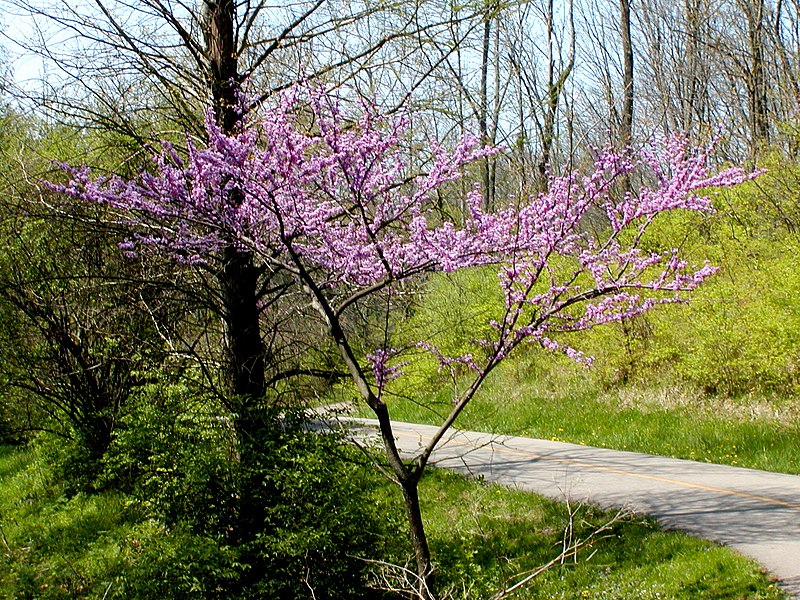
A joyful sign
When I turn away from human societies and look at Nature, I also find the new, but it is a different type of newness.  I see the bright yellow-green spring-leaves emerging on a tree that had been bare for months. And I see the brilliant pink blooms on an otherwise bare redbud tree. This is a type of newness that is different from human inventions. It is the newness of renewal and rebirth. It is a type of newness that is ancient. And it is reassuring amid a world of human struggle and destruction. For, as the 19th-century poet Gerard Manley Hopkins wrote:
"... nature is never spent;
There lives the dearest freshness deep down things...."
Hopkins saw that type of newness as a gift of God's Spirit, which "broods with warm breast and with ah! bright wings."

The newspaper's headlines might be only bad news, but the view of spring out my kitchen window is very good news.

~ ~ ~

Is there a way you find a renewal that lies deeper than human innovation?


(The quotation about the catalog is from the book
 The Card Catalog: Books, Cards, and Literary Treasures, © 2007, p. 82.)
(The lines by Hopkins are from his poem "God's Grandeur.")

Friday, April 2, 2021

Being Strengthened by Spring

The COVID pandemic beginning in 2020 brought so many types of losses. Losses of such things as:  Family members, friends, and acquaintances.  The ability to move about among people in public with ease and safety.  Gathering in indoor worship spaces to be inspired by beautiful music and words.  The relaxing conviviality of dining in restaurants while chatting with friends.

We can gain strength by naming those losses.  We can also be strengthened by turning our attention to the continuity of the cycles of Nature.  Such as spring's flowers -- which were the focus of the following article, first published in 2015.

~ ~ ~ 


A gift from Nature
The painter Georgia O'Keeffe once said, "A flower is relatively small."  And yet she depicted them as being enormous!  Her easily identifiable paintings of flowers, which were one of her favorite subjects later in her career, often depict a single, huge, brightly-colored flower spilling over the edges of the canvas.  One of O'Keeffe's flowers can cover a hundred times its square-area in real life.  A biologist could easily appreciate that out-of-scale depiction, although for biological rather than aesthetic reasons.  After all the flower was a revolution in the evolution of life on planet Earth.

Green plants with photosynthesizing chlorophyll did exist on our planet before there were flowers.  However, it could take those conifers over a year to produce seeds snugly nested in cones.  One revolution flowers brought (when they evolved 100 million years ago) was the ability to release a seed in only a month.  That was an explosion in reproductive capability. That flower-explosion also brought about a revolution in the prehistoric world of animals.  As flowers evolved into different shapes, the insect world evolved simultaneously, new insects being adapted to take advantage of new food-source shapes.  In turn, bird and mammal species found new food in the flowers, seeds, and insects, thus putting competitive pressure on the older species of dinosaurs.

“Beauty too rich for use”Today, understandably, few people are thinking about such significant events in the history of planet Earth when they purchase or pick a flower.  Flowers can be an earnest business for commercial flower-growers and florists.  But it is a flower's enjoyable color, fragrance, and shape that capture an average person's attention.

True, flowers do sometimes become a part of solemn ceremonies.  A wreath of flowers can soften the hard edge of a coffin, thus soothing the hearts of the bereaved.  Despite the flower's fragility, symbolizing the transitoriness of life, its reproductive associations bring a hint of life into the acceptance of death.

More frequently, however, flowers shout out "life!"  The humorist Mark Twain made the earnest observation that "Whatever a man's age, he can reduce it several years by putting a bright-colored flower in his buttonhole."  Over a century later, men wear boutonnieres much less often. But the symbolic tie between flowers and restored life endures.  All the way down to anti-war demonstrators inserting flowers into phalanxed soldiers' rifle barrels.

With their colorful intensity and their message of new life, specific flowers have gained a role as a prominent symbol in many of the world's faith-traditions:  The lily of Easter resurrection in Christianity. The lotus of life-giving tranquility in Buddhism. And the light-giving Golden Flower in Taoism.

For the billions of bees and other insects who search for food each day, flowers are a serious business.  But for most people, flowers are just plain fun!

Life can open up at spring.
~~~
Where do you encounter flowers?  Do you have any favorites?  What do they express?

Friday, March 30, 2018

A Church and a Novel

Say “the hunchback of Notre Dame,” and many people will think of that hulky character in one of the movie versions of the novel. Maybe the mental image evoked will include some sense of the height of the great cathedral of Notre Dame, from which the hunchbacked character looks down upon the jeering mob below. Rarely has there been such a famous intersection of a church and a novel; in this case, Paris's largest cathedral and the novel by Victor Hugo.

Paris's second largest church building, the much less famous Church of Saint-Sulpice, has had an interesting intersection with a novel, but in a quite different way.  And that intersection may say something about our human struggles to bring the illumination of both science and religion to our world.

Marking the sun's movements.
Now on display in Saint-Sulpice is this note about the long, straight line in the 17th-century church's floor:
"Contrary to fanciful allegations in a recent best-selling novel,
 this
[line] is not a vestige of a pagan temple.
 No such temple ever existed in this place.
It was never called a "Rose-Line'."
The "best-selling novel" discreetly referred to is the 2003 book The Da Vinci Code by Dan Brown.

Inspired by the regularities in Nature.The inlaid brass line is in fact part of a device (a "gnomon") for knowing when the spring equinox occurs, based on where during the course of a year a noon-time shaft of light falls along that line, or on the obelisk at the far end of it. The word "gnomon" has its root in the Greek word for "to know." But there is much that Brown does not appear to know (or desire to convey) about the true history of this gnomon. The religious reason for discerning the spring equinox is explained by an inscription on the obelisk's base: "Ad Certam Paschalis," or "for the determination of Easter." That religious task, as the 20th-century scientist Stephen Jay Gould explained, "requires considerable astronomical sophistication, for lunar and seasonal cycles must both be known with precision."

The sun-calculating device in the Church of Saint-Sulpice is not an exotic oddity, as one might think reading Brown's book.  In fact, other similar installations (sometimes called "meridian lines") can be found in cathedrals in Rome, Florence, and Bologna, Italy -- all demonstrating conjunctions of the Church and astronomy. Even beyond those other installations, there is additional evidence that Saint-Sulpice's gnomon has real Christian roots, and is not a pagan import: The Christian practice of scientifically calculating solar equinoxes was mastered notably by an English monk living in the 700's, the Venerable Bede. He developed tables for calculating Easter for the three centuries yet to come. His manual for that scientific field called "computus" continued to be used into the Middle Ages.

And what about the letters "P" and "S" in two of Saint-Sulpice's windows? Here again, the notice posted in the cathedral brings illumination:
"Please also note that the letters "P" and "S" in the small round windows
 at both ends of the transept refer to Peter and Sulpice, the patron saints of the church,
 and not an imaginary "Priory of Sion"
[a secret society in Brown's novel ]."

Art, religion, and science together.
The architecture of the Church of Saint-Sulpice is not to my personal taste. Nevertheless, I can admire the openness not only of the people who built Saint-Sulpice, but also the other Christian minds stretching back to the Venerable Bede and even beyond -- bringing together knowledge and inspiration from both science and religion.

~ ~ ~

Is there knowledge about the natural world from contemporary science that expands your spirit?


(The quotation by Stephen Jay Gould is from his Dinosaur in a Haystack, © 1995, p. 39.)