Showing posts with label God. Show all posts

Tuesday, November 29, 2022

What is Most Valuable?

"Thanksgiving."  It's a single word designating in the U.S. a single-day holiday in November.  But that word "Thanksgiving" can be broken apart into two words that point forward to another U.S. holiday roughly a month later:  "Thanks" is the theme of Thanksgiving Day, and "Giving" is the theme of the gift-giving day of Christmas.

How to decorate for Christmas?
Those two words might lead us to meditate upon intangible spiritual values, but unfortunately, in that one-month period between the two holidays, we are deluged with mail-order catalogs, advertisements, store displays, and news stories that emphasize spending money.  The news media judge the very day after Thanksgiving ("Black Friday") as being a success if enough money is spent, and they call the weeks before Christmas not "Advent" but "the holiday shopping season."  The innovation of Giving Tuesday puts only a slight dent in the steamroller of consumerism heading toward Xmas.

Inflation, especially when it is rapid, understandably makes people more conscious of prices.  But over a century ago, the perceptive Oscar Wilde cautioned people that knowing "the price of everything and the value of nothing" is a cynical way to live.  Several decades ago, a handful of renegade economists tried to remind people that how the news media report economic statistics can be misleading.  Take for example how the GNP (Gross National Product) is usually treated as an indicator of progress if it is growing.  However, that indicator even goes up when a people are in car accidents, because hospital supplies and car parts are produced.  In contrast, the GNP indicator is untouched when a person uses knitting material they already had stored to create a lovely gift for a family member or friend.  Those are examples of why Donella Meadows writes:

The GNP is obviously not a measure of progress....
It is indiscriminate.  It lumps together joys and sorrows, triumphs and disasters,
 profundities and trivializes, everything that costs money and nothing that doesn't.

Perhaps during the one-month period between Thanksgiving and Christmas, besides making a shopping list, we might pause to create a mental list of intangibles we are able to give.  One starting place might be to think back upon what things other than purchased products we have been blessed with having been able to give to others.  I would put on my list my having been able to be a teacher about topics related to religion, spirituality, Nature, and science.  (For a decade, this website has served as one avenue for that teaching.)

Where is something larger than ourselves?
The reverse side of giving is getting.  During the month near Christmas -- and the other winter festivities of Hannukah and Kwanzaa -- we might also reflect upon the intangibles we receive.  Of course, we are grateful for the love that binds our lives with others.  But are there things we have received that are more specific to our individual identities?  Here again (perhaps because I am now in my 70's) I look to the past.  And I think that one of the greatest gifts my parents and teachers gave me were those values that gave me a habit of looking beneath the surface of things -- an eye for the intangibles, the immeasurables, that are crucial to spirituality.  Those intangibles are there, whether or not we notice them.

In addition to such reflections upon our lives during the weeks near Christmas Day, might we perhaps shift our reading to include something different than our usual routine?  Something that would be enhancing?  And during those weeks, might we turn our attention to the changing aspects of Nature as the year moves into winter?

~ ~ ~ 

Is there something you are reading during the weeks near Christmas that you would like to tell others about?  Have you noticed something in Nature during this period that has invigorated you?


(The quotation by Oscar Wilde is from his 1892 Lady Windermere's Fan,
 as cited in Familiar Quotations, 16th edition, edited by John Bartlett, p. 566 #23.)
(The quotation by Donella H. Meadows is from her book The Global Citizen, © 1991, p. 232.)

Friday, September 2, 2022

No Escaping H2O

It was one of those literary works dubbed "classics" that high-school students in my day were required to read and study, even though we ourselves would never have chosen it for our reading entertainment.  It was the exotic, multi-page poem "The Rime of the Ancient Mariner" by Samuel Taylor Coleridge (1772-1834).  Even today, literary critics recognize Coleridge as having been one of the most insightful minds of his time.

A burden too heavy to bear?
The dead albatross hangs from the mariner's neck.
We high-schoolers, knowing we could not escape from the Ancient-Mariner poem, set our minds to finding some intriguing elements in that famous literary work.  We latched onto the bizarre plot development of the sailor in the poem having a dead albatross hung around his neck as a punishment.  We tried to enjoy Coleridge's rhythm and alliteration in some of the stanzas we memorized. For example, here is the description of the plight of the thirsty sailors when their sailing-ship becomes stranded on a windless ocean of undrinkable saltwater, the boards of the ship's deck even shrinking under the hot sun:
              "Water, water everywhere,
           And all the boards did shrink;
               Water, water everywhere
                 Nor any drop to drink."

Those lines popped into my head when I was reflecting upon some of the disturbing news events during the summer of 2022.  In Kentucky, freak floods occurred day after day, killing many.  At the same time, in the southwest of the U.S., the level of the Colorado River -- which several states depended upon for water -- had reached a record low.  Affected by climate change, the news about water was either "too much" or "too little."

There thus has been no escape from being concerned about water.  Even astronomers were searching for signs of it on far-off planets as evidence of the possibility of life elsewhere than on Earth.  Along with biologists, astronomers know that the common denominator of all forms of life we know about is water -- that remarkable liquid formed when atoms of the gas hydrogen and the gas oxygen bond together.

The common interest in water during the summer of 2022 (from the people of Kentucky to those living in the Southwest to even astronomers) was a contrast to most of the sentiments expressed publicly during that year.  More common had been polarized views that suggested that half of the population of people in the U.S. had nothing at all in common with the other half.  But water -- in some way -- became a common concern

A rash move.
Mariner shoots
the  albatross
with his crossbow
Why had the mariner's ship become stymied on a windless ocean?  The answer goes back to why that albatross had been hung around the mariner's neck as a punishment.  He had, for no reason, recklessly shot that great white bird that had been accompanying the ship for several days "for food or play."  The mariner had disregarded the fact that the presence of an albatross had traditionally been considered by sailors to be a good omen.  The poem suggests that there are moral laws to the universe that set limits which humans cannot pass without ensuing consequences.

Samuel Taylor Coleridge wrote at a time when poetry tended to moralize more than it does today.  Nevertheless, if he were writing his tale of the mariner today, I would hope he would still include in its final stanzas another set of lines we memorized in high school. 
They go like this:

"He prayeth well, who loveth well
Both man and bird and beast.

He prayeth best, who loveth best
All things both great and small;
For the dear God who loveth us,
He made and loveth all."

~ ~ ~

(Do any of the lines of Coleridge spark any thoughts or feelings in you?)


(All quotations are from Coleridge's "The Rime of the Ancient Mariner"
 taken from The Norton Anthology of English Literature, edited by M.H. Abrams, et al., ©1968.)
(Both pictures are in the public domain.)

Friday, August 5, 2022

Summer and the Seasons

"Too hot!"  That has long been a common complaint by many people on the hottest days of summer.  However, when the extreme becomes even more extreme (aggravated in part by climate change), it can be very hard to dreamily sing "Summertime, and the livin' is easy."  Perhaps the following article, first published five years ago, can help make us more appreciative of summer as part of the recurring cycle of the seasons.

~ ~ ~

It was a late summer.  There were more clouds than typical for a summer day, but that felt good because it gave relief from the hot summer sun.  What felt even better was a breeze that brushed across my face, bringing the promise of a respite from the summer heat we had endured for weeks.  "Maybe we'll get a cooling rain," I thought.  My slight elation at the change in weather was, however, kept in bounds by a larger awareness.  Namely, I knew that the pleasant shift in weather I was experiencing was the result of a distant hurricane that was coming ashore farther away, bringing destruction upon other people.


Natural forces more powerful than myself.
The soothing breeze that brushed my face thus raises the question of how I should think and feel about those things in Nature that bring both good and bad.  That tiny breeze raises spiritual and theological questions far beyond its small size.  To my way of thinking, the most distasteful responses to a hurricane during the past few years have been by people who claimed that God steered the hurricane away from them in response to their prayers.  Those people were thinking only of themselves, and seem to have had little concern about the other people who would be hurt by a re-directed hurricane.  Nor do such comments display an awareness of a long tradition of theological thought about the matter.

A less selfish response does not require more scientific understanding of storms.  It only requires a "compassionate heart," to use a Buddhist phrase.  A wiser and more  open-hearted response to tragedy was modeled by Jesus after a tower fell, killing people.  Even without a knowledge of Newtonian physics, Jesus knew that natural disasters do not injure just bad people, and that they do not spare just good people.  Challenging his listeners to join him in that enlightened response, he asked rhetorically,  "Those eighteen who were killed when the tower of Siloam fell on them -- do you think that they were worse offenders...?  No, I tell you." (Luke 13:4-5, NRSV).  Jesus's reminder to us that "bad things can happen to good people," as we say today, echoes that same insight form the Jewish tradition's book of Job in the Bible. Job's suffering from natural forces was not a punishment.

Although in English we have separate words for "wind" and "spirit," in the Bible's original languages, the two are the same word.  We might think "wind-spirit." That equivalence can remind me when that light wind touches my face, to ask myself what my own spirit is like, especially when I know of the dangerous hurricane further away.
What winds are blowing through my own spirit?
There is another side of the coin to this matter of the uncertainties of the natural world -- the fact that natural forces can bring both damaging winds and needed rain.  I easily notice when bad luck befalls me.  In contrast, I easily overlook all the ways I have been helped by good things that were just as much beyond my control. The light wind that brushes my face can, therefore, widen my awareness even further.  The double meaning of wind-spirit can remind me to remember a larger spirit of unseen forces that support my life.  A native American Ojibwe song put it this way:
"Sometimes I go about pitying myself,
But all the while
I am being carried by great winds across the sky."

~~~

Is there a way you have come to think about the uncontrollable uncertainties of life?

Friday, July 1, 2022

Yesterday, Today, and Tomorrow

Even though I love many aspects of Nature, I confess that I am not a very good gardener.  That is why the plants in my yard that have endured over the years are those than can survive with little care (except perhaps for a brief soaker-hose during extreme drought).  One plant that has just managed to endure through tough times is a plant with an unusual common name -- the "yesterday-today-tomorrow plant."  It is so named because each flower is a deep blueish purple when first appearing but changes to a light shade the next day. On the third day, the flower has turned white.  And so, when flowers come frequently enough, they display a range of three colors.

He also lived in changing times.
The scientific name for the yesterday-today-tomorrow plant is Brunfelsia, so named for Otto Brunfels, who lived in Germany during the first half of the 1500's.  Those were tumultuous times because in 1517 Martin Luther posted his famous theses on a Roman Catholic church, thus beginning the Protestant Reformation.  Otto Brunfels' life exemplifies those changes:  He had trained in a Catholic monastery but later became a pastor of a Protestant church.  One thing endured through those decades:  Brunfels' interest in herbs, which were one source of medicines.  Although the three-volume work on herbs he wrote included sometimes questionable folklore, it also displayed woodblock illustrations, which was a fairly new innovation for printed books.  As the contemporary commentator John Lienhard states about Brunfels' compendium, "The images long outlived the words."

I know that biologists have to name species with Latin names. Nevertheless, I do enjoy how the common name for that Brunfelsia plant expresses one aspect of how humans experience time.  We remember yesterday.  We are aware of today. And we think ahead to tomorrow.  How should we handle our awareness of those three periods of time?

I think it is a reasonable assumption that anybody who has lived any length of time is bound to have some regrets about the past (even if they don't like to admit it). However, as  the 5th-century B.C.E poet Agathon wisely reminds us, “Even God cannot change the past.”

What about tomorrow?  Our modern, Westernized technologized societies change so rapidly that it makes life harder than it otherwise might be.  Our uncertainties about tomorrow can make it easy to worry about what challenges will come next.  Yet Jesus encouraged his followers by saying "Do not worry about tomorrow... Today's trouble is enough for today." [Matt. 6:34, NRSV]  (Is a bit of wry humor perhaps being displayed in his second sentence?)

What about today?  Many spiritual advisers (ranging from yoga teachers to authors of self-help books) tell us to "be present" to what is happening right now.  Or they phrase it that we should "live in the present."  I do need to cultivate awareness.  Nevertheless, I also need to draw upon my memories of the past, sometimes being sustained by them.  And I need to think about future days and plan for them.  I cannot very well be isolated in the present.

Maybe I can learn something from that yesterday-today-tomorrow plant.  Despite its name's dividing time into three parts, it is the same flower that endured and evolved through the string of three days.  There was actually a continuity through the course of time.

~ ~ ~

As you reflect upon your life, are there some continuities you would like to sustain?

Inspiration for today, and for tomorrow.

(The quotation by John H. Lienhard is from his Engines of Our Ingenuity website, episode No. 2241, "Otto Brunfels.")
(The quotation by Agathon is taken from Bloomsbury Treasury of Quotations, edited by John Daintith, © 1994, p. 523.)
(The photo of flowers is by gailhampshire from Cradley, Malvern, U.K.
 and is used under a  Creative Commons Attribution 2.0 Generic license..)

Friday, June 3, 2022

Something Dependable

As summer approached, there was increasing discussion on the radio about the condition of my state's electric power supply.  Would it be able to withstand the high demands that would be placed upon it during summer's heat, when more air-conditioners would be run more often?  Had enough steps been taken to strengthen the state's electric grid to prevent the type of massive, extended blackouts that had occurred the winter of the year before -- shutting off furnaces, leaving people shivering inside their houses, some even dying?  The state's public-utility board and the electric grid operators both assured the public that the problems had been fixed.  And the company operating my local electricity ran TV commercials showing smiling people, happy that their electric company "had their back" (as the saying goes).  We could depend on them, we were assured. 

Nevertheless, I was not surprised when I awoke at 5:00 one May morning -- even before summer had begun -- and saw that the power was out in our house.  A glance out the window showed me that the same was true for my neighbors across the street, who are on a separate electric line and set of transformers.  Something on a much larger scale than the line to a single block of houses had been put out of commission.  And the cause had not been any extended period of intense heat, but instead a run-of-the-mill thunderstorm in the night.

Electricity of another kind.
Storm in the night
Admittedly, a power disruption for several hours is a modest challenge for most homes.  But it can symbolize the many failures of our human societies that can make them so undependable that sometimes we don't want to get out of bed in the morning.  Such incidents can, unfortunately, lead not merely to frustration (and maybe anger) but to hatred of some people who have not been dependable.  After a few hours in my house without hot coffee and without eggs being fried on my electric stove, I remembered that the power-company employees that were trying to restore the system also depended upon the same vulnerable system when they returned to their homes.  They had their challenges as well.

Fortunately, not too long after getting up in my dark house without power, there came something I know I could depend on: The sun gradually rose in the east.  It did so at the same predictable time it had the morning before.  Its light filtered through the clouds, bringing into my house a gentle but appreciated illumination through the windows.  I was able to set aside the flashlight I had been awkwardly carrying about, trying to do those morning tasks that did not require electricity.

In the New Testament's Gospel of Matthew, Jesus presents to his disciples what must be one of the most difficult of his instructions. Namely, “Love your enemies.” And what does Jesus put forward as an example that might inspire his disciples in such a difficult challenge? Does he point to some very noble person around him? No. Does he point to himself? No, not even that. Instead, what he points to is the reliable rising of the sun every morning, saying that we should be inspired by our “Father in heaven; for he makes his sun rise on the evil and on the good.” (Matt. 5:44a & 45a, NRSV). Thus it is that Jesus encourages his disciples to turn their attention to the non-human sphere that they might widen and deepen their appreciation of God, and thus be inspired -- even while living in human societies that can, at times, be so frustratingly undependable.

Seven hours after I had woken up in a house without electricity, the power was still not back on; and the electric company had given up on making any prediction of when it would be.  I, however, was able to make a prediction with considerable assurance: I knew the sun would set in the west that coming evening.  And I knew it would be dutifully rising the coming morning.  And that would be good.

Being energized by the sun.

~ ~ ~

(Is there a way you deal with the ordinary frustrations of life?)


(The picture of lightning is by Vedrin Jeliazkov
and is used under a Creative Commons Attribution-Share Alike 3.0 Unported license.)

Friday, November 5, 2021

Being Forgiving about the “Little Things”

Oops!  I forgot!
It seemed at first like such a little thing.  But as I listened further to the brief segment on radio (and later read the transcript), the seemingly small bit of news grew in significance and importance. The news story's title announced that "New York City's Public Libraries Abolish Fines on Overdue Materials."

The news moderator, inquiring about the mechanics of the new plan, asked the inevitable question:  Aren't fines necessary to get people to bring books back to the library/? The answer was "No."  As Tony Marx, president of the New York Public Library system, explained:

"It turns out late fees for books don't work. They don't bring the books back.
 Almost all the books come back anyway because people respect that if they are treated
 with respect and trust, they respond in kind."

Here, the brief news story about one city's libraries seemed to be turning into a much larger moral lesson.

Not that New York's library system was advocating total suspension of human responsibility:  A person would still have to pay for any books that were lost.  Nevertheless, besides abolishing any future late-fees, all library-card holders' accounts were being cleared of any accumulated late-fees.  That was because the library administrators recognized that accounts that had been blocked because of late-fees "are vastly disproportionately in the poorest neighborhoods.  And that's exactly where we need people using the library."  The news segment now seemed to be turning into a Biblical parable involving the tendency of human societies to become out of balance -- making the rich richer and the poor poorer, unless some correctives in behavior were regularly made.

Dennis Walcott, the president of Queens Public Library (part of New York City's public libraries) added a final comment that shifted the little news story into an even higher gear, turning it into something like a prophetic vision of hope.  Of the library's aim with its new rules to get especially the younger back into libraries, he declared:

"That's the goal, to have our children participate in the American Dream.
And the American Dream is through our libraries."

Not penalizing people so as to hold them responsible for little mistakes can seem "unnatural," as we might say.  But is it really so unnatural?  Is a mother's loving tolerance of her toddler's weaknesses really unnatural? Is it really against her nature?

And what about that larger, non-human realm of Nature that our lives are a part of?  Nature can seem to be totally unforgiving when hurricanes come.  But hurricanes hit a specific area of land only a few days out of the many days of the year.  On most days, Nature displays more regular, sustaining rhythms that could be called "forgiving."

In the Bible's Gospel of Matthew, Jesus presents to his disciples what must be one of the most difficult of his instructions.  He tells them to "love your enemies."  And what does Jesus put forward to inspire his disciples in such a difficult challenge (a challenge even harder than forgiving people's ordinary mistakes)?  Does Jesus point to some very noble person around him?  No. Does he point to himself?  No, not even that.  Instead, he points to the reliable rising of the sun every morning, saying that we should be inspired by our "Father in heaven; for he makes his sun rise on the evil and on the good."  The sun regularly rises, despite all humans' mistakes of the previous day (even if it was just being ashamed to return a late library book).  Thus it is that Jesus encourages his disciples to turn their attention to the non-human sphere -- Nature -- that they might deepen their appreciation of God, and thereby be inspired to be more loving.

Given another chance.

~ ~ ~

(Do you see any qualities in Nature that  you think we humans should emulate?)


(Quotations by the librarians are from radio segment "New York City's Public Libraries
 Abolish Fines on Overdue Materials," on National Public Radio's Morning Edition show of Oct. 7, 2021.)
(The Biblical verses cited are Matthew 5:44a & 45a [NRSV].)

Friday, September 3, 2021

More than Just an Art Critic

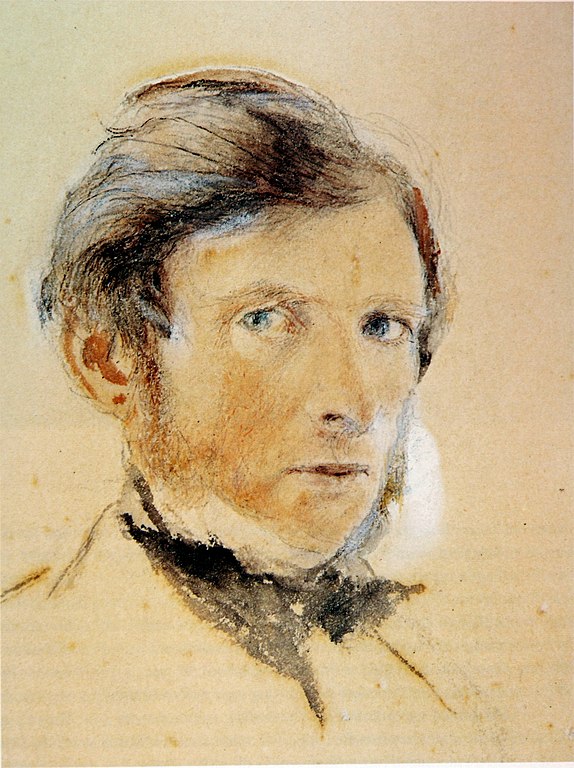
John Ruskin. He is usually identified as being an "art critic," such as in this typical entry from a dictionary:  "Ruskin, John. 1819-1900. British writer and art critic who considered a great painting to be one that conveys great ideas to the viewer.  His works include Modern Painters (1843-1860)."

John Ruskin,
self-portrait, 1861
But Ruskin thought about much more than art.  He even reflected deeply upon intellectual issues related to religion during the 19th century, during which he lived. It was a rapidly-changing, confusing time to many people in England.

The emergence of historically-oriented academic fields such as geology and paleontology had raised questions about the Bible's truth, which was being approached with a new, historical mindset (rather than symbolically or spiritually, as had been traditional).  Those sciences were revealing the Earth's age to be vastly older than traditionally imagined.  Ruskin confessed to a friend:

"If only the Geologists would let me alone, I could do very well, but those dreadful Hammers! I hear the clink of them
                                                 at the end of every cadence of the Bible verses."

For the first couple centuries after the rise of modern science in the 1600's, it had been hoped that scientific discoveries about the natural world would add new, overwhelming evidence to how Nature had been designed by a good, benevolent Creator.  But Ruskin was aware of the drawbacks in that approach because of the ambiguity of Nature.  Calling upon readers to view the natural world with a keen eye (the way they might examine a painting), he first lays out an idyllic scene:

"It is a little valley of soft turf, enclosed in its narrow oval by jutting rocks and broad flakes of nodding fern.... The autumn sun, low but clear, shines on the scarlet ash-berries and on the golden birch-leaves, which, fallen here and there, when the breeze has not caught them,
 rest quiet in the crannies of the purple rock."

But then, his camera-like eye pans slightly to the right:

"Beside the rock, in the hollow under the thicket, the carcase [carcass] of a ewe, drowned in the last flood, lies nearly bare to the bone, its white ribs protruding through
 the skin, raven-torn."

Ruskin (writing even before the after-effects of Darwin's Origin of Species) forces us to see the disturbing ambiguity of Nature: That which was death to the ewe is life to the ravens.

Nature as turbulent.
Despite Nature's not being able to be a straightforward moral guide to us, Ruskin does not think we should lose the compassionate capabilities of the human heart -- as demonstrated by the sympathetic manner in which he describes the next things his observant eye falls upon:

"I see a man fishing, with a boy and a dog -- a picturesque and pretty group enough certainly, if they had not been there all day starving. I know them, and I know the dog's ribs also, which are nearly as bare as the dead ewe's."                                                                 

These passages show how Ruskin viewed the face of Nature as being illuminative and yet turbulent.  Those qualities of Nature are also expressed in the paintings of J.M.W. Turner, which Ruskin greatly admired.

Nature as illuminative.

~ ~ ~ 

(Is there a way you view the presence of disturbing features in Nature and yet still derive inspiration from it?)


(The dictionary entry is from The American Heritage Dictionary, 3rd edition, © 1992.)
(Ruskin's statement about Bible verses was made in his letter of May 24, 1851 to Henry Acland.)
(Ruskin's descriptions of scenes in the natural world are from the 1860 edition of his Modern Painters, )

Friday, August 6, 2021

Being Inspired Even at a Distance

The Covid pandemic that began in 2020 put a kink in many people's usual plans for summer vacations, even in 2021, when vaccines were available for most adults in the U.S.  Life had changed, turning many in-person gatherings into virtual gatherings.  Adults had to depend more upon their memories of firsthand experiences they once had. And children needed to rely more on second-hand knowledge and their imaginations.  As I reflected on that situation, the following Wisdom in Leaves article, published four years previously, seemed particularly relevant.  It was titled "Hearing the Sea in a Shell."

~ ~ ~

A world of soft sand, sight, and sound.

It is an experience every child should have for the first time:  Holding a large shell to one's ear and hearing the sound of "the sea" supposedly still in the shell. How many parents or grandparents have initiated their child or grandchild to seashore wonders by instructing the child to "hear the ocean" in that way?  How many children have smiled upon first hearing the sound a large seashell makes, imagining for a moment they really heard the sea?  I recognize that an acoustical scientist could give a good, detailed explanation for the perhaps puzzling effect.  But I am more interested in how that experience can be an opening to how we and all things are part of a larger whole.  That is the very matter the poet William Wordsworth explored in his long poem The Excursion.

Even though the sea-in-seashell symbol could be a good literary opening, it appears in the middle of Wordsworth's poem when, in his memory, he sees himself as a boy:

"A curious child, who dwelt upon a tract
Of inland ground, applying to his ear
The convolutions of a smooth-lipped shell;
To which, in silence hushed, his very soul
Listened intensely; and his countenance soon
Brightened with joy; for from within were heard
Murmurings, whereby the monitor [the shell] expressed
Mysterious union with its native sea."

In the very next line, Wordsworth opens up the metaphor of how -- if we orient ourselves properly -- we can "hear" in the natural world intimations ("Murmurings") of a larger, deeper reality:  "Even such a shell the universe itself / Is to the ear of Faith...."  Moreover, Wordsworth later addresses his words to a larger divine Spirit that includes all of our own spirits, just "as the sea her waves."

The magic of children innocently believing (at least for a moment) they are hearing the sea in a shell derives from a child's wonderful delight in first discovering the world.  And so, a stanza early in the poem began with the statement "Such was the Boy."

Life-giving memories.

oil portrait of
William Wordsworth
by Benjamin Haydon

Even though we adults cannot actually return to our childhoods, Wordsworth expresses how, even in old age, our memory can restore to us some of our original exaltation. That ability of memory to recreate something not physically present is similar to the seashell's ability to recreate the physical ocean, which is not physically present:

"If the dear faculty of sight should fail,
Still, it may be allowed me to remember
What visionary powers of eye and soul
In youth were mine; when, stationed on the top
Of some huge hill -- expectant, I beheld
The sun rise up, from distant climes returned....
... my spirit was entranced
With joy exalted to beatitude...."

~~~


Are there ways you restore contact and communion with those who are not physically present?


(The two large excerpts are from Book IV, "Despondency Corrected" of The Excursion [1814]
That full section of the book-like poem can be read at this external link:  The Excursion, Book IV.)

Friday, July 2, 2021

There's More to Penn and His Pen

A child's learning involves being able to identify things. (Spoon. Ball.)  And it involves being able to recognize recurring patterns.  (That ball and spoon both go down when pushed off the edge of the table.)  However, that wonderful human ability to identify things and discern recurring patterns has a drawback: It easily results in our simplified classifying and stereotyping of people.

Not only do we easily group people by race or ethnic background, we also classify historical personages by what they are most famous for.  For example, one person becomes "a scientist" in the historical record, even though that "scientist" might have most enjoyed playing with their children. Or, another famous person becomes "a singer," even though that "singer" might have most enjoyed tinkering with old clocks.

Can classify the people by their clothes.
One historical figure in early North American history has become indelibly linked to the state of Pennsylvania:  William Penn, whose last name is the first part of that state's name.  There is a bit of irony here, because even after getting the king of England's permission to establish a colony in the "New World," William Penn spent more years in Germany and England than in the future U.S.  Because most education in the U.S. today is secularized, American-history textbooks classify the man as a political leader.  Books on the history of Christianity, in contrast, classify him as a leader of a religious movement, the Quakers.  As a result of such classifications, neither type of textbook is likely to tell the reader about Penn's thoughts and writings about Nature.

William Penn's enjoyment of Nature is demonstrated by the name he had preferred for the colony he founded in 1691: "Sylvania," meaning "forest" in Latin.  It is from the same Latin root for "Sylvania" that we get the little-used English word "sylvan," meaning related to wooded areas.  (It was King Charles II who stuck "Penn" on the front end of the colony's name in honor of William Penn's father, an admiral.)

Even though on national holidays such as the Fourth of July, patriotic Pennsylvanians might focus only on William Penn's interest in founding a colony, that man's appreciation of Nature is revealed in words like these that flowed from his pen:

"The world is certainly a great and stately volume of natural things, 
and may be styled the hieroglyphics of a better one, 
But, alas, how very few leaves of it do we seriously turn over!
... The country is both the philosopher’s garden and his library, 
in which he reads and contemplates 
The power, wisdom and goodness of God."

With those words in Penn's book "Some Fruits of Solitude," he is sharing in a long tradition within Christianity of viewing the natural world  as a revelatory "Book of Nature" that supplements and complements another book, the Bible.

Artists' portraits of Penn and his fellow 17th and 18th-century Quakers frequently portray them wearing their distinctive flat-topped black hats as an aid to picture-viewers in identifying them as being Quakers.  (The Quaker Oats Company has stated that one such portrait on their trademarked cereal boxes is not William Penn, as they once claimed, but is just a generic Quaker.)  Those flat-topped hats with two projections to the side look out of fashion today.

A sparkle of beauty added to our life.

But perhaps not out of fashion might be William Penn's additional thought that,"It would go a long way to caution and direct people in their use of the world" if "they were better studied" in the natural world as revealing the Divine.  He continues: 

"For how could man find the confidence to abuse it,
While they should see the Great Creator stare them in the face, 
in all and every part thereof?"

~ ~ ~

(Is there any way that you feel you "see the Great Creator" in Nature?)


(Both quotations are from William Penn's book "Some Fruits of Solitude" [1682, 1693], capitalization modernized.)

Friday, January 1, 2021

“Turning the Page” on a Year

When each New Year arrives, many of us hang up a new wall-calendar or insert a new set of pages in our day-timers.  And we sometimes make a resolution to behave differently, perhaps employing a book-related metaphor to describe the hoped-for change:  We say we are going to "turn over a new leaf" (the pages of books sometimes being called its "leaves").  Or we say we are going to "close the chapter" on something we wish to leave in the past.  Especially when the passing year was filled with trouble (as 2020 was with its COVID pandemic), we might say we are eager to "close the book" on the year gone by. 

But with that last example, we can understand the limitations of such metaphors:  A challenge such as a viral pandemic does not come to an end because we have labeled one particular day the end of a calendar year.  And even those processes in our lives that bring good things are continuous flows.  They are less like the flipped pages of a book and more like the slow advancement of a scroll.  Bringing about changes in human affairs is even better described as being like nurturing a green shoot, which in time becomes a larger plant.

Fortunately, we have been at this process of becoming since the day we were born.  We have a lot of practice with it because becoming is built into our biological nature.  As the neurobiologist Steven Rose explains:

Every living creature is in constant flux, always at the same time both being and becoming.... A newborn infant has a suckling reflex; within a matter of months
the developing infant begins to chew her food....
The paradox of development is that a baby has to be at the same time
  a competent suckler and to transform herself into a competent chewer. 
To be, therefore, and to become....

Our faith-traditions encourage us onward into unknown territory by reminding us that the ultimate Source of Life is also the very Ground of our Being that remains beneath us, supporting us even as we sometimes stumble.

Interestingly, the idea that even God cannot predict exactly what will be and what will be demanded in our engagement with the Divine is expressed in a pivotal story in the Christian Old Testament (the Hebrew Bible).  In Exodus 3:12-14, Moses, after being given a challenging long-term assignment by God, is promised by God, "I will be with you."  Nevertheless, Moses tries to gain more control over the situation by requesting to be told God's name.  Moses wants more control over the future than even God can promise.  And so, God provides to Moses the open-ended enigmatic reply, "I AM WHO I AM."  Translators sometimes add a footnote to this verse in order to express that God will be with Moses in both "being" and "becoming" -- just like that baby who both suckles and chews.  Such footnotes explain that what God has said could also be translated as "I WILL BE WHAT I WILL BE," or even "I WILL BECOME WHAT I WILL BECOME."

Even though ending a year cannot be an abrupt endpoint the way a book's chapter can be, maybe there can be value in a New-Year resolve to foster a new spirit that might lead to something better --  even if we can now only glimpse what that green shoot will become.

  ~ ~ ~ 

Is there a new shoot emerging that you would like to help cultivate?


(The Rose quote is from his chapter in Alas, Poor Darwin,
ed. by Hilary Rose and Steven Rose, © 2000. p. 310.)

Friday, November 6, 2020

Yearning for Something Better

"We pursue the true, the good, and the beautiful,
even though the false, the nasty, and the messy 
might have been just as useful to our genes."

What was it that attracted me to this statement by the contemporary philosopher Roger Scruton?  In part, it was my knowing that Truth, Goodness, and Beauty have been held by Christianity to be the three classic avenues through which we come to know God.  But something more immediate influenced me, something about human society today.  In a world in which we are told by some people not that there are additional facts but that there are "alternative facts," and told by still others that "truth isn't truth," it can be hard to find our bearings.  Hard to restore our grounding.  Scruton's statement reminded me that there is something within us that yearns for something better.

My responses to Scruton's words began to resonate with the picture on the cover of Scruton's book The Soul of the World.  It was a painting by the great 17th-century master Nicolas Poussin titled "Landscape with a Calm."  That painting (see below) does indeed convey an air of calm, with a herder and animals in the foreground, still water and sheep in mid-ground, and a gentle slope and stable architecture in the background.  A diffused sunlight bonds all the elements together.

Researching in an art book, I found out that although Poussin lived in the era of effusive baroque art, there was in Poussin a "conscious attempt to suppress feeling....[Nevertheless,] his paintings are hardly ever cold or lifeless."  That is because there is in them, even if it is subtle, "an emotional tension -- a tension developed between the imaginative force of the informing idea and the strict discipline of the means used to control and express it."  Poussin sought with his landscape paintings to convey more than a landscape.  He sought to convey not the surface complexity (or possible chaos) of the world but to hint at enduring truths obscured by our human disorders.  Even in his twenties, he had written:
"My nature leads me to seek out and cherish things that are well ordered,
shunning confusion which is as contrary and menacing to me
as dark shadows are to the light of day."

There it was: Echoing down from centuries ago, a statement of Poussin that there was also in his nature a yearning for an orderly, truthful dimension that lies beneath the visible surface of this too-often darkened world.

Moreover, isn't the yearning within us for some stable ground a yearning for more than truth? Isn't it also a yearning for something we can trust?  And for people we can trust?  (The chief cause of broken friendships is betrayal.)  If the yearning is for more than truth, it would be a yearning also for goodness in our relationships to the world.  And a yearning for a kind of beauty that is not always visible to our physical eyes.  Truth, Goodness, and Beauty.

~ ~ ~

Is there a way you try to restore your bearings in a world in which, it seems, "anything goes"?

Seeing more than the surface of this world.


(The quotes by Scruton are from The Soul of the World, © 2014, pp. 5 & 6.)
(The quotes by and about Poussin are from The Age of Baroque by Michael Kitson
in the series Landmarks of the World’s Art, © 1966 p. 73.)

Friday, August 7, 2020

A Shawl Wrapped All Around

Seeing farther by seeing the sky.

One of the first things I was taught about God (even before I entered elementary school) was that God loves me and everybody else.  Another of the earliest things I was taught about God (just as early in my life) was that God is everywhere.  I still hold to these two basic principles, even though I admit to the complexity of using that word "God."

But how can I ever imagine that God is everywhere?  (Especially when I have been cautioned against elevating anything in the world into a god, an idol.)  How can I ever imagine that anything is everywhere?

For me, growing up as a child, it was the sky that helped me envision how God could be everywhere at once.  God was invisible, but the sky, which I could see, expressed a kind of "everywhere."  When I stood outside and looked up and around me, the sky seemed to surround everything on the Earth.  As I scanned the sky and guided my sight back down to the Earth, the sky seemed to wrap around the edge of the Earth at the horizon, no matter which direction I was facing.

Today, I know of an open, inclusive church that has in its mission statement in the worship bulletin the phrase "God's all-encompassing love."  Even though I myself struggle with how anybody could actually love every person on this planet (so ornery do we humans often become), I do have a sense of what "all-encompassing" is.  I learned my sense of that from the over-arching, all-surrounding sky I could see when I was a child.

There was a second way, as a child, that the sky gave me a visual experience of "everywhere." For, after all, church-school had also reassured me that this God who loves me is with me no matter where I go.  I got a sense of "no-matter-where-I-go" by watching the sky as I rode in the car at night.  You can experience this yourself the next time you are riding in a vehicle at night (with someone else safely driving).  Look out the side window and notice how the objects here on Earth zip by.  A parked car flashes past the side window of your vehicle.  And there's a tree a little further away from the road, so it moves less quickly -- but even it first comes into view and then is gone!  That's how everything in life is:  Things come, and things go.

But now notice, in contrast, the moon or stars up in the sky.  Notice how they seem to travel with the vehicle you are in as it travels.  Just like God.

How can a bird be so loving?My high-school English teacher taught me not to mix metaphors.  But religion loves using multiple metaphors, and so I'm now going to do so.  I'm going to mix metaphors because I think this metaphor of the heavens wrapping all around us resonates with another metaphor used a few times in the Bible (such as Psalm 61:4 & Matthew 23:37).  Namely, the metaphor of God being like a caring mother bird sheltering her tiny chicks under her protective wings. We are like God's chicks.

~~~

Have you ever tried to imagine God "everywhere"?  How?

Friday, April 3, 2020

Hope during Hard Times

a poetic pen
Alexander Pope
When I was growing up, I often heard my mother citing snippets of poetry.  One such snippet was:
"Hope springs eternal in the human breast."
I knew that aphorism by heart long before I learned it was from the 18th-century poet Alexander Pope.

As I grew, finding my own identity, I heard many people expressing ideas that circled around that matter of being hopeful.  Radio and TV hosts frequently ask people, "Are you optimistic about the future?"  But optimism is different from hope (as the wide variety of answers given to that question demonstrates).  Whether or not a person is optimistic depends more upon their individual personality than upon what is actually probable.

Another word that circles around the matter of hope is the word "wish," but it too is different from hope.  The word "wish" often conveys a pie-in-the-sky type of wanting, as in when we speak of "wishful thinking."  Young children, before blowing out the candles on their birthday cakes, are told to "make a wish!"  The adults know, however, that at an early age, a child's wishing can be imagining things that are totally improbable.

The 19th-century philosopher Soren Kierkegaard wrote of a "passion for what is possible."  But what is possible in the future?  The better I can predict and even affect what might possibly come about in the future, the less often my hopes will be dashed, and the more often I will have the encouraging satisfaction of my hopes being fulfilled.  To borrow a metaphor sometimes used in the Taoist faith-tradition:  When woodcarvers create sculptures, their efforts will go better if they work with the natural grain of the wood.  Is there similarly a "grain" in the wood of life -- in the nature of things -- that I would be better off working with rather than resisting?

Certainly, if I wish the sun will rise in the sky tomorrow, my wish will be granted -- even if I am no longer alive to see it myself!  Even before modern science, astronomers had mapped out the movements of the sun, moon, and planets more precisely than any clocks they possessed.  The sun's rising tomorrow is not only possible but virtually assured.  That is not the case, however, with what will happen tomorrow in human societies.  There are too many factors involved in any single society to have an absolute assurance about what will happen.  There are even too many factors involved in one individual human life.

These reflections of mine on hope and the future have concentrated mostly upon thinking about the nature of hope by itself.  But in the Bible -- which so frequently exhorts people not to give up hope -- hope is not usually treated as a quality in and of itself.  Hope in the Christian tradition has been considered to be part of a triad of human spiritual qualities:  The other two qualities of the triad are faith and love.  That triad is rooted most explicitly in a New Testament passage in I Corinthians in which Paul writes:
"And now faith, hope, and love abide, these three;
 and the greatest of these is love."
-- 1 Corinthians 13:13 (NRSV)

Hope can become something even further away from wishing when it is blended with love.  When blended with love, hope can become transformed into something much larger than concern about my individual well-being and whether I can control or predict the future to my own advantage.  Blended with love, hope can become an ennobling way of life.

One of the trickiest questions revolving around hope is:  Can our hoping itself actively affect the future? The theologian Jürgen Moltmann (who wrote a book titled Theology of Hope) tackled that question.  He answered "yes" to it in this way:
"Biblical texts understand hope as a positive, divine power of life.
 It is the expectation of a good future....
  Consequently, hope...does not detach the human spirit from the present through delusions,  but rather the opposite;
 it pulls the promised future into the present."

a blue sky beyond the clouds
And as I try to become more loving (and not lose hope), maybe a walk in the early morning sun will help me.  Maybe it will help me feel the constancy of a hidden grain in the nature of things.  Maybe even a grain within our human lives.

~ ~ ~

(What do you hope for?)


(The Pope quotation is from An Essay on Man, l. 95.)
(The Kierkegaard quotation is from Fear and Trembling.)
(The Moltmann quotation is from New & Enlarged Handbook of Christian Theology,
 ed. by Donald W. Musser & Joseph L. Price, © 2003, pp. 249-250.)

Friday, March 6, 2020

Bound Together at the Root

We call them "pages" -- those rectangular sheets that form a book.  At one time, those pages were not infrequently called the "leaves" of a book.  Today, we employ that term less often (although we do still use "loose-leaf" notebooks, even in this digital age).  And occasionally we might say that a person is "leafing through" a magazine as they browse through its pages.

An eloquent pen.
John Donne
(1572-1631)
The employment of the same English word for both the pages of a book and those flat attachments to a tree we call "leaves" proved to be fertile ground for the pen of the early 17th-century poet and essayist John Donne.  His prose could at moments be as rich as poetry.  And he drew upon the "leaf" metaphor in "Meditation XVII" of his Devotions Upon Emergent Occasions.  That is the mediation in which he makes his more famous statement that "No man is an island, entire of itself."  But his expansion of the "leaf" metaphor is more intricate.

In his imagery, he turns a book into a living organism that goes through a season of rebirth -- the way a tree is reborn into a new spring of life, even though its leaves had fallen to the ground the autumn before.  In Donne's intricate picture, those "scattered leaves" are parts of our human lives, which can seem piecemeal.  But God is able to give new meaning to them, even though we are all mortals.  As Donne writes:
"When one man dies, one chapter is not torn out of the book,
 but translated into a better language."
One reason God is able to do that work of restoration is because "all mankind is of one author and is one volume."

Donne would doubtlessly have been aware of the long tradition in Christianity of describing the natural world as the "Book of Nature." Similar to the way that Christianity possessed a book -- the Bible -- as one source of revelation, the natural world was also viewed as being able to reveal things about God.  But in his "Meditation XVII," John Donne focuses just on humans and the challenge of our mortality.

All part of a whole.
"not torn out"
Death was a challenge he knew full well.  His wife Anne, at the age of 33, died after giving birth to a stillborn child.  Also, John Donne had to frequently deal with death as an Anglican pastor: ringing the bell to signal the loss, and then addressing the congregation through a sermon.  In his "leaf" metaphor, he takes advantage of the stitched edge of a book being called its "binding" to emphasize that we are all inescapably bound together.  In a more fascinating way, he describes death as not being removed from the "book" but as being "translated" as God reveals new meaning in each person's existence.  As Donne puts it:
"Some pieces are translated by age, some by sickness, some by war, some by justice;
 but God’s hand is in every translation, and his hand shall bind up
 all our scattered leaves again for that library
 where every book shall lie open to one another."

In the same way that the continuing work of the Creator recycles the minerals of a tree's fallen leaves back into the tree's new spring-life, the values of our human lives are not lost in Donne's vision.  Instead, at death, they are given new, deeper meanings as part of a larger whole.  Indeed, many of us have experienced how the lives of the people we have known but who have died can speak to us in a new way, even though they are physically gone from us.

Raising our sights.

~ ~ ~ 

(Is there a person no longer living whose life gives you additional understanding for your own life?  Who?  And how?)


(All the quotations are from John Donne's "Meditation XVII" from his Devotions Upon Emergent Occasions, 1624.)
(The portrait of Donne is in the public domain by virtue of its age beyond the artist's life.)

Friday, December 6, 2019

A Crocus in the Snow

A vibrant flower amid the cold.
It is a classic subject for nature photographers:  a vividly purple flower
 in the midst of white snow. Why is that image appealing to us?

Part of its appeal comes from its aesthetic beauty -- so much so that it demonstrates what have long been held to be some of the identifying characteristics of beauty.  One of those is that beauty is created when some features that might otherwise be experienced as being in conflict are instead held together in harmony.  In this case, the intensity of purple contrasts with the absence of color in the snow; yet the two are held in harmony.  The contemporary professor of religion Steven R. Guthrie, explaining this aspect of classical Western thought regarding beauty, writes that, "In Plato's dialogues... harmony in this sense is not uniformity or unanimity but the beauty that emerges from different elements in right relationship.... It is, in Dante's words, 'an order' from 'things disparate.' "

Most people like the image of the crocus in the snow.  That favorable emotional response points to another aspect that the Western philosophical and theological traditions have identified as being a characteristic of beauty.  Namely, that something beautiful creates a resonance within us that is pleasing.  In that regard, Guthrie explains that " [Thomas] Aquinas draws our attention to the immediate impression that beautiful things make upon our senses."

In the case of the crocus in the snow, however, those who find the image beautiful are often responding to more than the aesthetic beauty of purple against white.  A purple blotch on a white background would not elicit the same emotions that the flower does.  What also resonates within us in the case of the crocus, even if unconsciously, is the contrast between the new life of the emerging flower and the surrounding cold snow of winter -- the season in which most plants die back.  This additional form of contrast is also a dimension of the image's beauty that is pleasing to us.  Not only is the tension between purple and white held together, but life and death are held together in a moment of harmony when the crocus emerges out of the snow.  The 18th-century poet Christopher Smart, in his poem praising God, expressed how the crocus stands out from other plants around it.  He wrote:
"The laurels with the winter strive;
The crocus burnishes alive
     Upon the snow-clad earth."

The moment of plant-nativity displayed by the crocus can thus evoke within us that enduring quality of hope that sustains our human existence.  Gandhi once wrote:

Glimpses through the clouds."I do dimly perceive that whilst everything around me is ever changing, ever dying, there is underlying all that change a living power that is changeless, that holds
 all together, that creates, dissolves, and re-creates.... And is this power benevolent or malevolent? I see it as purely benevolent. For I can see that in the midst of death life persists, in the midst of untruth truth persists, in the midst of darkness light persists.
 Hence I gather that God is Life, Truth, Light."

It is through our human capacity to not only resonate when experiencing aesthetic beauty but also respond to symbols that we can open ourselves to the transcendent dimension of reality.  The crocus in the snow reveals to us more than the survival capability of a specific flower.  It points to the Ultimate Ground of all existence.  And in that Ground are the "flower-bulbs" and "seeds" of all that can be.  There is an Indian saying that:
"All the flowers of all the tomorrows
 are in the seeds of today."
The real challenge can be spotting those "seeds" and nurturing them.  Sometimes we cannot even see them at all.  But even when we cannot perceive them, we can hope, and like Gandhi we can have faith that they are there despite being hidden beneath the snow.

~ ~ ~

(What do you hope for?  Can you see any way you might contribute to that future growth of something good?)


(The Steven R. Guthrie quotation is from his book Creator Spirit:
 The Holy Spirit and the Art of Becoming Human
, © 2011. pp. 201-202 & 205.)
(The lines by Christopher Smart are from "A Song to David,"
 taken from Encompassing Nature, ed. Robert M. Torrance, © 1998, p. 1015.)
(The Gandhi quotation is from his Young India, 11-10-28, as quoted in Gleanings from
 the writings of Mahatma Gandhi bearing on God, God-Realization and the Godly way
, ed. R. K. Prabhu.)

Friday, October 5, 2018

When the “Lightning” Strikes

"Lightning, a kite, and an almanac by Dick."  It almost sounds like a Jeopardy clue under the category-heading of "Founding Fathers."  And the contestant who can hit their button first and say "Who was Benjamin Franklin?" gets the points.

A classic experiment.So frequently repeated are the story of Franklin flying a kite in the lightning storm and the title of Poor Richard's Almanack that we rarely get a chance to learn about the other contributions of Franklin. (Whose face and build are also widely recognized from the many portraits of him, some with the illumination of a lightning strike.).  Some people in the general public might know a bit about his having lived in France for awhile as part of his public service for his countrymen back in America.  Or maybe know about his fiddling with science even beyond that kite.  But we hear little about his religious habits or his spirituality.

That omission is why I was struck by one page in the book Gentlemen Scientists and Revolutionaries: The Founding Fathers in the Age of Enlightenment by Tom Shachtman. That author emphasizes that:
"The Founding Fathers' science was in no way opposite to their religion. 
The notion that science and religion were antithetical
is a nineteenth-century construct."
And in regard to Franklin, Shachtman writes:
"By the age of fifteen, Franklin wrote in his Autobiography, he had become
a doubter of organized religion...until he chanced upon printed lectures that
tried to debunk Deism:
[Franklin wrote:] ' They wrought an effect on me quite contrary
to what was intended by them, for the arguments of the Deists...appeared to me
much stronger than the refutations; in short I soon became a thorough Deist.' 
In his twenties, he set out his religious beliefs
in a ten-page liturgy, complete with a hymn."
Benjamin Franklin's explanation of his newly found religious orientation continues:
"I think it seems required of me, and my Duty, as a Man,
to pay Divine Regards to SOMETHING....
When I stretch my Imagination thro' and beyond...the visible fix'd Stars themselves,
into that Space that is every Way infinite, and conceive it fill'd with Suns like ours...,
then this little Ball on which we move, seems, even in my narrow Imagination,
to be almost Nothing, and my self less than nothing."

There were two things I liked in these passages.  The first was Franklin's ability to remain sufficiently open to change his mind.  He had apparently began reading the arguments trying to refute the existence of God because they aligned with his doubts about organized religion; but he turned in a different direction when he found the refutations lacking.  That turn in direction put him on a course where, several years later, he could put to pen his own majestic expression of religious belief.

Discovering many kinds of illumination.
The second thing I liked was Franklin's expression of his need to feel reverence (the paying of "Divine Regards," as he interestingly put it). Our media today are so quickly drawn towards brash voices and dominating personalities that it is easy to forget that we are often better served by humility.  And in religious and spiritual lives, humility is cultivated through following a path of reverence.
~ ~ ~

How do you think we can find a good midpoint between the extremes of brashness and timidity?


(Quotations are taken from Shachtman's Gentlemen Scientists and Revolutionaries, © 2014, pp. xii-xiv.)
(Both pictures are details from the originals, both of which are in the public domain.)

Friday, September 7, 2018

Yearning for Something Better

"We pursue the true, the good, and the beautiful,
even though the false, the nasty, and the messy 
might have been just as useful to our genes."

What was it that attracted me to this statement by the contemporary philosopher Roger Scruton?  In part, it was my knowing that Truth, Goodness, and Beauty have been held by Christianity to be the three classic avenues through which we come to know God.  But something more immediate influenced me, something about human society today.  In a world in which we are told by some people not that there are additional facts but that there are "alternative facts," and told by still others that "truth isn't truth," it can be hard to find our bearings.  Hard to restore our grounding.  Scruton's statement reminded me that there is something within us that yearns for something better.

My responses to Scruton's words began to resonate with the picture on the cover of Scruton's book The Soul of the World.  It was a painting by the great 17th-century master Nicolas Poussin titled "Landscape with a Calm."  That painting (see below) does indeed convey an air of calm, with a herder and animals in the foreground, still water and sheep in mid-ground, and a gentle slope and stable architecture in the background.  A diffused sunlight bonds all the elements together.

Researching in an art book, I found out that although Poussin lived in the era of effusive baroque art, there was in Poussin a "conscious attempt to suppress feeling....[Nevertheless,] his paintings are hardly ever cold or lifeless."  That is because there is in them, even if it is subtle, "an emotional tension -- a tension developed between the imaginative force of the informing idea and the strict discipline of the means used to control and express it."  Poussin sought with his landscape paintings to convey more than a landscape.  He sought to convey not the surface complexity (or possible chaos) of the world but to hint at enduring truths obscured by our human disorders.  Even in his twenties, he had written:
"My nature leads me to seek out and cherish things that are well ordered,
shunning confusion which is as contrary and menacing to me
as dark shadows are to the light of day."

There it was: Echoing down from centuries ago, a statement of Poussin that there was also in his nature a yearning for an orderly, truthful dimension that lies beneath the visible surface of this too-often darkened world.

Moreover, isn't the yearning within us for some stable ground a yearning for more than truth? Isn't it also a yearning for something we can trust?  And for people we can trust?  (The chief cause of broken friendships is betrayal.)  If the yearning is for more than truth, it would be a yearning also for goodness in our relationships to the world.  And a yearning for a kind of beauty that is not always visible to our physical eyes.  Truth, Goodness, and Beauty.

~ ~ ~

Is there a way you try to restore your bearings in a world in which, it seems, "anything goes"?

Seeing more than the surface of this world.


(The quotes by Scruton are from The Soul of the World, © 2014, pp. 5 & 6.)
(The quotes by and about Poussin are from The Age of Baroque by Michael Kitson
in the series Landmarks of the World’s Art, © 1966 p. 73.)