Friday, October 18, 2013

Trees, Time, and Passing By

Trees rarely make the front page.  That did happen, however, in 2004 when Wangari Maathai won the Nobel Peace Prize for her Green Belt Movement begun in Kenya.  Knowing a bit about ecology, I was not surprised to hear about the physical side effects that resulted from that movement's planting trees, such as cleaner streams due to reduced soil erosion.  What intrigued me more were the intangible benefits those trees brought.  For example, friendships between Kenyan women developed because, as they made their daily trips in the hot sun carrying water, they stopped to converse in the shade of trees.

As I have reflected about trees in general, I've concluded that the most enduring intangible benefits trees bring derive from the way they serve as tabernacles of time.  Many species of trees can have life spans longer than ours can ever reach.  Trees, therefore, help families and communities hold onto life-giving memories from generation to generation.  That role trees can serve is made explicit in these lines from the early 20th-century poet Stephen Vincent Benet as he describes Richmond, Virginia:
"The trees in the streets are old trees used to living with people,
Family trees that remember your grandfather's name."

In Sequoia Natl. Park in California, I stretched my neck far back to look up at a tree that was young and growing long before Jesus was born.  Such pine trees and sequoias help us transcend our normal sense of time.  We usually think of time in terms of human generations, but that is subjective and human-centered. The 20th-century American Buddhist poet Gary Snyder speaks to the relativity of time scales in this way:
"As the crickets' soft autumn hum
is to us,
so are we to the trees
as are they
to the rocks and the hills."

Compared to many long-living species of trees, we humans are just passing by.  We are to them passers-by in time, similar to the way we pass by a tree beside the sidewalk or walking path. In countries where people do not get virtually all their food from the grocery story, people can also be more aware of the other, tangible benefits those trees provide.  The Hindu Upadesa Tarangini brings together those tangible benefits with trees' intangible reminder that we are passers-by in the following benediction placed upon a tree:

"Oh tree!  You are standing on the path.  Live for a long time and be happy, because with your blossoms the cuckoo is happy, and with your pollen the bumblebees are happy, and passers by are happy with your fruits.  So live long!"

~~~

Is there any tree in particular that you remember? What is your memory of it?


(The Snyder poem is taken from
Buddhism and Ecology, ed. Mary Evelyn Tucker, et al., © 1997.)
(The Hindu blessing is taken from Hinduism and Ecology,
 by Ranchor Prime, © 1992.)

Friday, October 4, 2013

“Talk to the Animals” ?

Despite the peculiar style of drawings in the Doctor Dolittle books, and oddities in their plots, there is one thread throughout the series of books that remains appealing:  Namely, the notion of talking to the animals. The 1967 movie version starring Rex Harrison also left us with the catchy song-version of the idea, simply titled "Talk to the Animals."  Most people who have sung that song probably do not realize that the concept has ancient roots.

For example, based on statements in the Old Testament that King Solomon knew much about Nature (I Kings 4:33), a legend developed that Solomon could also talk to animals.  As retold poetically by Rudyard Kipling a century ago:  "There was never a King like Solomon, / Not since the world began; / But Solomon talked to a butterfly / As a man would talk to a man."

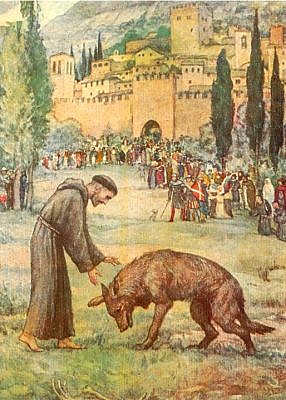
Christian art contains countless depictions of St. Francis of Assisi preaching to the birds.  St. Francis's gentleness, however, is also portrayed through the other side of the coin:  Namely, that he was also adept at listening to animals.  In one story, Francis is asked by the people in the town of Gubbio to help them deal with a wolf that has been harassing them.  After going into the woods to converse with the wolf, Francis returns with a message:  The wolf has agreed to leave you alone -- but only if you feed it!

Those two St. Francis stories -- his preaching to the birds and his listening to the Gubbio wolf -- raise a question:  Which do we value more, talking or listening?  Within our human societies, we often elevate people who we remember as being great leaders by quoting things they have said.  In contrast, in conversation between friends, we appreciate someone who is a good listener. Speaking and listening can be complementary within human societies.  However, it strikes me that our relationship with the non-human realm we call "Nature" is different.  Animals cannot understand our talk the way a human can.  We have better chances of accomplishing something if we listen to Nature.

Since the rise of the modern technology, there have been new means of listening to things in Nature.  The recorded calls of humpback whales are now recognizable to people who have never seen a whale.  There are numerous relaxation CD's available with bird songs interwoven with gentle music.  Usually, though, such CD's are used as background music.  I know myself how relaxing they can be.  But a more challenging task than relaxing is stopping what I am doing and listening to Nature itself for awhile.

Beneath all this matter of talking and listening lies an unspoken desire for communion with the non-human realm.  The native American Luther Standing Bear said that "so close did some of the Lakotas come to their feathered and furred friends that in true brotherhood they spoke a common tongue.”  A "common" tongue -- similar to the verb "to commune"!  Not an easy thing. And yet, not impossible.

~~

Does the idea of "listening" to Nature suggest something to you?  If so, what?


(The Kipling  quote is from the Just So Stories, 
by Rudyard Kipling, published in 1902.)
(The Doctor Dolittle movie poster is by Tom Chantrell, and is used through Fair Use.)

Friday, September 20, 2013

“Music, ‘Arabian nights,’ and Darwin”

It is sometimes the small, unexpected details that catch my eye when I am reading history or biography.  So it was when I was reading part of Gertrude Himmelfarb's book Darwin and the Darwinian Revolution.  I have read a number of books about the response to the publication of Darwin's Origin of Species in 1859.  But my attention was caught by what the British novelist George Eliot wrote in her diary on the evening of the very day Darwin's revolutionary book was published.  Describing how she had occupied herself that very evening, Eliot wrote:  "music, 'Arabian nights,' and Darwin."  What a combination of evening activities and reading before turning into bed!

George Eliot
George Eliot (a woman who wrote under that pseudonym) is most known for her somewhat psychological novels.  But she was also part of a movement of intellectuals who could no longer find credible the church's theological descriptions of the world.  To many such intellectuals, the church's theological concepts could no longer illuminate life.

When I was in college, I read an English translation made by George Eliot of Feuerbach's difficult book The Essence of Christianity, which was part of those 19th-century struggles. Feuerbach maintained that statements about God were actually just projections of human beings' own ideal image of themselves.

However, when I think of George Eliot's writings, what comes to mind are not those difficult religious struggles of the 19th century, but instead a coincidental conjunction I once experienced between Nature and Eliot's novel Silus Marner.

My high-school English class was reading together part of the novel in class.  Our English class was held in one of the wood, portable buildings that had been set up because the student body had grown larger than the main brick building.  Most students did not like having a class in one of those wood "shacks," but I did.  I liked the way the shacks (without air-conditioning) had windows on both sides of the classroom, thus allowing more air and sunlight to flow in.

On the particular day I remember, we were reading a passage in which the outcast Silus Marner experiences what seems to him a miracle.  While he is in a catatonic state, a small child with radiant golden hair crawls into his house through the open door, thus seeming to Silus to appear suddenly when he awakes.  He feels as if he has been graced with a gift from God upon seeing the child, which seemed to have a wonderful glow about it.

Although I knew the scene was contrived, the beauty of that scene seemed to stand out even more brightly to me because, as we read it, I was so aware of the sunlight right there at that moment, shining beautifully into our classroom.

~~~

Have you read a novel or story in which a scene was uncannily real to you?  Why?


(The painting of Eliot is in the public domain
because its copyright has expired.)

Friday, September 6, 2013

Desert – Spelled with One “s”

The first time I ever entered a desert, there was snow on the ground.  Needless to say, I was surprised.  Probably like many other people, I had associated deserts with the near absence of rain.  I had even heard about a book entitled The Land of Little Rain, which is an early example of American nature writing about a desert region.  Admittedly, what I encountered on my trip was not rainfall but snow.  However, the precipitation's being frozen made it even more surprising because I had also associated deserts with high temperatures.  Nor could high altitude account for the snow, because we were very close to sea level.  My surprise was even greater because I had lived for many years in a southern U.S. city where it snowed only once every ten years -- and I had come even further south to get to the desert.

The next surprise after the snow was that the desert's ground was not sand, but instead more like a gravel parking lot.  My third surprise was how fascinating were the variety of plants -- much more than cacti!  And I was struck by the desert's open vastness.

As I've thought about it, I've decided it is appropriate that I should have been disconcerted by the desert. Deserts, after all, were not designed to meet our human needs, nor even perhaps our expectations.  That is why in the Bible, the desert, or the wilderness, stands as a reminder that God neither created everything for humans, nor does God do everything for the sake of humans. Nevertheless, wilderness is seen as having its own value to God apart from any utilitarian value to humans.  As one verse puts it, [God] has cut a channel for the torrents of rain, and a way for the thunderbolt, to bring rain... on the desert, which is empty of human life."  (Job 38:25-26, NRSV).

Although the desert's being a counter to human-centeredness has been the primary lesson spiritual writers have taken from wilderness, there is also a more subtle lesson there.  That lesson comes from how severe landscapes are somehow able to bring forth a kind of growth in us as well, a kind of growth that lush settings cannot induce.  The contemporary Christian writer Kathleen Norris, in reflecting upon another type of sparse landscape wrote:  "A person is forced inward by the spareness of what is outward and visible in all this land and sky.... [W]hat seems stern and almost empty is merely open, a door into some simple and holy state."

This "opening" effect seems to occur in part because the vastness and quietness of the desert can evoke a stillness within us when we are on such landscapes.  A quiet reverence.  The opening of something new within us can also occur as we become more aware.  Each creosote bush or small juniper tree surprisingly sprouting in a terrain that at first seemed barren can make us more attentive.  Deserts may be short on rain, but they have their own world of life, both plant and animal.  Deserts may be short on precipitation, but they have had for humans many lessons to tell.

~~~

Have you ever taken a vacation to a desert?  If so, which one?  What impressed you most about it?

(The Norris quotation is from
Dakota: A Spiritual Geography, by Kathleen Norris, © 1993.)

Friday, August 23, 2013

Humane Beauty, Japanese Style

Water.  Stone.  Plants.  Wood.  With those four simple building blocks, the Japanese create traditional Japanese gardens.  Although using only four basic elements, they create a multitude of beautiful effects.  As they create those gardens (a tradition that dates back a thousand years), they provide what could be a course in the principles of aesthetics.  The gardens also provide what could be considered a lesson in our human relationship to Nature.

A basic principle of beauty -- any kind of beauty -- is that it brings into harmony what might be otherwise experienced as being conflicting.  As you stroll through a Japanese garden, you indeed experience a peace, a harmony, even as your eyes are filled with a variety of contrasting textures and shapes:  Stone path, soft grass.  Trickling water, hard rock.  Carved wood bridge, straight pine tree.  Great overhanging willow tree, a tiny splay of small stones.

The plants, walkways, bridges, pools of water, and occasional benches or buildings are arranged not only to provide a heightened experience of picturesque effects, but also so as to slow you down as you stroll through the garden.  I have had the pleasure of visiting a half-dozen Japanese gardens in the U.S.  I admire what the landscape designers have accomplished, even when the moisture and moss that are a feature in gardens in Japan are not available due to a drier climate.

Besides providing numerous lessons in aesthetics, my experiences in exploring Japanese gardens has led me to musings about our human relationships with Nature.  Certainly, designers of Japanese gardens and the people who frequent them display a love for Nature.  Nevertheless, the effects are clearly contrived, even when they are designed to feel natural.  There is not a weed anywhere (even though the hard-working people who maintain the garden are usually out of sight).  Because of this cultivated character, it seems to me that Japanese gardens can speak only partway to our human relationship with Nature.  They certainly cannot speak to our relationship with wilderness -- which by definition is land not cultivated for human use.  There is little sense of the otherness of Nature, or of its value in its own right, apart from human enjoyment.  Nor is there much of the predatory component within Nature.  (Even the koi fish are like giant pet goldfish, with food dispensers in some gardens so that human visitors can feed them.)

Despite those limitations, I would prefer that Nature be loved in this way than not at all.  Also, it would be wonderful if every U.S. city had a Japanese garden as a place for rest and renewal in the often hard and often stressful urban landscape.

In the final analysis, though, Japanese gardens are not a complete home for humans, but are instead places for us to occasionally visit.  They are a refined home for the cultivated koi.  If I had any doubt about that, it was removed by the sign on one garden's fish-food dispenser by the koi pond.  It read:  "Please don't feed the squirrels or other wildlife."

~~~

Have you ever visited a Japanese garden?  What do you remember about it?