Friday, April 1, 2022

The Colors of New

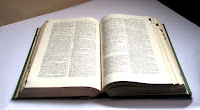
I know it dates me, but I remember well when physical card catalogs were the means of locating a book in a library. The 3 in. x 5 in. cards were kept in small, deep drawers that had a rod running though the cards near their bottom edge so they could not be spilled, disrupting their alphabetical order. In middle school, when my fellow students' class and I were taken to the library, we were taught how to use its card catalog. (In elementary school, simply browsing in the books had been sufficient.) The middle-school librarian taught us that for every book in the library, there were three types of cards in the catalog's wooden drawers: Title card, Author card, and one or more Subject cards.

Having learned that system, when my father took my sister and me to the city's central library, I was delighted upon seeing the massive wall of inviting brown drawers. I could browse through the creme-colored cards with almost as much enjoyment as browsing in the books themselves.

A recent book put out by the Library of Congress informs me that, "Harvard's assistant librarian, Ezra Abbot, is credited with creating the first modern card catalog designed for readers" in the 1860's. Previously, books that were being added to a library had often been merely listed in a librarian's ledger book -- making locating a listing as hard as locating the book itself. Another invention of that time-period was the book's card-pocket, in which a checkout card was kept, removed as a record when the book was borrowed, and replaced upon the book's being returned.

I marvel at not only the efficiency but also the simplicity of these two inventions: They were something any librarian could easily adopt and create on their own. (In contrast, imagine trying to build a computer and write cataloging software, or trying to draw today's barcodes by hand!)

Thinking back upon these changes in libraries, I become more aware of how countless new inventions have appeared during my lifetime. Even staying within the walls of a library, microfilm replaced paper newsprint, but was then itself replaced. Long-playing records were added to some libraries, but then became outdated. Changes in technology have come so fast that two historians, Andrew Pettegree and Arthur der Weduwen (in The Library: A Fragile History) caution today's librarians against jumping too quickly on the bandwagon of the new. Today's innovation can become tomorrow's antique artifact. A newer technology seems to always be just around the corner. Changes occur even more rapidly beyond a library's walls.
A joyful sign
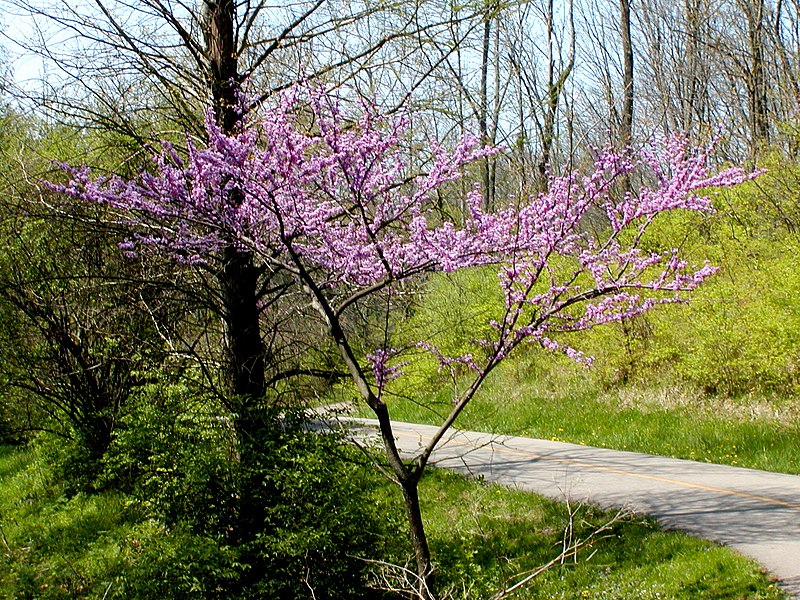
When I turn away from human societies and look at Nature, I also find the new, but it is a different type of newness.  I see the bright yellow-green spring-leaves emerging on a tree that had been bare for months. And I see the brilliant pink blooms on an otherwise bare redbud tree. This is a type of newness that is different from human inventions. It is the newness of renewal and rebirth. It is a type of newness that is ancient. And it is reassuring amid a world of human struggle and destruction. For, as the 19th-century poet Gerard Manley Hopkins wrote:
"... nature is never spent;
There lives the dearest freshness deep down things...."
Hopkins saw that type of newness as a gift of God's Spirit, which "broods with warm breast and with ah! bright wings."

The newspaper's headlines might be only bad news, but the view of spring out my kitchen window is very good news.

~ ~ ~

Is there a way you find a renewal that lies deeper than human innovation?


(The quotation about the catalog is from the book
 The Card Catalog: Books, Cards, and Literary Treasures, © 2007, p. 82.)
(The lines by Hopkins are from his poem "God's Grandeur.")

Friday, March 4, 2022

The Library of One’s Dreams

Reaching new heights through books.
painting by Carl Spitzweg

What do you think the perfect library would be like -- the library of your dreams?  For most book-lovers, I might guess, such a library would have books in great quantity.  But how should such a large number of books be stored?  That desire for numerous volumes has made many a book-lover yearn to have floor-to-ceiling wood shelves.  However, such shelves present the difficulty of browsing while perched precariously atop a ladder, well captured in the 1850 painting "Der Bücherwurm" ("The Bookworm").  

Thinking about myself alone, I would like any library I enter to contain both books on the subject I'm searching for and other books that might catch my eye, leading me to new discoveries or interests. However, if that were all a library held, it would be catering to my needs alone.  What about other people's needs?  A good public library would keep me from becoming selfish.  It would contain books I would never want to read so that it would continue to attract other people as well.

Without a doubt, the library most often declared to have been "the greatest" library of all times has been the ancient Library of Alexandria.  So hyped has been that library that it is said that it grew in size even after it no longer existed -- its supposed size enlarged with each new telling about its dream-like grandeur.  There are several legends about its supposed "destruction."  Take your pick whether you want the culprit to be Caesar, ancient Christians, or the Muslims.  Nevertheless, most historians join with Ian McNeely, who explains that most probably that library “decayed as the result of neglect” by political rulers, leaving “no one left to tend and preserve it.”

Before we get too dreamy about the "perfect" library, we might remember that some of our dreams at night are actually nightmares.  Similarly, some libraries been the stuff of bad dreams.  In 1575, when the scholar Hugo Blotius went to Vienna to take charge of Emperor Maximilian II's library, he discovered, in his words:
There was mould and rot everywhere, the debris of moths
 and bookworms, and a thick covering of cobwebs.

Roughly two centuries later, as part of an "Enlightenment" wave to purge religious influences upon society, books from a Jesuit college in Brussels were claimed for a royal collection.  Not yet having space to hold them, the royal library resorted to storing them in a church -- where there were mice!  So, as a pair of today's historians explain:
The secretary of the local literary society ... duly made a selection of 'useful books' which he placed on the shelves in the middle of the nave, and the remainder were strewn on the floor, so as to distract the mice with easily accessible food.

It thus seems that many forms of life are not that kind toward books.  Nor is inanimate Nature always that friendly towards book collections.  The San Francisco earthquake of 1989 spilled half-a-million books in its public library onto the floor, damaging many of them.

Humans' ability to learn to speak a language is a natural product of evolution; it is part of our brains' having evolved especially for that purpose.  But writing and reading do not come to us automatically or naturally (a fact those with dyslexia well know).  It might be said, therefore, that libraries are in a certain sense also "unnatural."  They are accomplishments of developed human culture.

Nevertheless, Nature (in forms other than mould, moths, spiders, and mice) cannot be kept entirely outside the walls of our libraries.  The pages of almost all books have been made from animal skins (i.e., parchment) or tree pulp (i.e., most paper).  The English word "book" is even derived from the word "beech," as in beech trees.

Windows into the world.
Moreover, what would a library's interior be without natural light to complement that which is artificially made?  And studying in a library would be oppressive if a person could not occasionally gaze out a window at grass, tree, clouds, or sky, thus resting their eye muscles and expanding their mind further than the book alone could do.

~ ~ ~ 

Do you have any favorite memories about libraries?


(The explanation about the Library of Alexandria by Ian F. McNeely is from
 his Reinventing Knowledge: From Alexandria to the Internet, © 2008, p. 35.)
(The other quotations are from The Library: A Fragile History by Andrew Pettegree
 and Arthur der Weduwen, © 2021, pp.1 & 233.
)

Friday, February 4, 2022

Vocabulary Lessons


Look it up!
My favorite elementary-school teacher was my fifth-grade teacher, who had a wonderful way of teaching her pupils the meaning of new words.  Each student kept in the storage compartment beneath their seat a dictionary (provided by the school, or the student could bring their own).  During reading-time, as one pupil read aloud from a book and others read along, the teacher would interrupt whenever we came to a word she thought might be unfamiliar to us. "What does that word mean?" she asked. "Look it up!"  At her command, we'd all grab our dictionaries from beneath our seats and race to find the word.  The first pupil to find it was rewarded by getting to read the dictionary's definition aloud.

That pattern of accumulating knowledge of more and more words continued during my education in middle school, high school, and college.  Knowing the meaning of words that were employed almost exclusively in college became a mark of a person's academic standing.

However, once I left the college campus, I had to learn a new type of vocabulary lesson -- how to shed words rather than accumulate more of them.  When conversing with people outside collegiate circles, using an esoteric word could hinder rather than enable communication.  And in preparing my own lectures to people of diverse backgrounds and education, I discovered that I could usually use a familiar synonym or a simple phrase instead of a technical word that only a few might know.  Besides my wanting to communicate clearly through my lectures, I did not want anyone in the class who did not know the meaning of a technical word to feel inferior to the rest of the class.

As years have gone by, and as I have observed more about the use of words and phrases in the English language, I have noticed another type of shedding of words.  Namely, the avoidance of words or phrases that were based on a disparagement of a particular group of people.  The most obvious example in the U.S. today is the use of the phrase "the 'n' word" instead of the slur it is referring to.  A less obvious example is that I virtually never hear the phrase "Indian giver" anymore.

Following the history of words.
Other abandoning of phrases are less known.  Have you ever noticed that preceding the title page in most books is a page that bears only the book's title (no subtitle or author)?  Few people today know that page was once called the "bastard title page," that term growing out of a condescending attitude that "bastards" supposedly had only half the parentage other people had.  Fortunately, publishers today have come to refer to that page of a book simply as the "half-title page."

Interestingly, some of the reconsideration of word usages crisscross our attitudes toward the non-human world of Nature.  People knowing only English might not know that the word "mulatto" for someone of half Caucasian and half Negro ancestry is to Spanish-speaking ears calling that person a "mule."  But why should those hard-working animals also be disparaged by implication because their strength has come from both donkeys and horses?

I myself would like to find a compact substitute for the expression "kill two birds with one stone."  I do recognize that some people living at a subsistence level have to depend upon killing wild birds for animal protein.  Nevertheless, in industrialized countries today, depleted bird populations demand that we cultivate an appreciation of keeping birds alive.  Although "kill two birds with one stone" is a familiar, casual expression, I do not want to be casual in my attitude toward birds.

Countless parents have told their kids, "Watch your language!"  Watching how the English vocabulary has shifted from when I was in the fifth grade to the present, I can discern two things about human nature:  An eagerness to learn (á la those fifth-grade students). And also an ability to become more considerate.
~ ~ ~
Can you discern any improvements in cultural attitudes during your lifetime, either toward humans or toward Nature?

Friday, January 7, 2022

Finding Joy despite
the Shadow of Sadness

 The Covid pandemic of 2020 and 2021 has forced everyone in the world to live with a shadow cast over their lives.  Sometimes that shadow has become greater with the loss of a family member or friend.  Even for those who have not experienced that kind of loss and grief directly, life has become more circumscribed with social-distancing and other restriction for safety.  We all need to be able to find a kind of joy -- even if only a small hidden joy -- despite the pandemic. That is why I found the following article from Wisdom in Leaves five years ago uplifting.  I hope it can also be so for you. It was titled "Laughing Beneath the Meteors."

~ ~ ~

What was it about the written reminiscence that made it so appealing?  Why could I so easily identify with the firsthand experience that was being described, and with the inner feeling the writer remembered?  It was a recollection by a poet in his twenties, thinking back to an occasion of nighttime camaraderie with peers:

"Some day I must tell how we sang, shouted, whistled, and danced through the dark lanes....  and how we laughed till the meteors showered round us,
 and we fell calm under the winter stars.
 And some of us saw the pathway of the spirits for the first time.
 And seeing it so far above us, and feeling the good road so safe beneath us,
 we praised God with louder whistling...."

A night-sky opening up our imaginations.As I read this recollection, I almost wished I were there myself.  The cool night air.  The feeling of relaxation among friends.  The happiness and contentment.  The star-filled sky above.  The wonder of a sudden meteor shower.

Even as relaxing and restorative as those things were, there was also a deeper layer that gently emerged.  It seemed to have to do with that experience young people can have when they feel their youthful idealism beginning to be channeled into the paths of their individual identities:
"[S]ome of us saw the pathway of the spirits for the first time."


I felt as if I knew those subjective emotions because I had experienced them myself at that stage of adolescence:  The paradox of joyful freedom despite not knowing what the future will hold. The only thing I had not experienced as such was the meteor shower.  But I still felt as if I could understand the meaning of what the author described.  Today, in our U.S. popular culture, such things as meteors get mentioned mostly in the form of the fear that a massive asteroid might hit the Earth, bringing devastation.  Modern science also tells us that our sun will eventually burn out, bringing death to the Earth.  Terrifying scenarios caused by uncontrollable events in outer space abound (guaranteeing work for screenwriters of disaster movies).  In contrast, the young poet remembers laughing with his companions as the meteors rained down.

A powerful war-time voice for humanity.
Wilfred Owen (1893-1918)

The reminiscence has a power of its own.  But it is given added poignancy by knowing that it was written by the British poet Wilfred Owen, who died at the age of 25, fighting in World War I.  Owen's war poems have a sensitivity of feeling not unlike that which is revealed in this reminiscence, shared by letter with a friend the year before Owen was killed in battle.

To me, the reminiscence, even as brief as it is, conveys an experience of belonging.  The combination of the companionship of friends and the surrounding realm of Nature convey a sense of ultimate belonging.  Wilfred Owen is now gone.  But nighttime is still cooler than the day. Overhead, there are still stars.  And there is still, I am sure, at least one more shooting star ready to be seen as it pierces the air
we breath.
~~~


Have you ever experienced a moment of deep contentment while you were in Nature?


(Owen's reminiscence is quoted in "Memoir (1931)" by Edmund Blunden,
in the Collected Poems of Wilfred Owen, © 1963.  p. 172.)
(The photograph of Owen is in the Public Domain because its copyright has expired.)

Friday, December 3, 2021

Reflecting about Fences and Walls

The word "wall" has frequently appeared in political news over the past several years. Less quoted have been the poet Robert Frost's lines: "Before I built a wall I'd ask to know / What I was walling in or walling out, / And to whom I was like to give offense."  Even beyond those lines, there are subtler and more complex thoughts in his poem "Mending Wall" -- making the following article on this website (published almost six years ago) still relevant.

~ ~ ~

I have lost count of how many times I've heard a particular line from a Robert Frost poem quoted, but quoted in a way that misrepresents it.  The line is:  "Good fences make good neighbors."  People who quote that line get the words right but usually take it out of context. Taken by itself, the line makes it sound as if Frost is saying it is good to construct some sort of wall between people.  However, in the poem, that line comes not from the lips of the speaker of the poem, but instead from the speaker's neighbor.  And the thoughts of the speaker -- quite opposite to the quoted line -- are:  "Something there is that doesn't love a wall...."  The judgment against the neighbor is reinforced by the speaker's saying that the wall-loving neighbor "moves in darkness."


A once popular poet.
As with many of Frost's poems, physical objects (in this case, the wall) are symbols for something larger, something about human psychology or interpersonal relationships.  Frost's favorite objects to employ in this way are those from Nature. Birch trees, stars, and tiny bugs all make appearances on Robert Frost's poetic stage.  Despite that symbolic role Nature often plays in Frost's poems, the features of Nature he uses are not just poetic devices.  Although the poet's main concern is humans, he is also interested in a right attitude toward Nature. There is thus in the poems an actual connection between humans and Nature, not an artificial linking.  In Frost's poems, Nature, when viewed in the right way, is frequently able to be a real guide for human behavior.  Nature can be a true reference point.  It has lessons to teach.

For example, in the poem "Mending Wall" that frequently quoted line appears when the speaker pinpoints Nature -- in the form of expanding, frozen ground -- as the cause of the wall's continually falling apart:
"Something there is that doesn't love a wall,
That sends the frozen-ground-swell under it,..."
The wall made of piled boulders, if it is to be maintained, requires mending every year not because it was poorly built but because it defied Nature.  The neighbor ("in darkness") seems to not be recognizing Nature's teaching that even the relatively solid earth will change.  Nature is not only a source of order but also a source of the undoing of order.

The contemporary Christian John Haught, from a theological perspective, raises a similar question.  Citing Biblical passages such as God saying, "See, I am making all things new," (Rev. 21:5, NRSV), Haught asks:  "Why should we think of God principally as a 'designer?'  Isn't God also the source of novelty?  And doesn't the introduction of novelty inevitably disrupt perfect design?"

the patient but powerful growth of a plantThe real trick is learning which features of Nature to cite when.  When, as guidance, do I cite the stable features of Nature, and when do I cite the changing ones?  I need to have knowledge not only of the non-human sphere of Nature but also of the human sphere -- understanding how we are both similar and dissimilar to the rest of the natural world.  Knowing how to interpret the world thus calls for growing in wisdom.

~~~

Is there any way you try to be guided by Nature?  Any way you are inspired by it?


(The Haught quote is from Responses to 101 Questions
 on God and Evolution by John F. Haught.  © 2001.  p. 87.)
(The entire Robert Frost poem can be read at this external link:  "Mending Wall.")