Friday, January 8, 2016

Paths, Not All Straight or Narrow

The front lawns in the suburb where I live display varying degrees of maintenance.  Some are impeccably trimmed; others are half-wild.  Although my lawn fits within the mid-range on that spectrum, it does have one distinctive feature, especially when the grass becomes dormant in the winter.  There is a diagonal path across it where the grass is kept matted down by the regular passage of neighborhood cats.  (Even though my wife and I are not sure how many cats use the path, it is clearly defined.)  That mark on our front lawn reveals to me that cats have joined a long tradition of animals and humans who have found it wise to follow a path that has been trod before, a path either secular or sacred.

Almost anywhere you look in the history of animals or people, you can come across the idea of following a path.  Just to take some examples from the U.S.:  James Fenimore Cooper's 1840 book The Pathfinder was inspired in part by stories about native Americans being skilled in finding their way in the wilderness.  American legend also contains the story of how in 1775 the hero Daniel Boone found an opening through the Appalachian Mountains, thus making possible the "Wilderness Road" for Europeans to move further west.  In fact, the trail he found was already there, having been used by Indians for generations.  And how did the Indians know about it?  By watching animals, particularly the buffalo.  They were the original pathfinders.

Turning to the other side of the globe, one of the most important scriptures of Buddhism, by its very name, indicates that honing one's life in a spiritually honorable fashion is like following a path.  A collection of elegant sayings of the Buddha is named The Dhammapada, which could be translated "The Path of Truth" or "The Path of the Teaching."  Furthermore, the idea that the followers of Buddhism are, in a sense, walking behind the Buddha is given beautiful artistic expression by the Buddha sometimes being represented symbolically by two footprints carved side by side on the ground in stone.

The religious symbol of a "path" or "way" is just as explicit, although in a somewhat mystical manner, in philosophical Taoism.  Particularly in Taoism's premier scripture, the Tao te ching.  In most English translations of that small classic, the word "Tao" is even translated as "way" because of the double meaning that English word can hold.  In one meaning, "the way" is the nature of the world, in the sense that we might speak of "the way things are."  In a second sense, "the way" is the way we ought to live our lives to best coordinate ourselves with the way the world truly is.

True, the cats that follow a path of tramped-down grass on my front lawn might feel they are just taking the smoothest route to the bowl of food my neighbor puts out.  But I know the cats are following a widespread and noble tradition by being led by fellow creatures who have traveled a path before them.

~~~

Is there a particular way that your life has followed a path of some people who went before you?


(The photo of Buddha footprints is by "Nemo's great uncle"
and is used under a Creative Commons Attribution Non-commercial License.)

Friday, December 25, 2015

Playing with the Nativity

Focus of a child's imagination
One luxury of our modern Western societies is that many of us are able to have a plenitude of Christmas decorations.  The selections in Christmas stories reveal the enduring popularity of nativity scenes, from folk pottery of South America to wood carvings of Asia.  My wife says that as a child her favorites were nativity scenes that allowed her to move unattached figures about.  And, of  course, some of the favorites of children in those scenes are, understandably, the animals.


Keeping life afloat
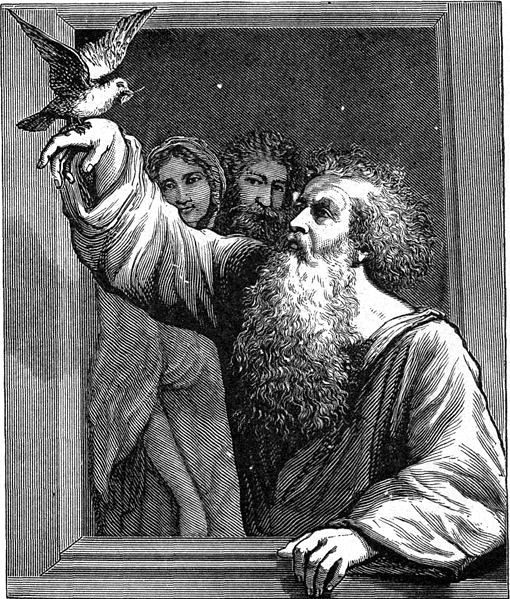
Seeing a child play with those animals that are a part of Jesus's birth-scene often makes me think of a similar children's toy:  the arks with pairs of animals, based on the story of the flood in the Bible's book of Genesis.  (Christianity shares with Judaism that version of the story of animals being saved; and the figure of Noah as rescuer is also in Islam's Qur'an.)  Young children enjoy animating the animals by moving them about.  And figuring out how to fit all the animals into the ark can be a learning experience.

Our contemporary dictionaries have several definitions for "ark," but one older use of the word endures only in history-recording dictionaries such as the Oxford English.  In the 1700's and 1800's, English gentlemen (and their counterparts in U.S.'s New England) were often collectors of objects from nature:  fossils, plant samples, bones, insects, etc.  If the collector could afford it, he kept those samples in a multi-drawered cabinet that came to be called an "ark."  The Biblical connection was so strong that the wood cabinets were sometimes even designed with a sloping top -- the way the roof of Noah's ark would have to have been sloped so the rain would run off.

Natural scientists of that time period had a "fitting" problem that was even greater than how to fit their growing number of samples into their arks (and even more challenging than children getting toy animals back into their ark).  Namely, figuring out how all the fossils, plants, and animals represented by their samples fit together historically and biologically.  Eventually, Darwin's discovery would prove to be a breakthrough.

This story of the resourcefulness of natural science converges with the resourcefulness of Christianity with its nativity scenes.  That is because the Bible itself does not explicitly depict any animals surrounding baby Jesus in the manger.  Sheep are only referred to indirectly in the Bible's book of Luke; camels are never mentioned in the story of the magi in Matthew; and no donkey is mentioned.  All those animals around the Christmas manger are thus the product of humans' imaginatively interpreting the meaning of the Biblical stories.  It seems as if representing the glory of new creation and the glory of God demanded a more holistic picture -- one that involved a range of animals.

Knowing how to careToday, for some of us, another dimension -- another aura -- surrounds those nativity scenes.  Just like Noah, we humans today are trying to rescue animals from extinction by trying to evoke in our human hearts a new birth of the spirit of Creation-Care.  On this ark of planet Earth.

~~~

Do you have any childhood memories involving crèches or living nativity scenes?


(The picture of a nativity is used under a
Creative Commons Attribution-Share Alike 3.0 Unported license by L.Kenzel.
Both illustrations of Noah are in the public domain because their copyrights have expired.)

Friday, December 11, 2015

Animal Attire, Fashionable or Not

In the latter third of the 20th century, as awareness grew about how many mammal species might be headed toward extinction, campaigns against the purchasing and wearing of furs emerged.  Such campaigns have helped increase consciousness about the very real danger of species extinction.  The campaigns, however, have sometimes led to stereotypes about the views of people in previous centuries, when animal furs and skins were more often used for clothing.

helping a bear
get warm
Our current fur controversies can easily lead us to associating the wearing of furs for clothing with being less appreciative of animals.  But in previous centuries, that was not always the case. Sometimes the reverse was true.  For example, in the early 1700's, a time in which there were no synthetic furs, Alexander Pope (1688-1744) reminded his readers to humbly remember that:
"... Nature's children all divide her care;
The fur that warms a monarch, warm'd a bear."

Indeed, as we go back further in the history of Western civilization, we often find a greater awareness and appreciation of our human dependence on animals to protect our vulnerable human bodies.  In Shakespeare's King Lear, the king comes upon a man who is without the usual protection of clothing, and turns that person into an object lesson, telling his own companions:  "Consider him well."  Then, speaking to the pitiable man, the king says, "Thou owest the worm no silk, the beast no hide, the sheep no wool."  The king then reminds us all that, "... unaccommodated [unclothed] man is no more but such a poor, bare, forked animal..."

The origins of the very first human attire are lost in pre-history.  That inability to name the inventor of clothing, along with an appreciation of clothing, could even lead to understanding clothing as being a gift from God.  That perspective appears in the Adam-and-Eve story in the Bible's book of Genesis.  Ashamed after having disobeyed God, the two archetypal humans try to conceal themselves:  "They sewed fig leaves together and made loincloths for themselves."  (Gen. 3:7, NRSV)  This was probably a laugh-line to an audience who would have been well aware how scratchy fig leaves would be.  God, although announcing the sad consequences of humans' trying to be like gods, then extends grace to the helpless humans in the form of more suitable attire:  "And the LORD God made garments of skins for the man and for his wife, and clothed them." (Gen. 3:21, NRSV)

bear tracks in snow
An appreciation of animal attire can also expand to a wonder at the ways animals themselves are "attired."  A half-century before Pope reminded the monarch that a bear had been warmed by the fur he also wore, the naturalist John Ray (1627-1705) marveled at the appropriate variations in the protective covering of different species.  Ray did not yet have Darwin's explanation for how such variations had come about through the natural process of evolution.  Nevertheless, Ray marveled not only at the fur covering some mammals, but also at the insulating blubber of fish in cold waters, and the warming down some birds are attired with.

~~~

Do you notice any changes in Nature as winter comes?  How do you prepare for it?


(The quote by Alexander Pope is from
An Essay on Man, 1733-34, Epistle III.)
(The excerpt from King Lear is from Act III, scene iv, 195.)
(The children's illustration is in the public domain because its copyright has expired.)

Friday, November 27, 2015

Finding the Thread of the Story

Long before there was the first written word, people looked up at the night sky and sensed that their life on Earth was part of a larger world, a larger story.  Once the rhythmic, circular movements of the sun and stars were charted, the mathematical harmony of that larger story came over time to be called "the music of the spheres" --  circular movements seeming to repeat themselves to eternity. However, in the 20th century, a different but also awesome story emerged from modern astronomers.  It is the story of how our universe began with a Big Bang, leading to the formation of galaxies, to our Sun, then to our planet Earth, and finally to life upon it.

Because that often-repeated narrative has come out of the discoveries of modern science, it seems so scientific, so objective.  Unlike ancient cultures' imaginative creation stories with their own messages to tell, the modern scientifically-based narrative gives the appearance of being just facts, not prejudiced by human desires.  Often overlooked, however, is one critical way in which that modern scientific narrative is unconsciously shaped by a human bias.

Think about it:  Why is that story of our universe, which begins with the Big Bang, always told with life on planet Earth as the outcome of its narrative?  Why is it told as a chain of events leading to the development of planet Earth?  A narrative could be constructed just as scientifically that would lead to planet X in galaxy Y, or to planet Z circling around one of many other suns in a different solar system.  The actual history of the universe is that of countless causes-and-effects scattering throughout the cosmos in innumerable directions.  Multiple chronologies, not just the one that leads to our home planet.

Thus analyzed, that often-repeated narrative about the universe that modern science has made possible reveals itself to be not totally objective.  But that is just as well.  After all, what meaning could it bring to us if we did not follow the thread of the story that leads to life on Earth and even to us?  The scientists who tell our modern story of the universe have thus revealed themselves to be not just scientists but also narrative-makers -- storytellers!  They have thus engaged in an ancient art.

Narratives are not simply an imaginative form of art. They can also be sources of knowledge. We humans can comprehend the world when we isolate threads that form a narrative.  The modern theologian John Haught speaks to this point when he writes:
"For human subjects the world is not experienced, at least in a rich or interesting way, apart from stories....  There is a narrative quality to all of our experience, and it is from stories, whether mythic or historical, that we acquire any sense or reality at all."

Looked at in still another way, one message of modern science's story of the universe is that out of the universe have emerged, of all things, storytellers!

~~~

Has your life been a story?  How?


(The Haught quotation is from Is Nature Enough?
  Meaning and Truth in the Age of Science, by John F. Haught.  © 2006. p. 46.)

Friday, November 13, 2015

Loving Rain

The last half of the 20th century and first part of the 21st saw many spiritual writers who were widely read:  Thomas Merton, Henri Nouwen, Thich Nhat Hanh, Kathleen Norris, and others. Although Thomas Merton is not my favorite (just a personal taste), there is part of one essay of his I like so much that I can return to it every few years.  It is that part in which he describes his experience of rain while he is alone in his cabin in the woods.

Merton's description of the rain is as good as about any nature writer's, but he puts a slight twist on his experience by interpreting the sound of the rain as being like speech:  "It fills the woods with an immense and confused sound.  It covers the flat roof of the cabin and its porch with insistent and controlled rhythms."  The heart of the significance of rain, as Merton understands it, is that rain is a gift, in contrast to a human society that has become increasingly commercialized.  Merton makes that point in the opening words of his essay:  "Let me say this before rain becomes a utility that they can plan and distribute for money.  By 'they' I mean the people who cannot understand that rain is a festival, who do not appreciate its gratuity, who think that what has no price has no value...."

A "gratuity."  A gift.  To use a theological word, grace.

Many years ago, I noticed how in the U.S., weathermen on TV almost invariably described predicted sunny weather as "good" and predicted rainy weather as "bad."  What a narrow, city-centered viewpoint, I realized -- one that thought of rain mostly in terms of the inconvenience of driving on wet city streets.  Or temporarily avoiding them until the rain subsides.  (Only when droughts have been occurring in some areas do we have weathermen looking forward hopefully for rain.)  But any farmer knows that what is really needed are alternations of sun and rain.  And all our human lives depend on the farmer's success.

Thomas Merton depicted the rain he experienced as "a festival."  His use of that word made me remember a photograph I saw in Life magazine when I was a boy.  It was of children and youth in a city in India, dancing about outdoors, completely drenched by the first monsoon. They had been parched for so long that they knew rain was a gift, and knew how to celebrate it as a festival, even to the point of bathing themselves in it.

More than that, as I've come to celebrate rain, I can also celebrate it as being ecumenical. That fact was expressed well by one second-century Jewish Midrash (commentary) on a Biblical psalm.  To appreciate this statement about rain, we need to realize that in the Jewish faith-tradition, the central written teaching -- the Torah -- is celebrated as a great gift because it enabled people to create a community together.  Nevertheless, there is, as this Midrash, explains, an even greater divine gift:
"The sending of rain is an event greater than the giving of the Torah.
 The Torah was a joy for Israel only,
 but rain gives joy to the entire world, including animals and birds."

~~~

Do you have a memory of an occasion in which you experienced rain as a gratuity?


(The Merton quotes are from "Rain and the Rhinoceros"
 in Raids on the Unspeakable by Thomas Merton, © 1966.  pp. 9-10.)
(The Midrash is Midrash Psalms 117 and is taken from The Green Bible, © 2008.  p. I-99.)