Friday, February 7, 2014

Byways of Chocolate and Flowers

I have no doubt that sales of chocolates and flowers increase in the U.S. before every Valentine's Day.  Hardly anyone shopping on Feb. 12th & 13th would know, however, that chocolate and flowers intersect at a point in history a little over three centuries ago. That conjunction tells a story involving, of all things, British imperialism, science, and religion.

As with many such incidents in the byways of history, the connecting character in the story is now one of the little-known figures of history.  His name is Hans Sloane (1660-1753), and he is the person who introduced milk-chocolate to the United Kingdom.  A larger story begins to emerge when we find out that Sloane had a collection of 71,000 objects that, after his demise, became the basis for the British Museum in London. Flowers enter the picture as we learn that among those objects were 800 new species of plants from around the world that he had collected.

What had brought that about?  Sloane's collecting was not just a personal mania.  He was part of a wave of collecting plants and animal specimens by the English during the 1600's and 1700's. That foundation for botanical and zoological studies rode the wave of British expansionism as the British Navy spread throughout the globe, establishing colonies, and securing trade in goods and slaves.  Plants -- particularly flowering tropical ones -- were among the cargo brought back to England.

It is the connections surrounding the milk-chocolate man Sloane that get us more specifically to matters involving flowers, science, and religion.  Sloane, with his vast collection of specimens, corresponded with the botanist John Ray (1627-1705), who  would come to publish a three-volume catalogue of over 16,00 plant species.

John Ray
Ray was able to accomplish such an astonishing feat because he developed an innovative system of classification, the key to which was concentrating on the seeds produced by flowers. Although modern biological classification has evolved beyond Ray's system, he established species as the basic unit.  Also, modern botany still employs Ray's major division of plants into monocotyledons (such as corn), which have a single leaf sprouting from the seed, and dicotyledons (such as lima beans), which have two leaves sprouting from the seed.

In the historical study of the relationship between science and religion, John Ray is best know for another book he wrote, The Wisdom of God Manifested in the Works of the Creation.  That title dates Ray as being from an earlier era of science, in which scientists more freely mixed their scientific observations with their belief about God.  It is an approach no longer used by scientists today.

Nevertheless, virtually everybody feels that Nature's cacao plant and the chocolate derived from it were very smart inventions.  And countless people love flowers.  Hopefully, we have all been able at times to feel (as Ray did) a love for the marvelous intricacy of living beings, whether or not we depict it as being the wisdom of God.

~~~

Have chocolate or flowers added anything to your spirit for living?  How?


(The drawing of John Ray is in the Public Domain
 because its copyright has expired.)

Friday, January 24, 2014

Much between the Oink and Curly Tail

A character in PBS's Call the Midwife remarked that dogs look up to us, cats look down at us, but pigs see us as we are.  That bit of wit may say more about our relationships with dogs and cats than it does about pigs.  Nevertheless, pigs probably deserve more credit than they usually get.  Just to start with, we virtually never hold up any quality of a pig for people to emulate.  We say humans should be faithful, and recognize dogs as being so.  In contrast, to call a person a "pig" or a "hog" is always an insult.

detail from
Gauguin's The Black Pigs
Despite that contrast between our attitudes about dogs and pigs, there may well have been a similarity between the way ancient ancestors of dogs and of pigs entered the circle of human culture.  Our domesticated pigs are descendants of tusked wild boars.  Scavenging in humans' waste heaps, those boars that were less aggressive would have been more likely to have been domesticated (just as dogs were from their wild ancestors).  Recent DNA studies have now revealed that the transition from wild boars to pigs was made in seven separate regions of the world, ranging from China to India to Central Europe.

The human-pig relationship, however, has been an uneven one ever since those domestications in Neolithic times.  The unevenness has extended far beyond the matter of pork-eating being a taboo in parts of Judaism and Islam, in contrast with it being the primary source of meat in New Guinea. The larger difficulty has been in humans' not having figured out what degree of wildness and tameness they want in the lives of their hogs.  For centuries in Europe, hogs were allowed to wander freely, perhaps getting some of their own food from the forests, but also being able to search out humans' garbage.  That freedom meant that hogs sometimes caused accidents or killed children, leading to the oddity of a number of hogs having actually been put on trial during the 14th century before being executed.

Today, we have other problems resulting from an opposite condition -- a reduction in the pigs' freedom.  The over-concentration of hogs in massive factory farms has led to unnatural concentrations of urine and feces, far beyond the ability of Nature to reprocess it into the ground. And beyond our ability to find a good way of dealing with it.

pig statue in Sweden
Yes, the history of human-pig relationships has been an awkward one.  Knowing something of human nature, it should not be surprising that people have sometimes pointed the finger of blame at the pigs, even though we ourselves have been ultimately at fault.  It is not just Charlotte in E.B. White's Charlotte's Web who might feel some sympathy for the pig. Perhaps we could give pigs more credit for all they have contributed to the human race -- from pork to leather to bristle brushes to even finding highly valued truffles.  I am doubtful, however, that pigs will be given full credit.  Even when we see a sausage in a bun with mustard, we linguistically honor our canine friends by exclaiming "hot dog" -- saying "dog," when it was the pig that made the real sacrifice.

~~~

As you read this short history, did it bring any thoughts to mind?

Friday, January 10, 2014

Our Time, and Nature’s Time

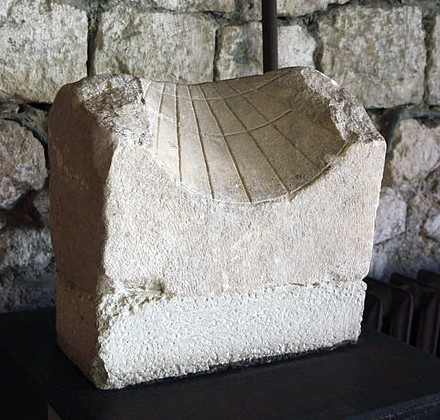
Humankind, over the course of centuries, has figured out how to measure time with progressively greater precision. From ancient water clocks that marked off only hours to contemporary atomic clocks that can divide a mere second into billionths, the desire to mark off time more precisely has been part of the human story. Nevertheless, in our everyday lives, we often don't know how to handle time in a way that satisfies us perfectly. That ancient human challenge endures, despite all our Day-Timers and appointment software.

ancient sundial
In 2nd-century Rome, where public sundials became unusually widespread, the playwright Plautus complained:
"The gods confound the man who first found out
How to distinguish hours!
Who in this place set up a sun-dial,
To cut and hack my days so wretchedly
Into small portions."
I'm glad, for his sake, that Plautus is not alive today, experiencing how we cut up time into quarter-hours and, in the case of athletes, fractions of a second.

I was provided a quite different perspective on time when my wife told me about something she observed on a T.V. cooking show.  The chef showed the viewers a clam the size of my wife's fist, pointing out the rings on the shell that marked off periods of growth.  Then -- after explaining that the clam was 200 years old -- the chef opened it, pulled out the small body inside, and chopped it into a few pieces for consumption.  My wife said she felt there was something not right about it:  200 years of life gone, and in just a few gulps.  (I have imagined what a different scenario it would be if the little clam had been kept alive in an aquarium for fascinated visitors to peer in at it and be amazed.)

So what are we to make of time?  What is time itself, after all?  It is not something easily thought about in the abstract by average minds.  Even the quite intelligent St. Augustine in the 4th century said that he thought he easily knew what time was -- until he tried to say exactly what it was. Indeed, when we want to think about time, we have to either mark off time in measurements or compare ourselves to something like a mountain or a clam.  And as we do so, the sun rises and sets, and the Earth tilts back and forth on its axis, both unaffected, but encompassing our lives in regular natural cycles.

Despite all our measuring of time, despite all the synchronizations demanded by our modern urban societies, there is also a phenomenon almost every person has noticed:  Namely, that time, in fact, seems to drag at times and at other times go by so quickly.  The early 20th-century Christian writer Henry Van Dyke put it so insightfully and poetically:
"Time is
Too Slow for those who Wait,
Too Swift for those who Fear,
Too Long for those who Grieve,
Too Short for those who Rejoice;
But for those who Love
Time is not."

~~~
Does time ever challenge you?  How?

(The Plautus quote is taken from
The Discoverers by Daniel J. Boorstin, © 1983.)
(The original form of Van Dyke's poem [the last word of which is frequently misquoted as "eternity"]
 can be read at this external link: The Works of Henry Van Dyke, Vol 1. © 1921.  p. 259)

Friday, December 27, 2013

Home, Semi-Sweet Home

Teachers of writing might, for good reason, caution movie writers to use the concept of "home" cautiously. The problem is that it can easily lead to sentimentality – to an expression of emotion that seems overdone to the movie viewer.  If the opening scene of a movie depicts a family seated quietly in their living-room with a needlepoint of "Home, Sweet Home" on the wall above the fireplace, the viewer should be wary.  Unless that self-proclaimed label of domestic sweetness is tongue-in-cheek about the dysfunctional nature of the family beside the fireplace, we are likely to find the movie becoming saccharine.

Nevertheless, the concept of "home" can genuinely touch deep resonances within us if it is skillfully used by a poet.  The very word "home" can express a place of belonging we'd like to get back to, even if we've never quite been there.  Some of the best instances I've encountered of the use of "home" also speak to a relationship with Nature.

One poem that makes an explicit correlation (and which seems to portray an actual event in the poet's life) is written by Joseph Bruchac.  The poem has the unusual title of "Geese Flying over a Prison Sweat Lodge."  A session together in a sweat lodge (similar to a sauna) is one Native-American way of bonding socially and re-grounding spiritually.  In the incident this particular poem describes, however, being in the comforting interior space of the lodge ("inside our memories /  waiting to be born again") is contrasted with the imprisoning walls of prison life ("mortared stone / with razor wire on top").  Paradoxically, once enclosed within the set of walls of the sweat lodge, the prisoners find release through a contact with Nature they cannot even see.  That is because they hear "the cries of the geese... their touch deep as bone, / speaking words never written / That always mean home."

The "home" metaphor can be powerful (if deftly used) because it speaks not only to our inner resonances with the natural world but also to our loneliness and our fear of separation. I know of no better expression of the two elements together -- Nature and longing -- than in the following short poem by Rainer Maria Rilke.  Interestingly, Rilke, like Bruchac, draws upon migrating birds' astounding homing instinct -- their urge to get home.
"Ah, not to be cut off,
not through the slightest partition
shut out from the law of the stars.
The inner – what is it?
if not intensified sky,
hurled through with the birds and deep
with the winds of homecoming."


~~~

Do you have a way of getting back home spiritually?


(The Bruchac poem can be found in
 Native American Songs and Poems, ed. Brian Swann, © 1996.)
(The Rilke poem, trans. by Stephen Mitchell, is from
 Ahead of All Parting:  The Selected Poetry and Prose of Rainer Maria Rilke, © 1995.)

Friday, December 13, 2013

The Starry Sky

I most recently encountered the idea in F. C. Happold's Religious Faith and Twentieth-Century Man.  Like a number of other thoughtful Christian writers over the past half-century, Happold (a modern mystic ) has commented upon the contrast between the cosmology of Biblical times and the one provided by our contemporary astronomy.  These writers know that the Bible was not meant to be science.  Nevertheless, they raise the question of whether "modern man's" way of thinking about the world is now so different that we cannot respond spiritually in a way paralleling that of people several centuries ago.  They point out how we now have detailed scientific knowledge of the cosmos, and ask if the kind of religious sentiment felt by people centuries ago is not diminished in contrast.

But I wonder.  I recognize that there has been an immense change in our scientific knowledge of the cosmos... but still I wonder.  I wonder whether it is our increased knowledge of astronomy that poses the problem, or perhaps something else.  I wonder if the challenge doesn't come more from some side effects of our scientific technology.

In Biblical times, people did not know about light-years of distance, or about the millions of galaxies, or about an expanding universe.  Those people could, however, simply look up at the sky at night and see more stars than anyone could count.  The stars were to them as innumerable as the grains of sand upon the shore (Gen. 22:17).  And those people's response could be sacred awe.

Today, most people rarely have the same experience, but I do not think it is because our scientific knowledge is so much greater.  It is instead because our firsthand experience of the night sky is so limited.  When we today look up at the sky at night, we most likely see only a fraction of the number of stars Biblical man saw.  All the ambient city lights prevent us from seeing a black-velvet background of sky studded with stars beyond anyone's counting.

Even if there were not so many electric lights outside to interfere, would that mean there wouldn't still be another problem?  Wouldn't all our technological temptations (TV., computers, and cellphones) distract us?  Even when there are a fair number of stars visible, how often do you see people in U.S. cities pause from their activities to look up and survey the starry night sky?

time exposure of night sky
Even if I cannot see as many stars as I would like to, I still like to look up and see as many as I can -- and I find it so wondrous!  That is why I like to periodically leaf through my book of Gerard Manley Hopkins' poems and read the opening lines of "The Starlight Night."  Those lines read:  

"Look at the stars!  look, look up at the skies!
O look at all the fire-folk sitting in the air!
The bright boroughs, the circle-citadels there!"

~~~

Do you have a favorite remembrance of having experienced the starry sky?