Friday, September 3, 2021

More than Just an Art Critic

John Ruskin. He is usually identified as being an "art critic," such as in this typical entry from a dictionary:  "Ruskin, John. 1819-1900. British writer and art critic who considered a great painting to be one that conveys great ideas to the viewer.  His works include Modern Painters (1843-1860)."
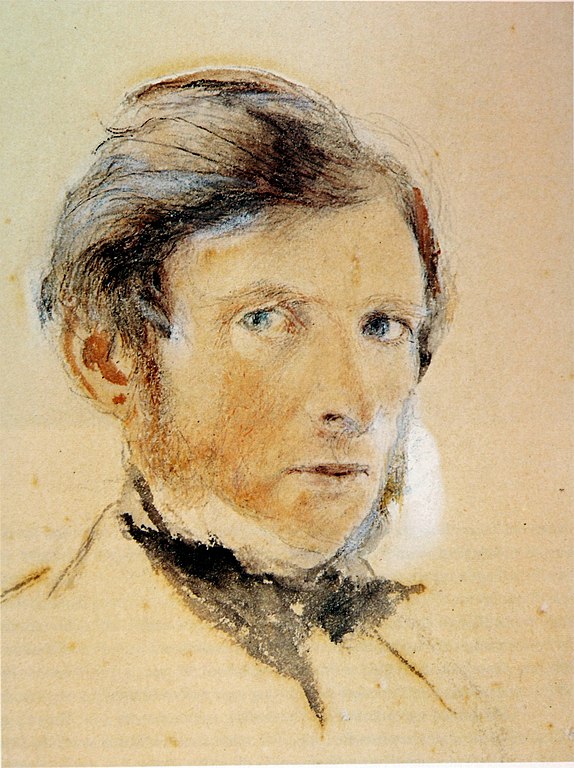
John Ruskin,
self-portrait, 1861
But Ruskin thought about much more than art.  He even reflected deeply upon intellectual issues related to religion during the 19th century, during which he lived. It was a rapidly-changing, confusing time to many people in England.

The emergence of historically-oriented academic fields such as geology and paleontology had raised questions about the Bible's truth, which was being approached with a new, historical mindset (rather than symbolically or spiritually, as had been traditional).  Those sciences were revealing the Earth's age to be vastly older than traditionally imagined.  Ruskin confessed to a friend:

"If only the Geologists would let me alone, I could do very well, but those dreadful Hammers! I hear the clink of them
                                                 at the end of every cadence of the Bible verses."

For the first couple centuries after the rise of modern science in the 1600's, it had been hoped that scientific discoveries about the natural world would add new, overwhelming evidence to how Nature had been designed by a good, benevolent Creator.  But Ruskin was aware of the drawbacks in that approach because of the ambiguity of Nature.  Calling upon readers to view the natural world with a keen eye (the way they might examine a painting), he first lays out an idyllic scene:

"It is a little valley of soft turf, enclosed in its narrow oval by jutting rocks and broad flakes of nodding fern.... The autumn sun, low but clear, shines on the scarlet ash-berries and on the golden birch-leaves, which, fallen here and there, when the breeze has not caught them,
 rest quiet in the crannies of the purple rock."

But then, his camera-like eye pans slightly to the right:

"Beside the rock, in the hollow under the thicket, the carcase [carcass] of a ewe, drowned in the last flood, lies nearly bare to the bone, its white ribs protruding through
 the skin, raven-torn."

Ruskin (writing even before the after-effects of Darwin's Origin of Species) forces us to see the disturbing ambiguity of Nature: That which was death to the ewe is life to the ravens.

Nature as turbulent.
Despite Nature's not being able to be a straightforward moral guide to us, Ruskin does not think we should lose the compassionate capabilities of the human heart -- as demonstrated by the sympathetic manner in which he describes the next things his observant eye falls upon:

"I see a man fishing, with a boy and a dog -- a picturesque and pretty group enough certainly, if they had not been there all day starving. I know them, and I know the dog's ribs also, which are nearly as bare as the dead ewe's."                                                                 

These passages show how Ruskin viewed the face of Nature as being illuminative and yet turbulent.  Those qualities of Nature are also expressed in the paintings of J.M.W. Turner, which Ruskin greatly admired.

Nature as illuminative.

~ ~ ~ 

(Is there a way you view the presence of disturbing features in Nature and yet still derive inspiration from it?)


(The dictionary entry is from The American Heritage Dictionary, 3rd edition, © 1992.)
(Ruskin's statement about Bible verses was made in his letter of May 24, 1851 to Henry Acland.)
(Ruskin's descriptions of scenes in the natural world are from the 1860 edition of his Modern Painters, )

Friday, August 6, 2021

Being Inspired Even at a Distance

The Covid pandemic that began in 2020 put a kink in many people's usual plans for summer vacations, even in 2021, when vaccines were available for most adults in the U.S.  Life had changed, turning many in-person gatherings into virtual gatherings.  Adults had to depend more upon their memories of firsthand experiences they once had. And children needed to rely more on second-hand knowledge and their imaginations.  As I reflected on that situation, the following Wisdom in Leaves article, published four years previously, seemed particularly relevant.  It was titled "Hearing the Sea in a Shell."

~ ~ ~

A world of soft sand, sight, and sound.

It is an experience every child should have for the first time:  Holding a large shell to one's ear and hearing the sound of "the sea" supposedly still in the shell. How many parents or grandparents have initiated their child or grandchild to seashore wonders by instructing the child to "hear the ocean" in that way?  How many children have smiled upon first hearing the sound a large seashell makes, imagining for a moment they really heard the sea?  I recognize that an acoustical scientist could give a good, detailed explanation for the perhaps puzzling effect.  But I am more interested in how that experience can be an opening to how we and all things are part of a larger whole.  That is the very matter the poet William Wordsworth explored in his long poem The Excursion.

Even though the sea-in-seashell symbol could be a good literary opening, it appears in the middle of Wordsworth's poem when, in his memory, he sees himself as a boy:

"A curious child, who dwelt upon a tract
Of inland ground, applying to his ear
The convolutions of a smooth-lipped shell;
To which, in silence hushed, his very soul
Listened intensely; and his countenance soon
Brightened with joy; for from within were heard
Murmurings, whereby the monitor [the shell] expressed
Mysterious union with its native sea."

In the very next line, Wordsworth opens up the metaphor of how -- if we orient ourselves properly -- we can "hear" in the natural world intimations ("Murmurings") of a larger, deeper reality:  "Even such a shell the universe itself / Is to the ear of Faith...."  Moreover, Wordsworth later addresses his words to a larger divine Spirit that includes all of our own spirits, just "as the sea her waves."

The magic of children innocently believing (at least for a moment) they are hearing the sea in a shell derives from a child's wonderful delight in first discovering the world.  And so, a stanza early in the poem began with the statement "Such was the Boy."

Life-giving memories.

oil portrait of
William Wordsworth
by Benjamin Haydon

Even though we adults cannot actually return to our childhoods, Wordsworth expresses how, even in old age, our memory can restore to us some of our original exaltation. That ability of memory to recreate something not physically present is similar to the seashell's ability to recreate the physical ocean, which is not physically present:

"If the dear faculty of sight should fail,
Still, it may be allowed me to remember
What visionary powers of eye and soul
In youth were mine; when, stationed on the top
Of some huge hill -- expectant, I beheld
The sun rise up, from distant climes returned....
... my spirit was entranced
With joy exalted to beatitude...."

~~~


Are there ways you restore contact and communion with those who are not physically present?


(The two large excerpts are from Book IV, "Despondency Corrected" of The Excursion [1814]
That full section of the book-like poem can be read at this external link:  The Excursion, Book IV.)

Friday, July 2, 2021

There's More to Penn and His Pen

A child's learning involves being able to identify things. (Spoon. Ball.)  And it involves being able to recognize recurring patterns.  (That ball and spoon both go down when pushed off the edge of the table.)  However, that wonderful human ability to identify things and discern recurring patterns has a drawback: It easily results in our simplified classifying and stereotyping of people.

Not only do we easily group people by race or ethnic background, we also classify historical personages by what they are most famous for.  For example, one person becomes "a scientist" in the historical record, even though that "scientist" might have most enjoyed playing with their children. Or, another famous person becomes "a singer," even though that "singer" might have most enjoyed tinkering with old clocks.

Can classify the people by their clothes.
One historical figure in early North American history has become indelibly linked to the state of Pennsylvania:  William Penn, whose last name is the first part of that state's name.  There is a bit of irony here, because even after getting the king of England's permission to establish a colony in the "New World," William Penn spent more years in Germany and England than in the future U.S.  Because most education in the U.S. today is secularized, American-history textbooks classify the man as a political leader.  Books on the history of Christianity, in contrast, classify him as a leader of a religious movement, the Quakers.  As a result of such classifications, neither type of textbook is likely to tell the reader about Penn's thoughts and writings about Nature.

William Penn's enjoyment of Nature is demonstrated by the name he had preferred for the colony he founded in 1691: "Sylvania," meaning "forest" in Latin.  It is from the same Latin root for "Sylvania" that we get the little-used English word "sylvan," meaning related to wooded areas.  (It was King Charles II who stuck "Penn" on the front end of the colony's name in honor of William Penn's father, an admiral.)

Even though on national holidays such as the Fourth of July, patriotic Pennsylvanians might focus only on William Penn's interest in founding a colony, that man's appreciation of Nature is revealed in words like these that flowed from his pen:

"The world is certainly a great and stately volume of natural things, 
and may be styled the hieroglyphics of a better one, 
But, alas, how very few leaves of it do we seriously turn over!
... The country is both the philosopher’s garden and his library, 
in which he reads and contemplates 
The power, wisdom and goodness of God."

With those words in Penn's book "Some Fruits of Solitude," he is sharing in a long tradition within Christianity of viewing the natural world  as a revelatory "Book of Nature" that supplements and complements another book, the Bible.

Artists' portraits of Penn and his fellow 17th and 18th-century Quakers frequently portray them wearing their distinctive flat-topped black hats as an aid to picture-viewers in identifying them as being Quakers.  (The Quaker Oats Company has stated that one such portrait on their trademarked cereal boxes is not William Penn, as they once claimed, but is just a generic Quaker.)  Those flat-topped hats with two projections to the side look out of fashion today.

A sparkle of beauty added to our life.

But perhaps not out of fashion might be William Penn's additional thought that,"It would go a long way to caution and direct people in their use of the world" if "they were better studied" in the natural world as revealing the Divine.  He continues: 

"For how could man find the confidence to abuse it,
While they should see the Great Creator stare them in the face, 
in all and every part thereof?"

~ ~ ~

(Is there any way that you feel you "see the Great Creator" in Nature?)


(Both quotations are from William Penn's book "Some Fruits of Solitude" [1682, 1693], capitalization modernized.)

Friday, June 4, 2021

Sunsets and Time

 How do you bring a successful TV series to an end before it is canceled or, perhaps even worse, before it loses its glow?  That was the challenge the PBS producers of the Inspector Morse mystery series had to deal with.  The grumpy, somewhat elderly detective Morse had warmed his way into so many viewer's hearts that the writers had to figure out an acceptable way of having him die in the last show, rather than leaving viewers hanging with an open-ended story line.  But how could the death be handled delicately?  Interestingly, part of the writers solution was to use a touching scene at sunset (days before Morse's demise) to reflect upon the meaning of human mortality.

A "sunset" or yesterday's world?
Sunsets have on a number of occasions been a means for writers to touch on the challenge of perishability.  And also to touch on truths about time -- for, after all, nothing can stop that incorrigible movement of the sun in the sky, day after day.  Sometimes the sunset metaphor can be pessimistic.  Such as when the late-19th-century writer H.G. Wells, in his book The Time Machine, has his lead character journey to the years 802,701 and beyond.  There he encounters a dystopian world and "the sunset of mankind."

But to me it is in a way ironical that a sunset should become the metaphor for a dark vision of the future.  Even though it is true that sunsets proceed the darkness of night, I have found that when people do have an emotional reaction to sunsets, they almost invariably find them to be beautiful.  That is noteworthy because we live in an age in which we often dismiss beauty as being something merely subjective—something merely "in the eye of the beholder."  However, the writer Crispin Sartwell points out regarding our judgments about beauty that:
"Though different persons can of course differ in particular judgments,
 it is also obvious that our judgments coincide to a remarkable extent:
 it would be odd or perverse for any person to deny that
 a perfect rose or a dramatic sunset was beautiful."
What did Sartwell choose as one of his two examples to demonstrate that judgments of beauty are not merely subjective?  A sunset!

Nevertheless, our urbanized and technologized lives make it harder to enjoy sunsets.  Buildings can block our view.  And prime-time TV draws us indoors to watch an electronic screen rather than look out a window.

Beyond its beautiful colors, there is something else we might gain from watching a sunset.  In our modern, technologized lives, time has become mathematical -- broken up into smaller and smaller measured units.  Even though today's clocks (being more often electronic instead of mechanical) no longer produce the sound of "tick, tock, tick, tock," they still measure off the seconds.  Almost every computer carries a mathematical representation of the current time in the lower right-hand corner of the screen.  But the mathematical model for time is artificial because we do not actually experience time as equal tiny units.  Instead, we experience events that have a duration. If we did not experience duration, we would not be able to hear the melody of a line of music; we would hear only separate notes. If we did not experience duration, we would not be able to make sense of a spoken sentence; we would hear only isolated words one after another.

An opportunity for contemplation.
Thus it is that watching a sunset, besides slowing us down, can bring us back to the way that our lives are a part of the natural world.  For, as the environmental and spiritual writer Bill McKibben wrote:
"The most fascinating thing about dusk 
  is the lack of demarcation.
 It’s one long smooth transition."

~ ~ ~

(Do you remember watching a sunset?  When?  Where?  What was it like?)


(The quotation by Sartwell is from his entry on “Beauty” in the Stanford Encyclopedia of Philosophy. © 2016. pp. 1 & 2.)(The quotation by McKibben is from his book The Age of Missing Information, © 1992, p. 148.)

Friday, May 7, 2021

The Sounds of Morning

In a modern city in the U.S., the most quiet time is probably around 4:00 a.m.  At that hour, even most of the night-lifers have gone home (bars having in many cities closed around 2:00); and the alarm clocks of most workers have not yet rung.  Virtually the only sound is the faint background hum coming from an interstate or other highway.

But soon, -- even before the first hint of light in the sky -- come the first sounds of morning. Perhaps a car engine being started.  Or maybe a truck making its early deliveries to a grocery store or cafe.  If the windows of our homes are open, we might hear fainter sounds, such as a TV in another house being turned on to catch the morning weather and traffic report.

Even by 5:00 a.m., however, there still might not be any sounds from non-human life.  Rarely anymore is there the crow of a rooster in any U.S. city or suburb.  During the night, there might have been the twittering of a half-asleep pigeon.  But most birds will wait until the first hint of daylight on the horizon before calling out to see if its companions are awake.

Because I am very nearsighted, even during the daytime I have a hard time identifying birds by sight when they are at a distance, especially when they are partly obscured by the foliage of trees.  And so I especially enjoy the rich birdsong of morning.  Even without being able to see the birds, I can recognize a number of species by sound, and be thankful that the birds I am familiar with in my neighborhood have made it safely through the night.

Besides being a time for awakening, daybreak is a time for healing.  In the New Testament, Jesus on several occasions points to things in Nature as signs of the constancy of God’s love for the world. And, when providing an example of how we should love both our neighbors and our enemies alike, Jesus points not to some human being but to the sun -- saying that God “causes his sun to rise on the bad as well as the good.” (Matthew 5:45, NJB).  Jesus thus evokes an an image of an expansiveness of love wrapping around the Earth to its farthest bounds.

With the new glow the sunrise brings, often tinged with faint pink and blue, it can indeed call for a change of spirit.  A Native American prayer designed for being used at sunrise says:

"You, whose day it is,
make it beautiful.
Get out your rainbow colors,
so it will be beautiful."

Sunrise is thus a time for healing, forgiving, and awakening to the discovery of a new day.

Daybreak is thereby also a time for hoping.  It is a time when we can wake from any troubled dreams of the previous night, when we struggled on a subconscious level with the tumult of the day before.  Morning can be a time when we can be enlivened by our "dreams" in a different meaning of that word. The 20th-century poet Langston Hughes, a black man, readily knew tumult. But he encouraged his readers by writing:

"Hold fast to dreams

For if dreams die

Life is a broken-winged bird

That cannot fly." 

Daybreak can be a time in which even birds can wake to a newly spirited day.

~ ~ ~ 

(Do you remember any particular occasions soon after sunrise that brought you a feeling of grace? When and where did that occur?)

(The Native American prayer is a traditional Nootka song to bring fair weather.
It is quoted in Every Part of this Earth is Sacred:
Native American Voices in Praise of Nature
, edited by Jana Stone, © 1984.)
(The Langston Hughes quotation is from his poem "Dreams," from
The Collected Works of Langston Hughes, © 2002.)